 Add to Chrome
 Add to Firefox
 Add to Edge
Investigation into In-Context Learning Capabilities of Transformers
Apr 28, 2026
Transformers have demonstrated a strong ability for in-context learning (ICL), enabling models to solve previously unseen tasks using only example input output pairs provided at inference time. While prior theoretical work has established conditions under which transformers can perform linear classification in-context, the empirical scaling behavior governing when this mechanism succeeds remains insufficiently characterized. In this paper, we conduct a systematic empirical study of in-context learning for Gaussian-mixture binary classification tasks. Building on the theoretical framework of Frei and Vardi (2024), we analyze how in-context test accuracy depends on three fundamental factors: the input dimension, the number of in-context examples, and the number of pre-training tasks. Using a controlled synthetic setup and a linear in-context classifier formulation, we isolate the geometric conditions under which models successfully infer task structure from context alone. We additionally investigate the emergence of benign overfitting, where models memorize noisy in-context labels while still achieving strong generalization performance on clean test data. Through extensive sweeps across dimensionality, sequence length, task diversity, and signal-to-noise regimes, we identify the parameter regions in which this phenomenon arises and characterize how it depends on data geometry and training exposure. Our results provide a comprehensive empirical map of scaling behavior in in-context classification, highlighting the critical role of dimensionality, signal strength, and contextual information in determining when in-context learning succeeds and when it fails.

SensorChat: Answering Qualitative and Quantitative Questions during Long-Term Multimodal Sensor Interactions
Feb 05, 2025Natural language interaction with sensing systems is crucial for enabling all users to comprehend sensor data and its impact on their everyday lives. However, existing systems, which typically operate in a Question Answering (QA) manner, are significantly limited in terms of the duration and complexity of sensor data they can handle. In this work, we introduce SensorChat, the first end-to-end QA system designed for long-term sensor monitoring with multimodal and high-dimensional data including time series. SensorChat effectively answers both qualitative (requiring high-level reasoning) and quantitative (requiring accurate responses derived from sensor data) questions in real-world scenarios. To achieve this, SensorChat uses an innovative three-stage pipeline that includes question decomposition, sensor data query, and answer assembly. The first and third stages leverage Large Language Models (LLMs) for intuitive human interactions and to guide the sensor data query process. Unlike existing multimodal LLMs, SensorChat incorporates an explicit query stage to precisely extract factual information from long-duration sensor data. We implement SensorChat and demonstrate its capability for real-time interactions on a cloud server while also being able to run entirely on edge platforms after quantization. Comprehensive QA evaluations show that SensorChat achieves up to 26% higher answer accuracy than state-of-the-art systems on quantitative questions. Additionally, a user study with eight volunteers highlights SensorChat's effectiveness in handling qualitative and open-ended questions.
SensorQA: A Question Answering Benchmark for Daily-Life Monitoring
Jan 10, 2025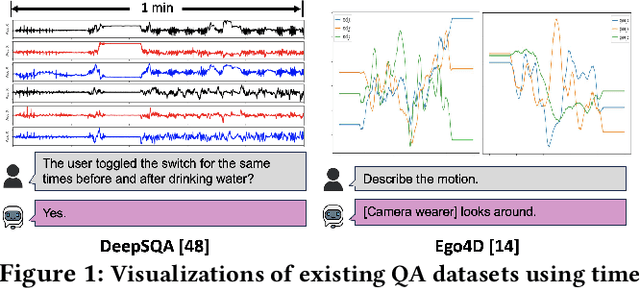
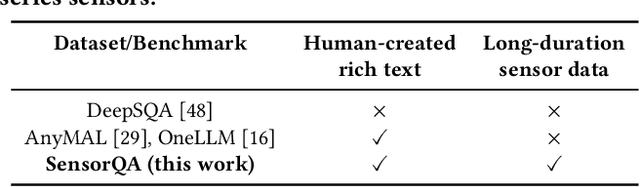

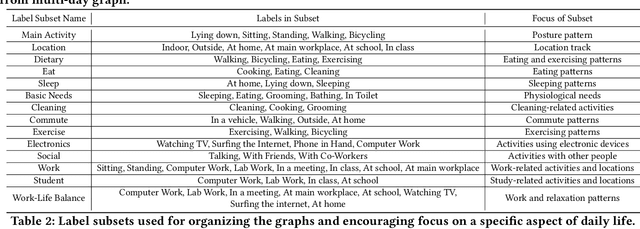
With the rapid growth in sensor data, effectively interpreting and interfacing with these data in a human-understandable way has become crucial. While existing research primarily focuses on learning classification models, fewer studies have explored how end users can actively extract useful insights from sensor data, often hindered by the lack of a proper dataset. To address this gap, we introduce SensorQA, the first human-created question-answering (QA) dataset for long-term time-series sensor data for daily life monitoring. SensorQA is created by human workers and includes 5.6K diverse and practical queries that reflect genuine human interests, paired with accurate answers derived from sensor data. We further establish benchmarks for state-of-the-art AI models on this dataset and evaluate their performance on typical edge devices. Our results reveal a gap between current models and optimal QA performance and efficiency, highlighting the need for new contributions. The dataset and code are available at: \url{https://github.com/benjamin-reichman/SensorQA}.