 Add to Chrome
 Add to Firefox
 Add to Edge
MASS: Mesh-inellipse Aligned Deformable Surfel Splatting for Hand Reconstruction and Rendering from Egocentric Monocular Video
Apr 10, 2026
Reconstructing high-fidelity 3D hands from egocentric monocular videos remains a challenge due to the limitations in capturing high-resolution geometry, hand-object interactions, and complex objects on hands. Additionally, existing methods often incur high computational costs, making them impractical for real-time applications. In this work, we propose Mesh-inellipse Aligned deformable Surfel Splatting (MASS) to address these challenges by leveraging a deformable 2D Gaussian Surfel representation. We introduce the mesh-aligned Steiner Inellipse and fractal densification for mesh-to-surfel conversion that initiates high-resolution 2D Gaussian surfels from coarse parametric hand meshes, providing surface representation with photorealistic rendering potential. Second, we propose Gaussian Surfel Deformation, which enables efficient modeling of hand deformations and personalized features by predicting residual updates to surfel attributes and introducing an opacity mask to refine geometry and texture without adaptive density control. In addition, we propose a two-stage training strategy and a novel binding loss to improve the optimization robustness and reconstruction quality. Extensive experiments on the ARCTIC dataset, the Hand Appearance dataset, and the Interhand2.6M dataset demonstrate that our model achieves superior reconstruction performance compared to state-of-the-art methods.

Embracing the Dark Knowledge: Domain Generalization Using Regularized Knowledge Distillation
Jul 06, 2021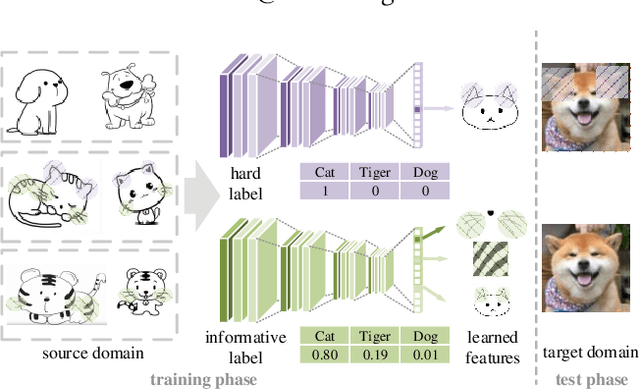
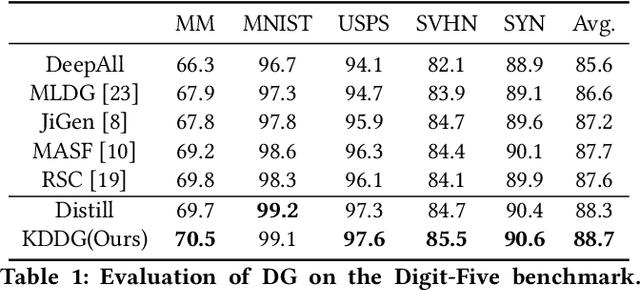
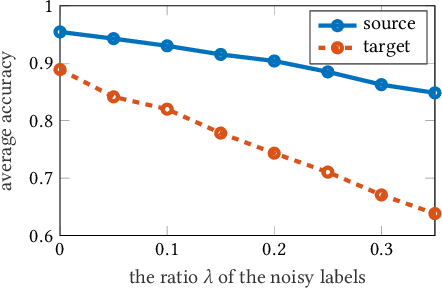
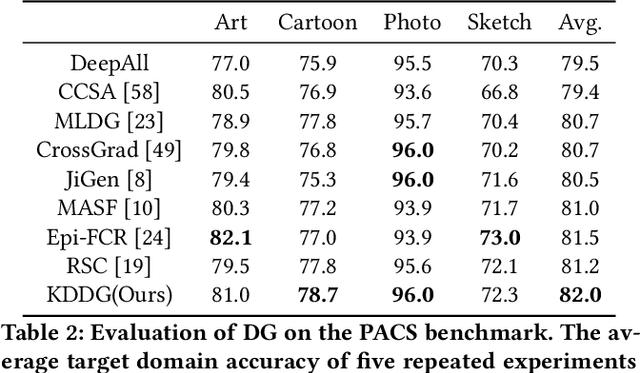
Though convolutional neural networks are widely used in different tasks, lack of generalization capability in the absence of sufficient and representative data is one of the challenges that hinder their practical application. In this paper, we propose a simple, effective, and plug-and-play training strategy named Knowledge Distillation for Domain Generalization (KDDG) which is built upon a knowledge distillation framework with the gradient filter as a novel regularization term. We find that both the ``richer dark knowledge" from the teacher network, as well as the gradient filter we proposed, can reduce the difficulty of learning the mapping which further improves the generalization ability of the model. We also conduct experiments extensively to show that our framework can significantly improve the generalization capability of deep neural networks in different tasks including image classification, segmentation, reinforcement learning by comparing our method with existing state-of-the-art domain generalization techniques. Last but not the least, we propose to adopt two metrics to analyze our proposed method in order to better understand how our proposed method benefits the generalization capability of deep neural networks.