 Add to Chrome
 Add to Firefox
 Add to Edge
Local Fokker--Planck Geometry for Score Estimation: Heat-Ball Mean-Value Representations and Exact High-Dimensional Sampling
Jun 26, 2026
Score-based generative models and Langevin samplers rely on estimating the score function $\nabla_x\log p_t(x)$ of a forward diffusion. Classically this is tractable when the drift is linear: the marginal density is Gaussian and the score is a global conditional expectation. For a general nonlinear, state-dependent drift the marginal density has no closed form, and existing methods--denoising score matching and global Fokker--Planck residual penalties--resort to global averaging that inflates estimation error in low-density regions precisely where accuracy is most critical. We address this by developing a local Fokker--Planck geometric framework that replaces global conditioning with local parabolic averaging. Our approach rests on three contributions. First, a time change to the cumulative-variance coordinate reduces the variable-coefficient Fokker--Planck equation to a standard inhomogeneous heat equation, on which we extend Evans' classical heat-ball monotonicity method to derive exact local mean-value representations for the score $\nabla_x\log p$ together with the density, log-density, and entropy density; local well-posedness is established under an explicit dimension-dependent drift budget. Second, for high-dimensional Monte Carlo evaluation of the resulting heat-ball integrals, we introduce the $κ$-measure and derive its exact factorized sampler with unit per-sample weight, $χ^2_2$ radial concentration. Third, the $r\to0$ limit of the heat-ball residual recovers the pointwise Fokker--Planck residual, showing that the local framework is a one-parameter generalization of global FP-residual methods, and that the DSM population minimizer is feasible for the heat-ball constraint at every scale. We validate the framework on 2D structured data on 256-dimensional MNIST, and on a dedicated sampler study confirming the concentration laws.

Game Theory and Coverage Optimization Based Multihop Routing Protocol for Network Lifetime in Wireless Sensor Networks
Jul 03, 2023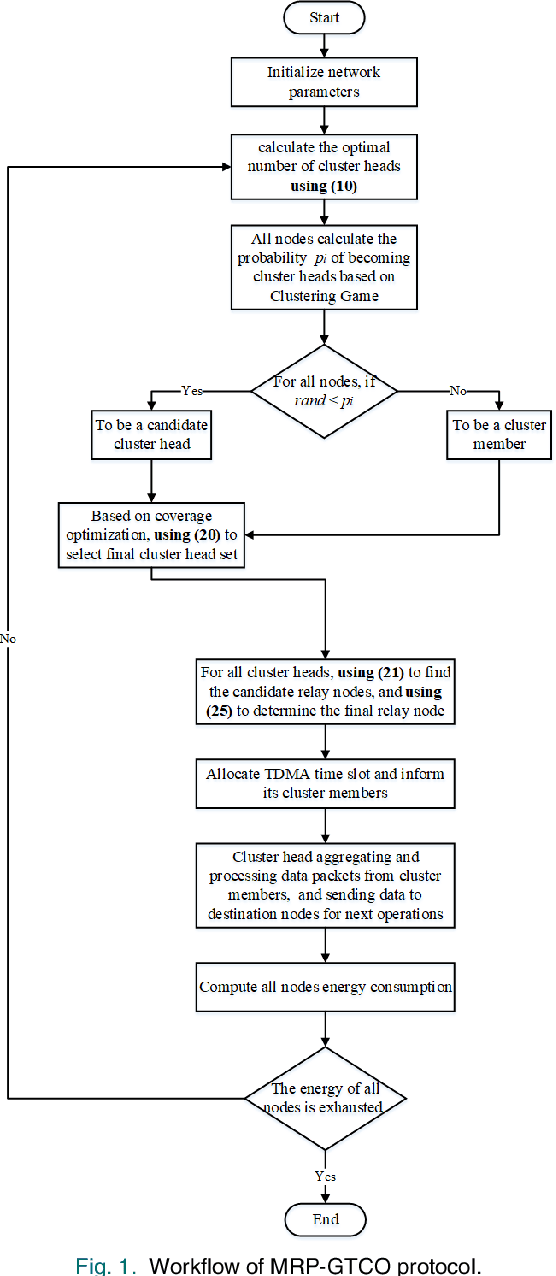
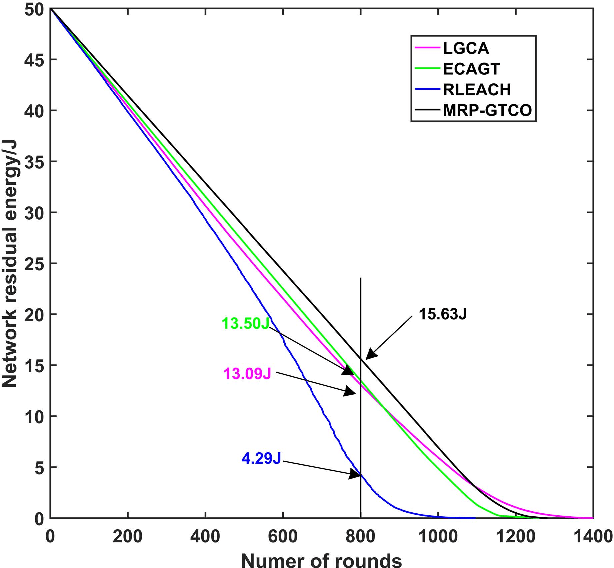
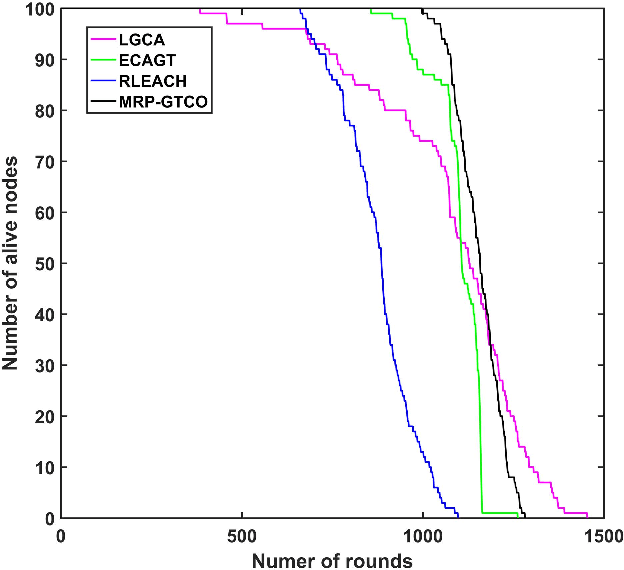
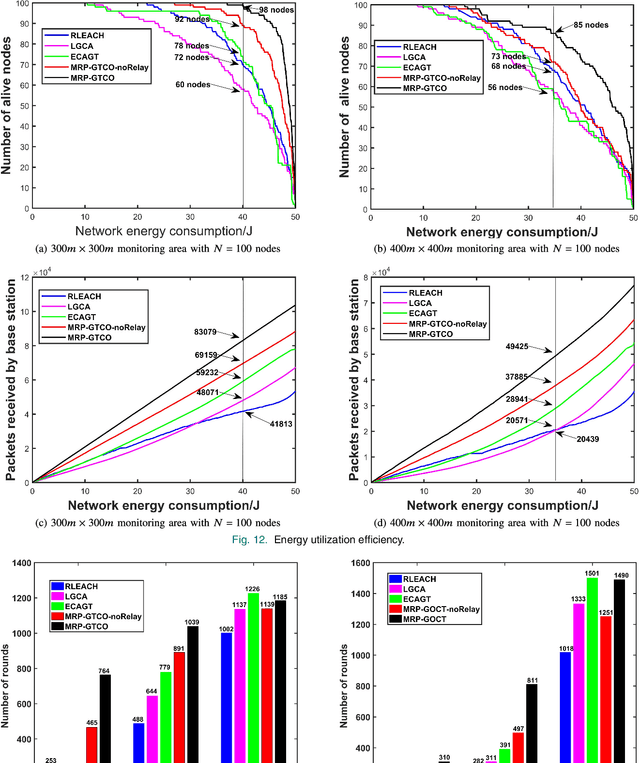
Wireless sensor networks (WSNs) are self-organizing monitoring networks with a large number of randomly deployed microsensor nodes to collect various physical information to realize tasks such as intelligent perception, efficient control, and decision-making. However, WSN nodes are powered by batteries, so they will run out of energy after a certain time. This energy limitation will greatly constrain the network performance like network lifetime and energy efficiency. In this study, to prolong the network lifetime, we proposed a multi-hop routing protocol based on game theory and coverage optimization (MRP-GTCO). Briefly, in the stage of setup, two innovational strategies including a clustering game with penalty function and cluster head coverage set were designed to realize the uniformity of cluster head distribution and improve the rationality of cluster head election. In the data transmission stage, we first derived the applicable conditions theorem of inter-cluster multi-hop routing. Based on this, a novel multi-hop path selection algorithm related to residual energy and node degree was proposed to provide an energy-efficient data transmission path. The simulation results showed that the MRP-GTCO protocol can effectively reduce the network energy consumption and extend the network lifetime by 159.22%, 50.76%, and 16.46% compared with LGCA, RLEACH, and ECAGT protocols.
* 14 pages, 13 figure, 3 tables
GaitFi: Robust Device-Free Human Identification via WiFi and Vision Multimodal Learning
Aug 30, 2022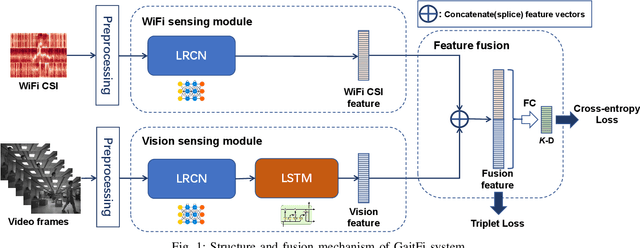

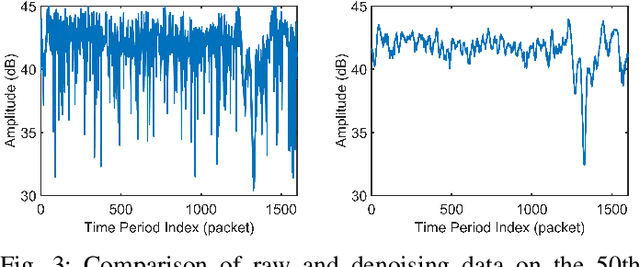
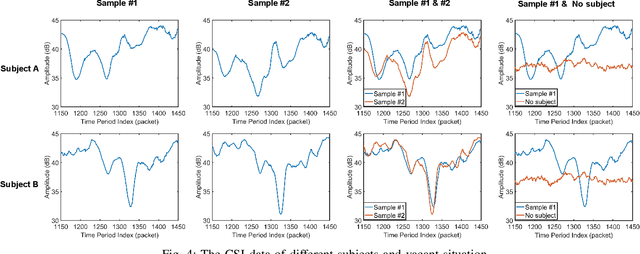
As an important biomarker for human identification, human gait can be collected at a distance by passive sensors without subject cooperation, which plays an essential role in crime prevention, security detection and other human identification applications. At present, most research works are based on cameras and computer vision techniques to perform gait recognition. However, vision-based methods are not reliable when confronting poor illuminations, leading to degrading performances. In this paper, we propose a novel multimodal gait recognition method, namely GaitFi, which leverages WiFi signals and videos for human identification. In GaitFi, Channel State Information (CSI) that reflects the multi-path propagation of WiFi is collected to capture human gaits, while videos are captured by cameras. To learn robust gait information, we propose a Lightweight Residual Convolution Network (LRCN) as the backbone network, and further propose the two-stream GaitFi by integrating WiFi and vision features for the gait retrieval task. The GaitFi is trained by the triplet loss and classification loss on different levels of features. Extensive experiments are conducted in the real world, which demonstrates that the GaitFi outperforms state-of-the-art gait recognition methods based on single WiFi or camera, achieving 94.2% for human identification tasks of 12 subjects.