 Add to Chrome
 Add to Firefox
 Add to Edge
Through the PRISM: Preference Representation in Intermediate States of Video Diffusion Models
Jun 18, 2026
Evaluating video generation with clean, pixel-based reward models disconnects evaluation from the noisy diffusion process and incurs massive VAE decoding costs. In this paper, we challenge this paradigm by asking a fundamental question: Can a powerful video generator inherently discriminate preferences directly from noisy latents? To answer this, we introduce \textbf{PRISM} (\textbf{P}reference \textbf{R}epresentation in \textbf{I}ntermediate \textbf{S}tates of Diffusion \textbf{M}odels). PRISM employs a lightweight Query-based Aggregation head with a frozen video diffusion backbone to decode preference signals from noisy latents. Surprisingly, PRISM not only achieves SOTA preference accuracy but also unlocks strong noise-robustness, which enables early-stage Best-of-$N$ sampling. This allows for filtering suboptimal candidates at the very beginning of denoising, drastically reducing computation while boosting video quality. We also reveal a strong positive correlation between a backbone's generative performance and its inherent evaluative power, enabling self-improving video backbones.

From Exploration to Exploitation: A Two-Stage Entropy RLVR Approach for Noise-Tolerant MLLM Training
Nov 11, 2025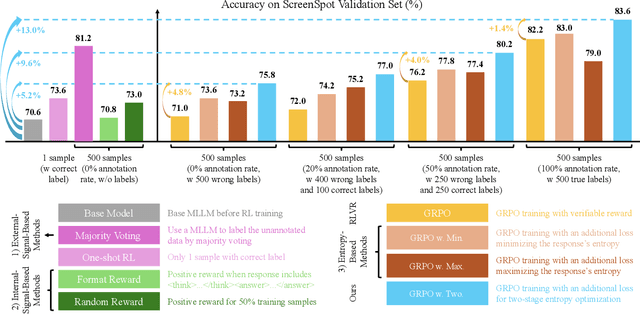

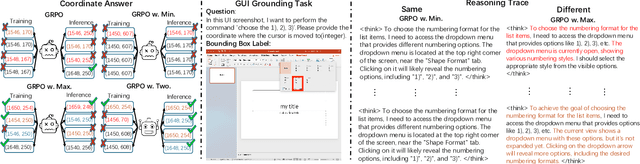

Reinforcement Learning with Verifiable Rewards (RLVR) for Multimodal Large Language Models (MLLMs) is highly dependent on high-quality labeled data, which is often scarce and prone to substantial annotation noise in real-world scenarios. Existing unsupervised RLVR methods, including pure entropy minimization, can overfit to incorrect labels and limit the crucial reward ranking signal for Group-Relative Policy Optimization (GRPO). To address these challenges and enhance noise tolerance, we propose a novel two-stage, token-level entropy optimization method for RLVR. This approach dynamically guides the model from exploration to exploitation during training. In the initial exploration phase, token-level entropy maximization promotes diverse and stochastic output generation, serving as a strong regularizer that prevents premature convergence to noisy labels and ensures sufficient intra-group variation, which enables more reliable reward gradient estimation in GRPO. As training progresses, the method transitions into the exploitation phase, where token-level entropy minimization encourages the model to produce confident and deterministic outputs, thereby consolidating acquired knowledge and refining prediction accuracy. Empirically, across three MLLM backbones - Qwen2-VL-2B, Qwen2-VL-7B, and Qwen2.5-VL-3B - spanning diverse noise settings and multiple tasks, our phased strategy consistently outperforms prior approaches by unifying and enhancing external, internal, and entropy-based methods, delivering robust and superior performance across the board.