 Add to Chrome
 Add to Firefox
 Add to Edge
SGD at the Edge of Stability: Stochastic Stabilization with Large Learning Rates
Jun 29, 2026
Modern deep learning has been shown to operate at the edge of stability, routinely using learning rates far larger than those justified by classical optimization theory. Most prior analyses of the edge of stability phenomenon focus on deterministic gradient descent, leaving the stochastic setting largely unexplored. In this work, we provide sharp convergence guarantees for Stochastic Gradient Descent (SGD) applied to the multiclass cross-entropy loss, for both linear classifiers and two-layer neural networks. We show that the stochasticity of SGD may cause the dynamics to alternate between an edge-of-stability regime that is dominated by curvature-driven oscillations, and a stable regime in which the expected loss decreases at a controlled rate. Despite that, we prove that SGD self-stabilizes the dynamics, ensuring that the iterates return to stability in a fixed number of iterations and allowing convergence in the best-iterate sense even with large learning rates. Experiments validate our theoretical findings and illustrate the benefits of SGD in the large-stepsize regime.

Curvature-Aware Training for Coordinate Networks
May 15, 2023Coordinate networks are widely used in computer vision due to their ability to represent signals as compressed, continuous entities. However, training these networks with first-order optimizers can be slow, hindering their use in real-time applications. Recent works have opted for shallow voxel-based representations to achieve faster training, but this sacrifices memory efficiency. This work proposes a solution that leverages second-order optimization methods to significantly reduce training times for coordinate networks while maintaining their compressibility. Experiments demonstrate the effectiveness of this approach on various signal modalities, such as audio, images, videos, shape reconstruction, and neural radiance fields.
How You Start Matters for Generalization
Jun 17, 2022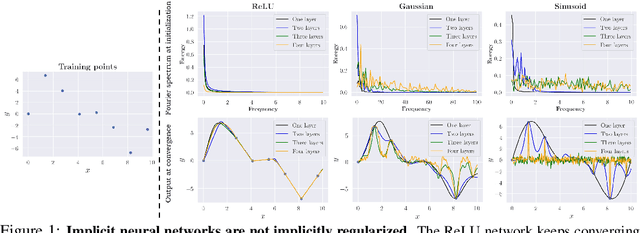
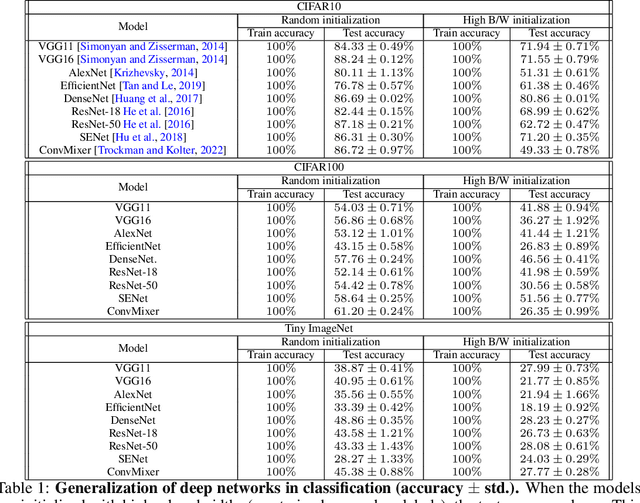
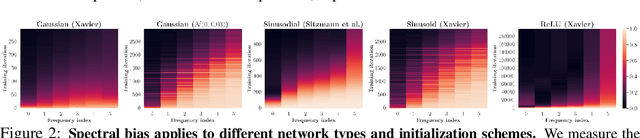
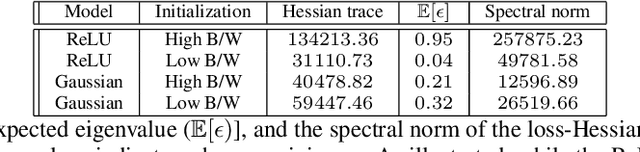
Characterizing the remarkable generalization properties of over-parameterized neural networks remains an open problem. In this paper, we promote a shift of focus towards initialization rather than neural architecture or (stochastic) gradient descent to explain this implicit regularization. Through a Fourier lens, we derive a general result for the spectral bias of neural networks and show that the generalization of neural networks is heavily tied to their initialization. Further, we empirically solidify the developed theoretical insights using practical, deep networks. Finally, we make a case against the controversial flat-minima conjecture and show that Fourier analysis grants a more reliable framework for understanding the generalization of neural networks.
On Regularizing Coordinate-MLPs
Feb 01, 2022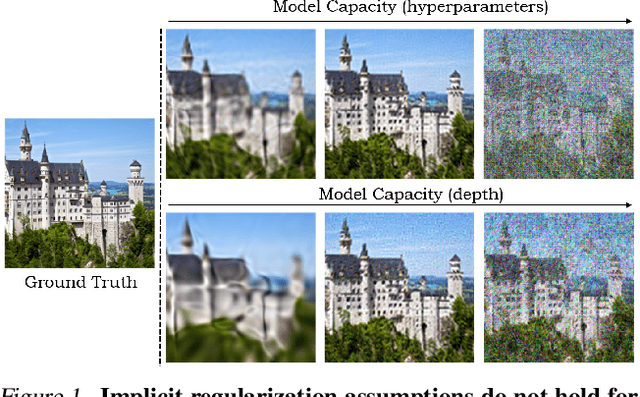
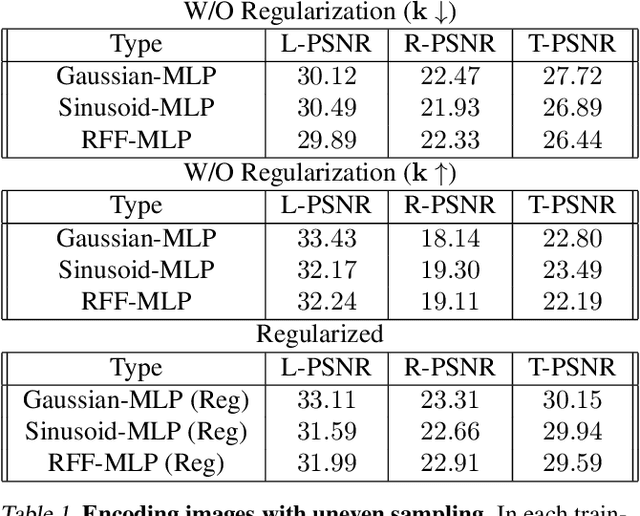
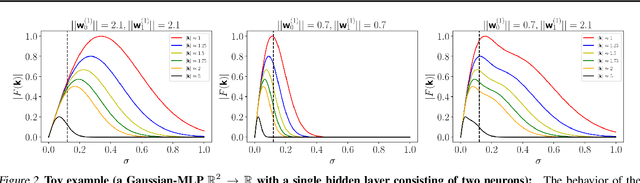
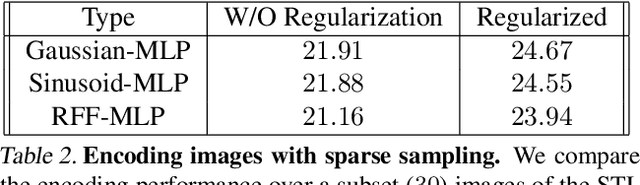
We show that typical implicit regularization assumptions for deep neural networks (for regression) do not hold for coordinate-MLPs, a family of MLPs that are now ubiquitous in computer vision for representing high-frequency signals. Lack of such implicit bias disrupts smooth interpolations between training samples, and hampers generalizing across signal regions with different spectra. We investigate this behavior through a Fourier lens and uncover that as the bandwidth of a coordinate-MLP is enhanced, lower frequencies tend to get suppressed unless a suitable prior is provided explicitly. Based on these insights, we propose a simple regularization technique that can mitigate the above problem, which can be incorporated into existing networks without any architectural modifications.