 Add to Chrome
 Add to Firefox
 Add to Edge
How Far Has AI Come in Liver Fibrosis Staging? A Large-Scale Real-World Dataset and Benchmark
May 25, 2026
Despite years of methodological progress, how far AI has come in liver fibrosis staging has never been systematically evaluated under the heterogeneous, multi-center conditions that define clinical practice. To address this gap, we introduce LiFS, a large-scale dataset and benchmark derived from the MICCAI 2025 CARE-Liver challenge, comprising 610 patients across multiple centers and scanners with multi-sequence MRI. To the best of our knowledge, LiFS is the first benchmark providing complete gadoxetic acid-enhanced sequences with histopathology-confirmed annotations from diverse real-world scanners. Through systematic evaluation of 9 independently developed methods selected from 96 registered teams against in-cohort radiologist reference results, our findings address how far current AI has progressed toward clinical-level liver fibrosis staging from three complementary perspectives. First, against radiologists, the best AI methods were broadly comparable to the senior radiologist and significantly exceeded the junior radiologist in selected settings, while median AI performance generally approached junior-radiologist levels. Second, from a data perspective, cross-center heterogeneity, label imbalance, and contrast-enhanced sequence variability emerge as the dominant challenges for AI methods. Third, from a technical perspective, methodological design choices, including spatial registration, input dimensionality, multi-modal fusion strategy, and backbone architecture, appear to modulate cross-center robustness, although no single choice alone closes the gap. Overall, LiFS provides a rigorous real-world benchmark for positioning the current state of AI in liver fibrosis staging and for enabling future research on the key challenges that limit clinically reliable deployment.

MuSCLe: A Multi-Strategy Contrastive Learning Framework for Weakly Supervised Semantic Segmentation
Jan 18, 2022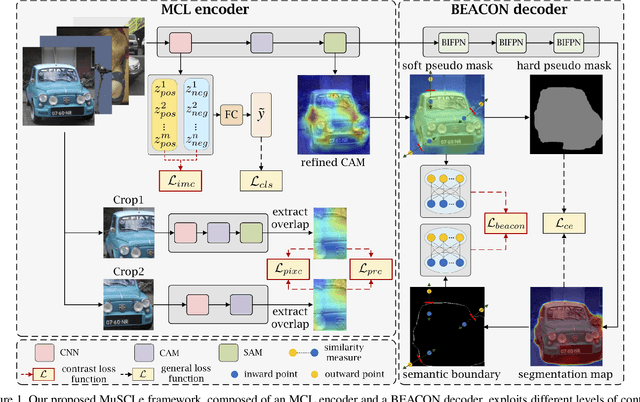
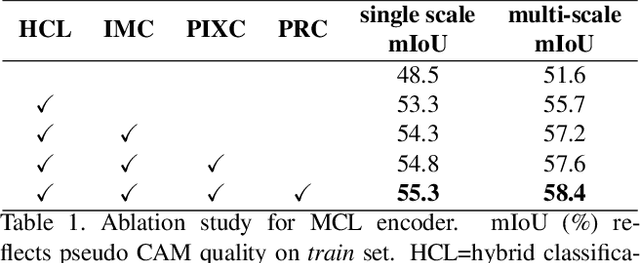
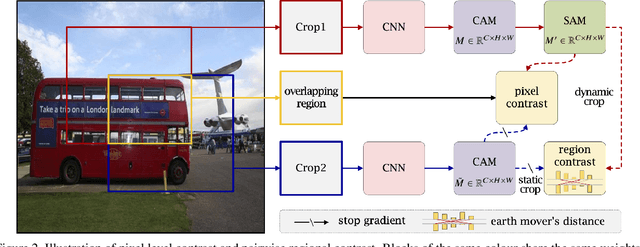
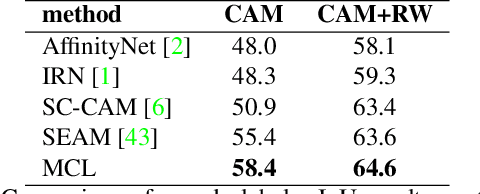
Weakly supervised semantic segmentation (WSSS) has gained significant popularity since it relies only on weak labels such as image level annotations rather than pixel level annotations required by supervised semantic segmentation (SSS) methods. Despite drastically reduced annotation costs, typical feature representations learned from WSSS are only representative of some salient parts of objects and less reliable compared to SSS due to the weak guidance during training. In this paper, we propose a novel Multi-Strategy Contrastive Learning (MuSCLe) framework to obtain enhanced feature representations and improve WSSS performance by exploiting similarity and dissimilarity of contrastive sample pairs at image, region, pixel and object boundary levels. Extensive experiments demonstrate the effectiveness of our method and show that MuSCLe outperforms the current state-of-the-art on the widely used PASCAL VOC 2012 dataset.