 Add to Chrome
 Add to Firefox
 Add to Edge
Multivariate Time Series Forecasting needs Cross Variable Loss
Aug 06, 2026
Multivariate time series forecasting presents unique challenges because future variables often co-evolve under shared system dynamics. While existing studies mainly focus on cross-variable dependencies in historical observations, dependencies among future values are much less explored. Specifically, modern forecasting models largely follow the Direct Forecasting (DF) paradigm, generating multi-step forecasts with point-wise objectives that do not explicitly constrain cross-variable structure. In this work, we show that the DF objective is mismatched in the presence of cross-variable and lagged dependencies, revealing an objective gap. To address this issue, we propose \textbf{C}ross-\textbf{V}ariable \textbf{Loss} (CvLoss), a plug-in structural regularizer that constrains forecast residuals on a cross-variable graph. CvLoss penalizes inconsistent edge-wise residual differences over forecast patches, encouraging consistency across both synchronous and asynchronous interactions. Our experiments show that CvLoss consistently improves competitive forecasting models, outperforms representative learning objectives, and is compatible with a variety of forecasting backbones.

Distilling Time Series Foundation Models for Efficient Forecasting
Jan 19, 2026Time Series foundation models (TSFMs) deliver strong forecasting performance through large-scale pretraining, but their large parameter sizes make deployment costly. While knowledge distillation offers a natural and effective approach for model compression, techniques developed for general machine learning tasks are not directly applicable to time series forecasting due to the unique characteristics. To address this, we present DistilTS, the first distillation framework specifically designed for TSFMs. DistilTS addresses two key challenges: (1) task difficulty discrepancy, specific to forecasting, where uniform weighting makes optimization dominated by easier short-term horizons, while long-term horizons receive weaker supervision; and (2) architecture discrepancy, a general challenge in distillation, for which we design an alignment mechanism in the time series forecasting. To overcome these issues, DistilTS introduces horizon-weighted objectives to balance learning across horizons, and a temporal alignment strategy that reduces architectural mismatch, enabling compact models. Experiments on multiple benchmarks demonstrate that DistilTS achieves forecasting performance comparable to full-sized TSFMs, while reducing parameters by up to 1/150 and accelerating inference by up to 6000x. Code is available at: https://github.com/itsnotacie/DistilTS-ICASSP2026.
KAIROS: Unified Training for Universal Non-Autoregressive Time Series Forecasting
Oct 02, 2025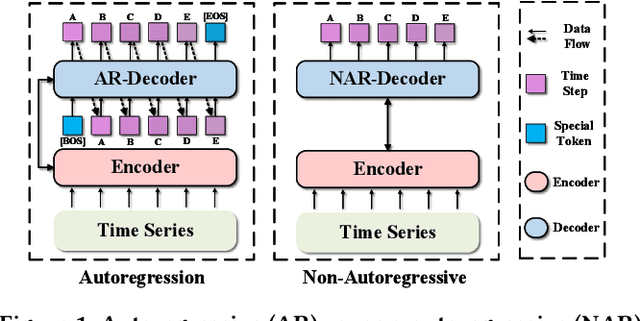

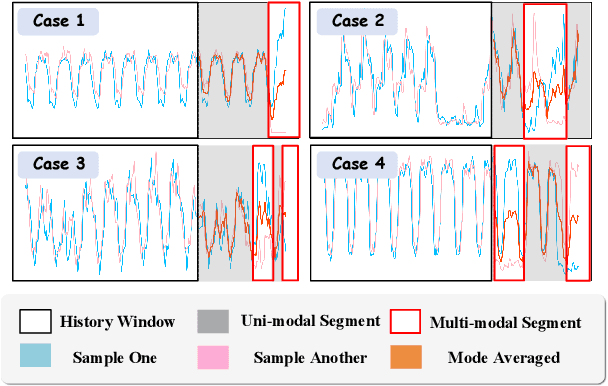
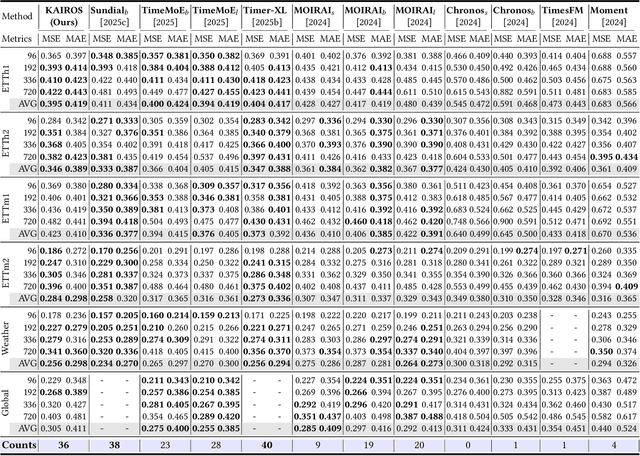
In the World Wide Web, reliable time series forecasts provide the forward-looking signals that drive resource planning, cache placement, and anomaly response, enabling platforms to operate efficiently as user behavior and content distributions evolve. Compared with other domains, time series forecasting for Web applications requires much faster responsiveness to support real-time decision making. We present KAIROS, a non-autoregressive time series forecasting framework that directly models segment-level multi-peak distributions. Unlike autoregressive approaches, KAIROS avoids error accumulation and achieves just-in-time inference, while improving over existing non-autoregressive models that collapse to over-smoothed predictions. Trained on the large-scale corpus, KAIROS demonstrates strong zero-shot generalization on six widely used benchmarks, delivering forecasting performance comparable to state-of-the-art foundation models with similar scale, at a fraction of their inference cost. Beyond empirical results, KAIROS highlights the importance of non-autoregressive design as a scalable paradigm for foundation models in time series.
DualSG: A Dual-Stream Explicit Semantic-Guided Multivariate Time Series Forecasting Framework
Jul 30, 2025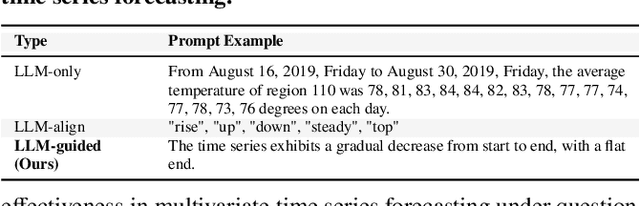
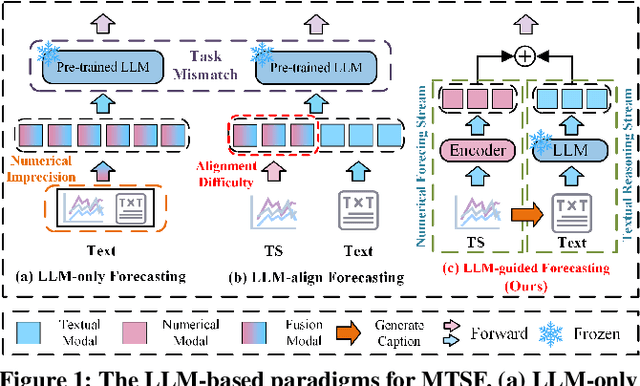
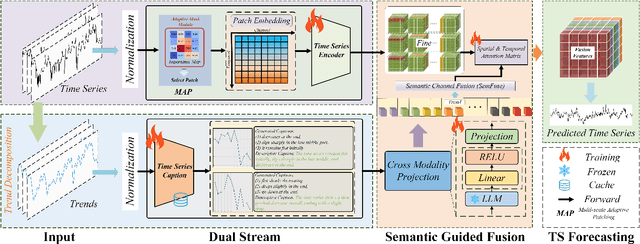

Multivariate Time Series Forecasting plays a key role in many applications. Recent works have explored using Large Language Models for MTSF to take advantage of their reasoning abilities. However, many methods treat LLMs as end-to-end forecasters, which often leads to a loss of numerical precision and forces LLMs to handle patterns beyond their intended design. Alternatively, methods that attempt to align textual and time series modalities within latent space frequently encounter alignment difficulty. In this paper, we propose to treat LLMs not as standalone forecasters, but as semantic guidance modules within a dual-stream framework. We propose DualSG, a dual-stream framework that provides explicit semantic guidance, where LLMs act as Semantic Guides to refine rather than replace traditional predictions. As part of DualSG, we introduce Time Series Caption, an explicit prompt format that summarizes trend patterns in natural language and provides interpretable context for LLMs, rather than relying on implicit alignment between text and time series in the latent space. We also design a caption-guided fusion module that explicitly models inter-variable relationships while reducing noise and computation. Experiments on real-world datasets from diverse domains show that DualSG consistently outperforms 15 state-of-the-art baselines, demonstrating the value of explicitly combining numerical forecasting with semantic guidance.