 Add to Chrome
 Add to Firefox
 Add to Edge
Navigating Speech Enhancement for Real-Time MRI: A Systematic Assessment of Signal Quality, Source Preservation, and Downstream Tasks
Aug 17, 2026
Audio recorded during real-time magnetic resonance imaging (rtMRI) is heavily contaminated by scanner noise, but it remains unclear whether general-purpose speech enhancement improves the signal for speech research and downstream processing. Three off-the-shelf systems---Denoiser, PASE, and RE-USE---are evaluated across five rtMRI corpora using naturally recorded inputs, a clean-input probe, and an archived paired additive-noise probe. The multi-task evaluation spans learned quality predictors, speaker and phone representations, reference-based intelligibility and quality measures, acoustic--phonetic probes, automatic speech recognition (ASR), and paralinguistic tasks. The central result is that enhancement effects are endpoint dependent: higher predicted-quality scores do not reliably imply better ASR performance or greater source fidelity. Across 15 corpus--recognizer comparisons using corpus-provided processed inputs, RE-USE yielded lower word-error-rate point estimates in 11, whereas Denoiser yielded higher estimates in 13. In the paired additive-noise probe, PASE and RE-USE improved recognized-phone agreement, intelligibility, and perceptual-quality point estimates. Denoiser improved recognized-phone agreement and short-time objective intelligibility (STOI) but reduced speaker-embedding similarity. No system was uniformly best across corpora, recognizers, and endpoints. Enhanced rtMRI audio should therefore be treated as a task-specific transformed derivative rather than a universally improved replacement for the original or DSP-processed waveform.

LLM-Assisted Rule Based Machine Translation for Low/No-Resource Languages
May 16, 2024We propose a new paradigm for machine translation that is particularly useful for no-resource languages (those without any publicly available bilingual or monolingual corpora): LLM-RBMT (LLM-Assisted Rule Based Machine Translation). Using the LLM-RBMT paradigm, we design the first language education/revitalization-oriented machine translator for Owens Valley Paiute (OVP), a critically endangered Indigenous American language for which there is virtually no publicly available data. We present a detailed evaluation of the translator's components: a rule-based sentence builder, an OVP to English translator, and an English to OVP translator. We also discuss the potential of the paradigm, its limitations, and the many avenues for future research that it opens up.
Speech Representations and Phoneme Classification for Preserving the Endangered Language of Ladin
Aug 27, 2021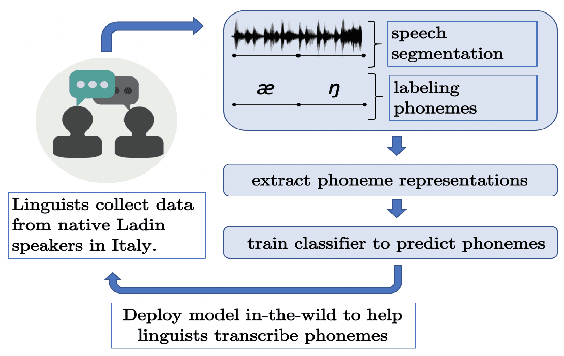
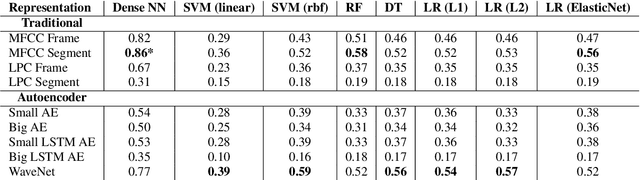
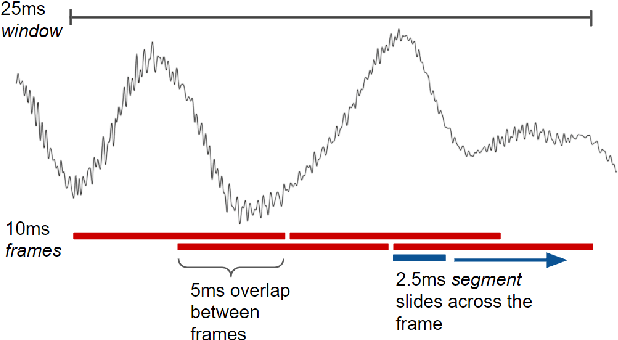
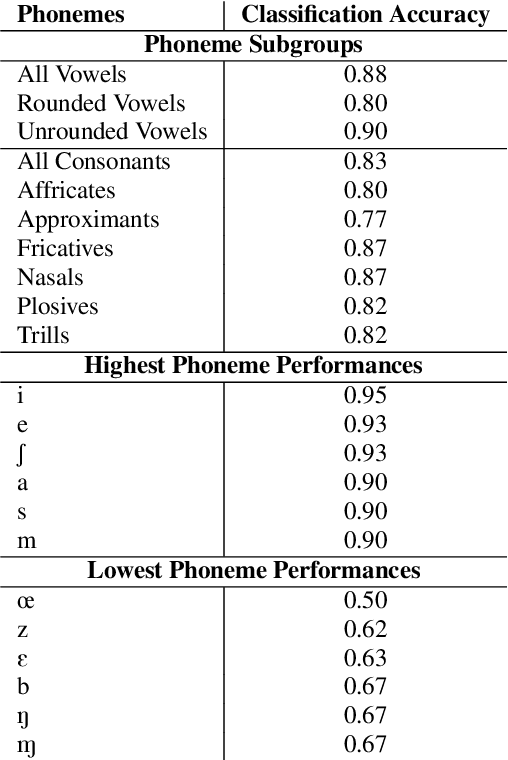
A vast majority of the world's 7,000 spoken languages are predicted to become extinct within this century, including the endangered language of Ladin from the Italian Alps. Linguists who work to preserve a language's phonetic and phonological structure can spend hours transcribing each minute of speech from native speakers. To address this problem in the context of Ladin, our paper presents the first analysis of speech representations and machine learning models for classifying 32 phonemes of Ladin. We experimented with a novel dataset of the Fascian dialect of Ladin, collected from native speakers in Italy. We created frame-level and segment-level speech feature extraction approaches and conducted extensive experiments with 8 different classifiers trained on 9 different speech representations. Our speech representations ranged from traditional features (MFCC, LPC) to features learned with deep neural network models (autoencoders, LSTM autoencoders, and WaveNet). Our highest-performing classifier, trained on MFCC representations of speech signals, achieved an 86% average accuracy across all Ladin phonemes. We also obtained average accuracies above 77% for all Ladin phoneme subgroups examined. Our findings contribute insights for learning discriminative Ladin phoneme representations and demonstrate the potential for leveraging machine learning and speech signal processing to preserve Ladin and other endangered languages.