 Add to Chrome
 Add to Firefox
 Add to Edge
Rigel: Self-Distilled Score Adaptation for Image and Video Captioning Evaluation
Jun 29, 2026
Automatic evaluation of image and video captioning is essential for benchmarking multimodal systems, although standard evaluation metrics show limited alignment with human judgments. Recent approaches using large language models (LLMs), commonly referred to as LLM-as-a-Judge, have improved alignment with human judgments but still suffer from a mismatch between large-vocabulary language modeling and evaluation over a small label set. To address this, we propose Rigel, an automatic evaluation metric for image and video captioning, based on self-distilled score adaptation. The metric employs an evaluation-specific scoring head distilled from a frozen LLM, which captures judgment signals in a task-aligned space without relying on large-vocabulary token sets. We then refine the LLM backbone with human judgment data. To train Rigel, we constructed the Vid-Lepus dataset, which contains 3,338 video clips, 33,380 reference captions, and 5,637 candidate captions. Experiments on multiple benchmarks show that Rigel outperforms state-of-the-art metrics, achieving over 10-point improvements on ActivityNet-Fact in the reference-free setting.

Flow as Flow: Modeling Robot Velocity Fields as Probability Velocity Fields for Flow-Based Object Manipulation
Jun 23, 2026Cross-embodiment data have become central to training robotic foundation models. To leverage such heterogeneous data, we focus on flow-based object manipulation, where robot flows (robot velocity fields) serve as embodiment-agnostic motion representations. Previous studies do not formulate robot flows as dense velocity fields, but as displacements of sparse keypoints, while such velocity fields better match the continuous-time nature of motions. We propose Flow as Flow, a framework that models robot flows as probability flows based on a flow matching formulation. By naturally modeling such velocity fields within this formulation, our method achieves efficient and high-quality robot flow generation. Across standard benchmarks, our method outperforms representative baseline methods on standard metrics, while achieving approximately 33$\times$ faster generation. Furthermore, through real-world experiments evaluating 9 methods with 260 trials per method across 13 manipulation tasks, we show that our method achieves a higher average success rate than the baseline methods. Our project page is available at https://flow-as-flow-u0n5y.kinsta.page.
ELSA: Acoustic Event-Level Semantic Alignment for Fine-Grained Reference-Free Text-to-Audio Evaluation
Jun 16, 2026Text-to-audio (TTA) generation, synthesizing audio from natural language, has been widely studied for its ability to capture precise user intent. To effectively advance TTA models, it is essential to reliably evaluate generated audio without relying on costly human subjective ratings, motivating the development of automatic evaluation metrics that correlate well with human judgments. While recent CLAP-based metrics provide practical reference-free solutions, their coarse-grained text-audio similarity matching often correlates poorly with human ratings. To address this, we propose ELSA, a reference-free evaluation metric for fine-grained text-audio alignment. ELSA decomposes generated audio guided by distinct acoustic events derived from the text query and assesses event-level alignment. Experiments across four TTA benchmarks show that ELSA reveals a higher correlation with human subjective ratings than prior metrics, highlighting its effectiveness for reliable TTA evaluation.
MLLM-as-a-Judge Exhibits Model Preference Bias
Apr 13, 2026Automatic evaluation using multimodal large language models (MLLMs), commonly referred to as MLLM-as-a-Judge, has been widely used to measure model performance. If such MLLM-as-a-Judge methods were biased, they could distort model comparisons and benchmark-driven scientific progress. However, it remains unclear to what extent MLLM-as-a-Judge methods favor or disfavor text generated by specific MLLMs. In this study, we propose Philautia-Eval to investigate such model-specific preference bias. Philautia-Eval quantifies the degree of the bias by disentangling preference tendencies from differences in generation quality. Using 1.29M caption-score pairs collected from 12 MLLMs, we found that representative MLLMs tend to exhibit self-preference bias. Moreover, experimental results indicate mutual preference bias within particular model families, which is potentially driven by reused connectors and overlapping instruction-tuning resources. Finally, we introduce a simple ensemble of MLLMs, Pomms. Our results demonstrated that Pomms effectively mitigated the model-specific preference bias while maintaining performance.
ABMAMBA: Multimodal Large Language Model with Aligned Hierarchical Bidirectional Scan for Efficient Video Captioning
Apr 09, 2026In this study, we focus on video captioning by fully open multimodal large language models (MLLMs). The comprehension of visual sequences is challenging because of their intricate temporal dependencies and substantial sequence length. The core attention mechanisms of existing Transformer-based approaches scale quadratically with the sequence length, making them computationally prohibitive. To address these limitations, we propose Aligned Hierarchical Bidirectional Scan Mamba (ABMamba), a fully open MLLM with linear computational complexity that enables the scalable processing of video sequences. ABMamba extends Deep State Space Models as its language backbone, replacing the costly quadratic attention mechanisms, and employs a novel Aligned Hierarchical Bidirectional Scan module that processes videos across multiple temporal resolutions. On standard video captioning benchmarks such as VATEX and MSR-VTT, ABMamba demonstrates competitive performance compared to typical MLLMs while achieving approximately three times higher throughput.
HiFlow: Tokenization-Free Scale-Wise Autoregressive Policy Learning via Flow Matching
Mar 28, 2026Coarse-to-fine autoregressive modeling has recently shown strong promise for visuomotor policy learning, combining the inference efficiency of autoregressive methods with the global trajectory coherence of diffusion-based policies. However, existing approaches rely on discrete action tokenizers that map continuous action sequences to codebook indices, a design inherited from image generation where learned compression is necessary for high-dimensional pixel data. We observe that robot actions are inherently low-dimensional continuous vectors, for which such tokenization introduces unnecessary quantization error and a multi-stage training pipeline. In this work, we propose Hierarchical Flow Policy (HiFlow), a tokenization-free coarse-to-fine autoregressive policy that operates directly on raw continuous actions. HiFlow constructs multi-scale continuous action targets from each action chunk via simple temporal pooling. Specifically, it averages contiguous action windows to produce coarse summaries that are refined at finer temporal resolutions. The entire model is trained end-to-end in a single stage, eliminating the need for a separate tokenizer. Experiments on MimicGen, RoboTwin 2.0, and real-world environments demonstrate that HiFlow consistently outperforms existing methods including diffusion-based and tokenization-based autoregressive policies.
AnoleVLA: Lightweight Vision-Language-Action Model with Deep State Space Models for Mobile Manipulation
Mar 16, 2026In this study, we address the problem of language-guided robotic manipulation, where a robot is required to manipulate a wide range of objects based on visual observations and natural language instructions. This task is essential for service robots that operate in human environments, and requires safety, efficiency, and task-level generality. Although Vision-Language-Action models (VLAs) have demonstrated strong performance for this task, their deployment in resource-constrained environments remains challenging because of the computational cost of standard transformer backbones. To overcome this limitation, we propose AnoleVLA, a lightweight VLA that uses a deep state space model to process multimodal sequences efficiently. The model leverages its lightweight and fast sequential state modeling to process visual and textual inputs, which allows the robot to generate trajectories efficiently. We evaluated the proposed method in both simulation and physical experiments. Notably, in real-world evaluations, AnoleVLA outperformed a representative large-scale VLA by 21 points for the task success rate while achieving an inference speed approximately three times faster.
NaiLIA: Multimodal Nail Design Retrieval Based on Dense Intent Descriptions and Palette Queries
Mar 05, 2026We focus on the task of retrieving nail design images based on dense intent descriptions, which represent multi-layered user intent for nail designs. This is challenging because such descriptions specify unconstrained painted elements and pre-manufactured embellishments as well as visual characteristics, themes, and overall impressions. In addition to these descriptions, we assume that users provide palette queries by specifying zero or more colors via a color picker, enabling the expression of subtle and continuous color nuances. Existing vision-language foundation models often struggle to incorporate such descriptions and palettes. To address this, we propose NaiLIA, a multimodal retrieval method for nail design images, which comprehensively aligns with dense intent descriptions and palette queries during retrieval. Our approach introduces a relaxed loss based on confidence scores for unlabeled images that can align with the descriptions. To evaluate NaiLIA, we constructed a benchmark consisting of 10,625 images collected from people with diverse cultural backgrounds. The images were annotated with long and dense intent descriptions given by over 200 annotators. Experimental results demonstrate that NaiLIA outperforms standard methods.
ReMoRa: Multimodal Large Language Model based on Refined Motion Representation for Long-Video Understanding
Feb 18, 2026While multimodal large language models (MLLMs) have shown remarkable success across a wide range of tasks, long-form video understanding remains a significant challenge. In this study, we focus on video understanding by MLLMs. This task is challenging because processing a full stream of RGB frames is computationally intractable and highly redundant, as self-attention have quadratic complexity with sequence length. In this paper, we propose ReMoRa, a video MLLM that processes videos by operating directly on their compressed representations. A sparse set of RGB keyframes is retained for appearance, while temporal dynamics are encoded as a motion representation, removing the need for sequential RGB frames. These motion representations act as a compact proxy for optical flow, capturing temporal dynamics without full frame decoding. To refine the noise and low fidelity of block-based motions, we introduce a module to denoise and generate a fine-grained motion representation. Furthermore, our model compresses these features in a way that scales linearly with sequence length. We demonstrate the effectiveness of ReMoRa through extensive experiments across a comprehensive suite of long-video understanding benchmarks. ReMoRa outperformed baseline methods on multiple challenging benchmarks, including LongVideoBench, NExT-QA, and MLVU.
Mobile Manipulation Instruction Generation from Multiple Images with Automatic Metric Enhancement
Jan 28, 2025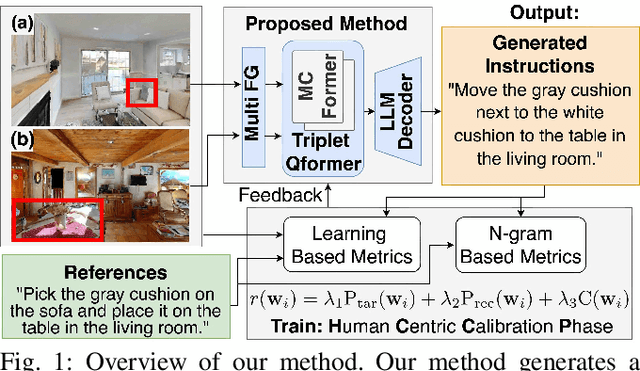
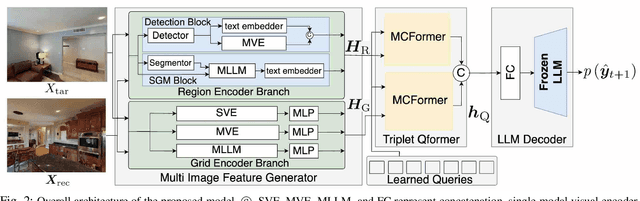
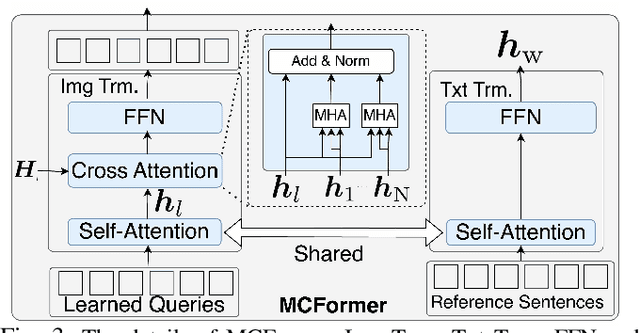

We consider the problem of generating free-form mobile manipulation instructions based on a target object image and receptacle image. Conventional image captioning models are not able to generate appropriate instructions because their architectures are typically optimized for single-image. In this study, we propose a model that handles both the target object and receptacle to generate free-form instruction sentences for mobile manipulation tasks. Moreover, we introduce a novel training method that effectively incorporates the scores from both learning-based and n-gram based automatic evaluation metrics as rewards. This method enables the model to learn the co-occurrence relationships between words and appropriate paraphrases. Results demonstrate that our proposed method outperforms baseline methods including representative multimodal large language models on standard automatic evaluation metrics. Moreover, physical experiments reveal that using our method to augment data on language instructions improves the performance of an existing multimodal language understanding model for mobile manipulation.