 Add to Chrome
 Add to Firefox
 Add to Edge
NaiLIA: Multimodal Nail Design Retrieval Based on Dense Intent Descriptions and Palette Queries
Mar 05, 2026
We focus on the task of retrieving nail design images based on dense intent descriptions, which represent multi-layered user intent for nail designs. This is challenging because such descriptions specify unconstrained painted elements and pre-manufactured embellishments as well as visual characteristics, themes, and overall impressions. In addition to these descriptions, we assume that users provide palette queries by specifying zero or more colors via a color picker, enabling the expression of subtle and continuous color nuances. Existing vision-language foundation models often struggle to incorporate such descriptions and palettes. To address this, we propose NaiLIA, a multimodal retrieval method for nail design images, which comprehensively aligns with dense intent descriptions and palette queries during retrieval. Our approach introduces a relaxed loss based on confidence scores for unlabeled images that can align with the descriptions. To evaluate NaiLIA, we constructed a benchmark consisting of 10,625 images collected from people with diverse cultural backgrounds. The images were annotated with long and dense intent descriptions given by over 200 annotators. Experimental results demonstrate that NaiLIA outperforms standard methods.

Nearest Neighbor Future Captioning: Generating Descriptions for Possible Collisions in Object Placement Tasks
Jul 18, 2024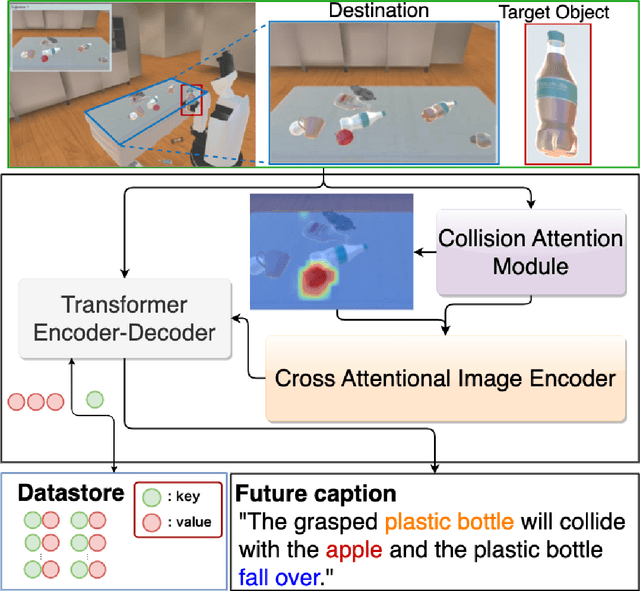
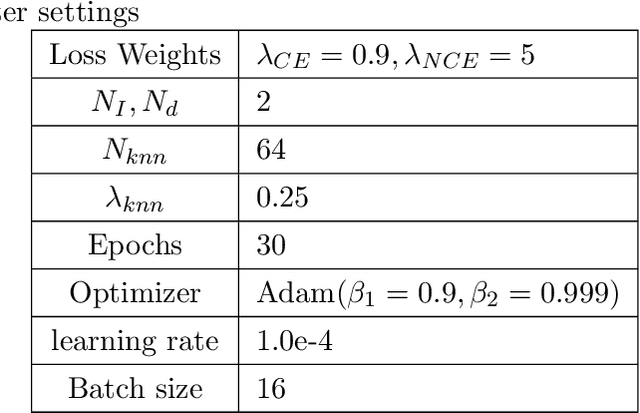
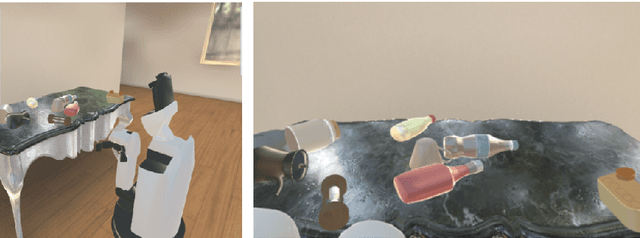

Domestic service robots (DSRs) that support people in everyday environments have been widely investigated. However, their ability to predict and describe future risks resulting from their own actions remains insufficient. In this study, we focus on the linguistic explainability of DSRs. Most existing methods do not explicitly model the region of possible collisions; thus, they do not properly generate descriptions of these regions. In this paper, we propose the Nearest Neighbor Future Captioning Model that introduces the Nearest Neighbor Language Model for future captioning of possible collisions, which enhances the model output with a nearest neighbors retrieval mechanism. Furthermore, we introduce the Collision Attention Module that attends regions of possible collisions, which enables our model to generate descriptions that adequately reflect the objects associated with possible collisions. To validate our method, we constructed a new dataset containing samples of collisions that can occur when a DSR places an object in a simulation environment. The experimental results demonstrated that our method outperformed baseline methods, based on the standard metrics. In particular, on CIDEr-D, the baseline method obtained 25.09 points, whereas our method obtained 33.08 points.