 Add to Chrome
 Add to Firefox
 Add to Edge
Omnilingual ASR: Open-Source Multilingual Speech Recognition for 1600+ Languages
Nov 12, 2025
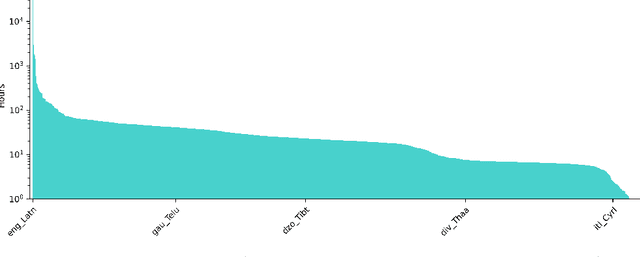
Automatic speech recognition (ASR) has advanced in high-resource languages, but most of the world's 7,000+ languages remain unsupported, leaving thousands of long-tail languages behind. Expanding ASR coverage has been costly and limited by architectures that restrict language support, making extension inaccessible to most--all while entangled with ethical concerns when pursued without community collaboration. To transcend these limitations, we introduce Omnilingual ASR, the first large-scale ASR system designed for extensibility. Omnilingual ASR enables communities to introduce unserved languages with only a handful of data samples. It scales self-supervised pre-training to 7B parameters to learn robust speech representations and introduces an encoder-decoder architecture designed for zero-shot generalization, leveraging a LLM-inspired decoder. This capability is grounded in a massive and diverse training corpus; by combining breadth of coverage with linguistic variety, the model learns representations robust enough to adapt to unseen languages. Incorporating public resources with community-sourced recordings gathered through compensated local partnerships, Omnilingual ASR expands coverage to over 1,600 languages, the largest such effort to date--including over 500 never before served by ASR. Automatic evaluations show substantial gains over prior systems, especially in low-resource conditions, and strong generalization. We release Omnilingual ASR as a family of models, from 300M variants for low-power devices to 7B for maximum accuracy. We reflect on the ethical considerations shaping this design and conclude by discussing its societal impact. In particular, we highlight how open-sourcing models and tools can lower barriers for researchers and communities, inviting new forms of participation. Open-source artifacts are available at https://github.com/facebookresearch/omnilingual-asr.

MetaCLIP 2: A Worldwide Scaling Recipe
Jul 29, 2025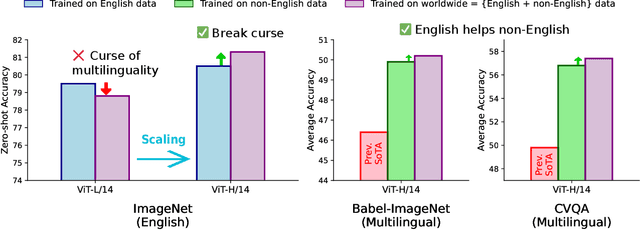
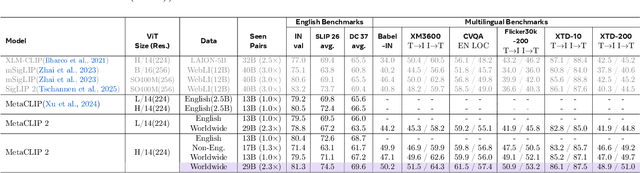
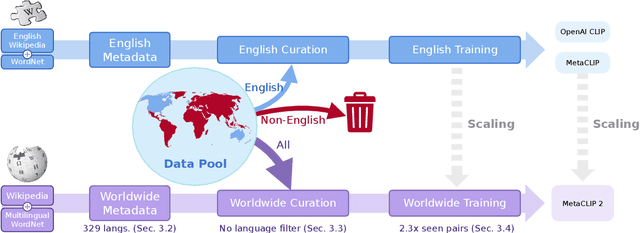

Contrastive Language-Image Pretraining (CLIP) is a popular foundation model, supporting from zero-shot classification, retrieval to encoders for multimodal large language models (MLLMs). Although CLIP is successfully trained on billion-scale image-text pairs from the English world, scaling CLIP's training further to learning from the worldwide web data is still challenging: (1) no curation method is available to handle data points from non-English world; (2) the English performance from existing multilingual CLIP is worse than its English-only counterpart, i.e., "curse of multilinguality" that is common in LLMs. Here, we present MetaCLIP 2, the first recipe training CLIP from scratch on worldwide web-scale image-text pairs. To generalize our findings, we conduct rigorous ablations with minimal changes that are necessary to address the above challenges and present a recipe enabling mutual benefits from English and non-English world data. In zero-shot ImageNet classification, MetaCLIP 2 ViT-H/14 surpasses its English-only counterpart by 0.8% and mSigLIP by 0.7%, and surprisingly sets new state-of-the-art without system-level confounding factors (e.g., translation, bespoke architecture changes) on multilingual benchmarks, such as CVQA with 57.4%, Babel-ImageNet with 50.2% and XM3600 with 64.3% on image-to-text retrieval.