 Add to Chrome
 Add to Firefox
 Add to Edge
SIMAX: A Scalable and Interpretable Framework for Multi-Fidelity and Annotated Clinician-Patient Dialogue Simulation
Jun 29, 2026
Background. The widespread deployment of ambient digital scribes is driving large-scale capture of clinician-patient dialogues. Human coding of clinical communication data remains costly, inconsistent, and difficult to scale, motivating AI-driven communication coding systems. However, evaluating these systems requires real-world dialogues and human-coded labels, both hard to obtain at scale. Methods. We developed SIMAX (Scalable and Interpretable Framework for Multi-Fidelity and Annotated Clinician-Patient Dialogue Simulation), a framework for generating controlled clinical dialogue data with reference behavioral annotations. SIMAX generates clinician-patient dialogues from predefined clinical scenarios, personas and voice conditions, and target communication behaviors. Behaviors are controlled using two codebooks: the Global Codebook for overall communication quality and the WISER Codebook for specific countable behaviors. We evaluated SIMAX using automated and human quality assessments and an example communication coding system. Results. SIMAX generated 3,388 simulated dialogues across three specialties, multiple visit stages, persona characteristics, and accent conditions. Automated assessment showed mean UTMOS and WV-MOS scores of 3.03 and 2.61, WER and CER of 0.07 and 0.05, and CLAP cosine similarity of 0.41, suggesting reasonable speech naturalness, high transcription fidelity, and positive text-audio correspondence. Human evaluation showed a median MOS of 4.67 and a median clinical realism score of 3.00. Downstream evaluation suggests that SIMAX can assess how a communication coding system responds to behavioral targets and reveal insufficient sensitivity in some dimensions. Conclusions. SIMAX generates controlled and reproducible simulated clinician-patient dialogues, providing a data foundation for developing, validating, and refining communication coding systems.

RELEAP: Reinforcement-Enhanced Label-Efficient Active Phenotyping for Electronic Health Records
Nov 08, 2025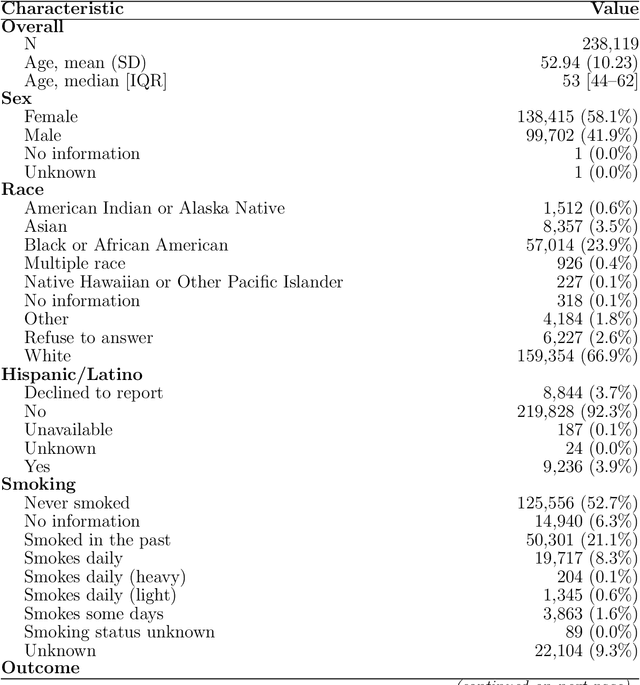
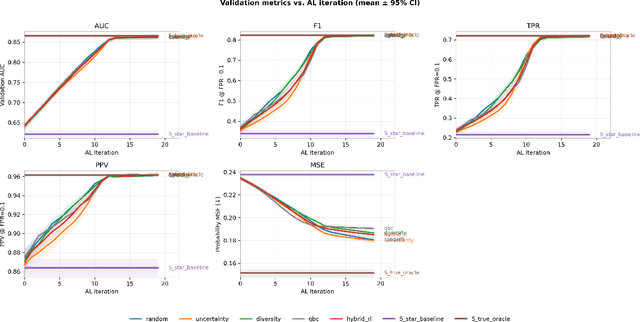
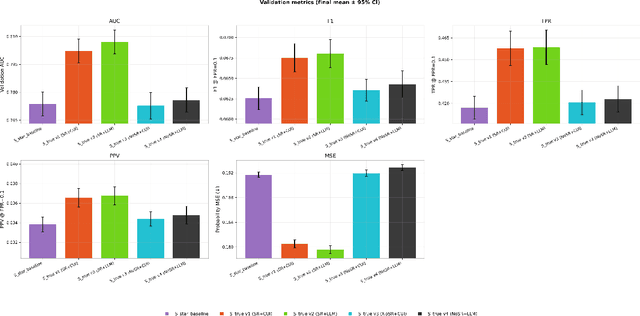
Objective: Electronic health record (EHR) phenotyping often relies on noisy proxy labels, which undermine the reliability of downstream risk prediction. Active learning can reduce annotation costs, but most rely on fixed heuristics and do not ensure that phenotype refinement improves prediction performance. Our goal was to develop a framework that directly uses downstream prediction performance as feedback to guide phenotype correction and sample selection under constrained labeling budgets. Materials and Methods: We propose Reinforcement-Enhanced Label-Efficient Active Phenotyping (RELEAP), a reinforcement learning-based active learning framework. RELEAP adaptively integrates multiple querying strategies and, unlike prior methods, updates its policy based on feedback from downstream models. We evaluated RELEAP on a de-identified Duke University Health System (DUHS) cohort (2014-2024) for incident lung cancer risk prediction, using logistic regression and penalized Cox survival models. Performance was benchmarked against noisy-label baselines and single-strategy active learning. Results: RELEAP consistently outperformed all baselines. Logistic AUC increased from 0.774 to 0.805 and survival C-index from 0.718 to 0.752. Using downstream performance as feedback, RELEAP produced smoother and more stable gains than heuristic methods under the same labeling budget. Discussion: By linking phenotype refinement to prediction outcomes, RELEAP learns which samples most improve downstream discrimination and calibration, offering a more principled alternative to fixed active learning rules. Conclusion: RELEAP optimizes phenotype correction through downstream feedback, offering a scalable, label-efficient paradigm that reduces manual chart review and enhances the reliability of EHR-based risk prediction.