 Add to Chrome
 Add to Firefox
 Add to Edge
Illusions of the Gold Standard: A Large-scale Analysis of Human Evaluation Protocols for Long-form Text Generation
Jun 09, 2026
Human evaluation plays a critical role in assessing the quality of generated text. However, the reliability and reproducibility of these evaluations depend on transparent and well-documented protocols -- details that are frequently missing in current practice. In this work, we conduct a large-scale analysis of human evaluation protocols for evaluating long-form generation tasks in *CL conference publications from 2023--2025, including a full manual review of 284 papers and LLM-assisted analysis for another 1.8k+ papers. We define a set of 20 reportable criteria related to reproducibility of human evaluation studies, and apply these criteria to systematically examine reporting norms and practices within the community. We find widespread under-reporting of important aspects of human evaluation study design, leading to ambiguity about what was measured and how, who contributed judgments, and how judgments should be interpreted. Based on these findings, we outline actionable recommendations to support more transparent and reproducible reporting in future research. Our analysis code and annotated dataset can be found at: https://github.com/larchlab/Illusions-of-the-Gold-Standard

Addressing Pitfalls in Auditing Practices of Automatic Speech Recognition Technologies: A Case Study of People with Aphasia
Jun 10, 2025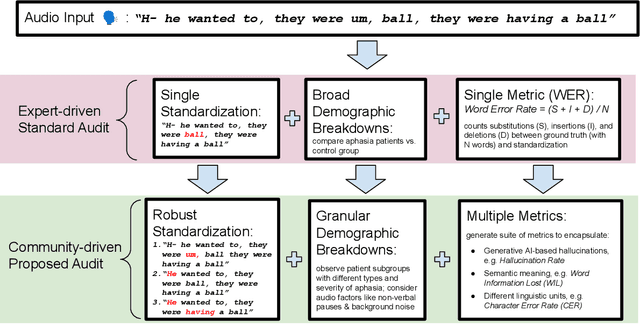
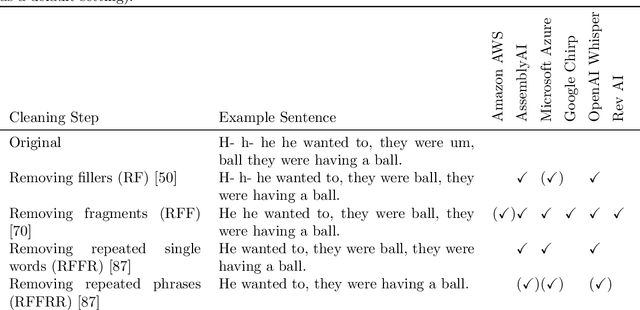
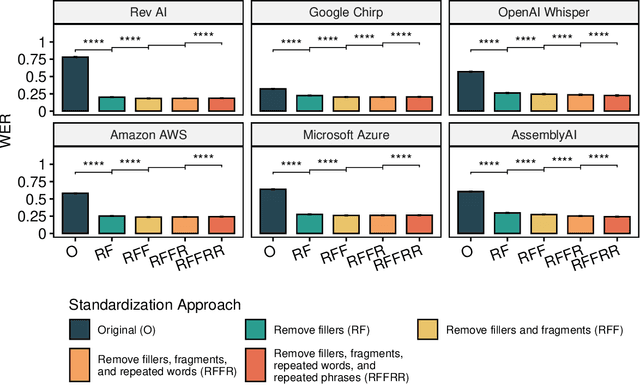
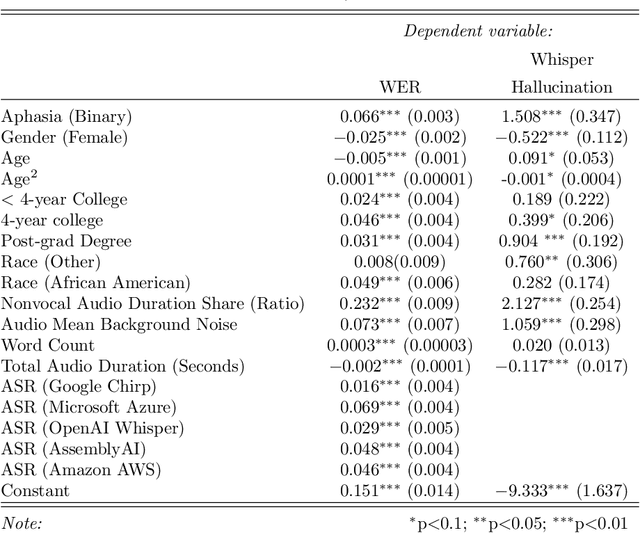
Automatic Speech Recognition (ASR) has transformed daily tasks from video transcription to workplace hiring. ASR systems' growing use warrants robust and standardized auditing approaches to ensure automated transcriptions of high and equitable quality. This is especially critical for people with speech and language disorders (such as aphasia) who may disproportionately depend on ASR systems to navigate everyday life. In this work, we identify three pitfalls in existing standard ASR auditing procedures, and demonstrate how addressing them impacts audit results via a case study of six popular ASR systems' performance for aphasia speakers. First, audits often adhere to a single method of text standardization during data pre-processing, which (a) masks variability in ASR performance from applying different standardization methods, and (b) may not be consistent with how users - especially those from marginalized speech communities - would want their transcriptions to be standardized. Second, audits often display high-level demographic findings without further considering performance disparities among (a) more nuanced demographic subgroups, and (b) relevant covariates capturing acoustic information from the input audio. Third, audits often rely on a single gold-standard metric -- the Word Error Rate -- which does not fully capture the extent of errors arising from generative AI models, such as transcription hallucinations. We propose a more holistic auditing framework that accounts for these three pitfalls, and exemplify its results in our case study, finding consistently worse ASR performance for aphasia speakers relative to a control group. We call on practitioners to implement these robust ASR auditing practices that remain flexible to the rapidly changing ASR landscape.