 Add to Chrome
 Add to Firefox
 Add to Edge
Reducing Hallucination in Enterprise AI Workflows via Hybrid Utility Minimum Bayes Risk (HUMBR)
Apr 13, 2026
Although LLMs drive automation, it is critical to ensure immense consideration for high-stakes enterprise workflows such as those involving legal matters, risk management, and privacy compliance. For Meta, and other organizations like ours, a single hallucinated clause in such high stakes workflows risks material consequences. We show that by framing hallucination mitigation as a Minimum Bayes Risk (MBR) problem, we can dramatically reduce this risk. Specifically, we introduce a Hybrid Utility MBR (HUMBR) framework that synthesizes semantic embedding similarity with lexical precision to identify consensus without ground-truth references, for which we derive rigorous error bounds. We complement this theoretical analysis with a comprehensive empirical evaluation on widely-used public benchmark suites (TruthfulQA and LegalBench) and also real world data from Meta production deployment. The results from our empirical study show that MBR significantly outperforms standard Universal Self-Consistency. Notably, 81% of the pipeline's suggestions were preferred over human-crafted ground truth, and critical recall failures were virtually eliminated.

The Llama 3 Herd of Models
Jul 31, 2024Modern artificial intelligence (AI) systems are powered by foundation models. This paper presents a new set of foundation models, called Llama 3. It is a herd of language models that natively support multilinguality, coding, reasoning, and tool usage. Our largest model is a dense Transformer with 405B parameters and a context window of up to 128K tokens. This paper presents an extensive empirical evaluation of Llama 3. We find that Llama 3 delivers comparable quality to leading language models such as GPT-4 on a plethora of tasks. We publicly release Llama 3, including pre-trained and post-trained versions of the 405B parameter language model and our Llama Guard 3 model for input and output safety. The paper also presents the results of experiments in which we integrate image, video, and speech capabilities into Llama 3 via a compositional approach. We observe this approach performs competitively with the state-of-the-art on image, video, and speech recognition tasks. The resulting models are not yet being broadly released as they are still under development.
Efficient conditioned face animation using frontally-viewed embedding
Mar 16, 2022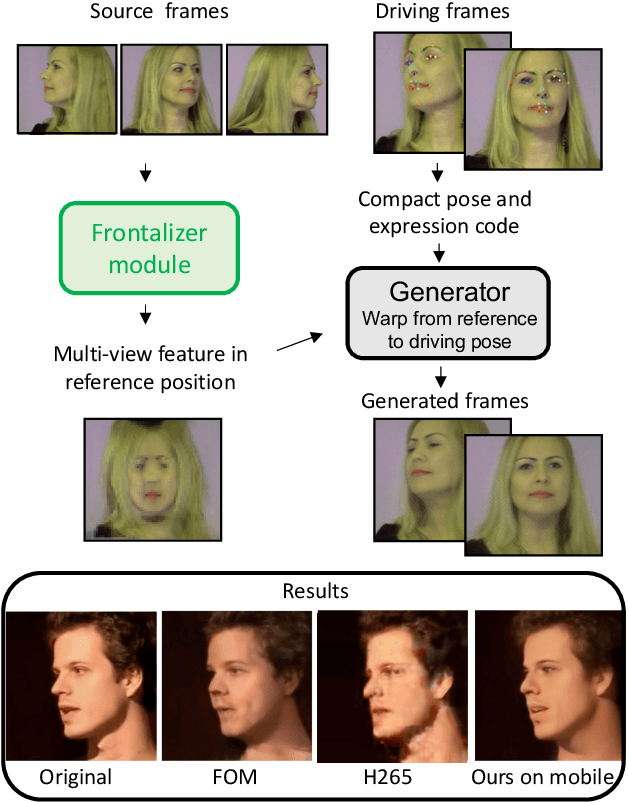

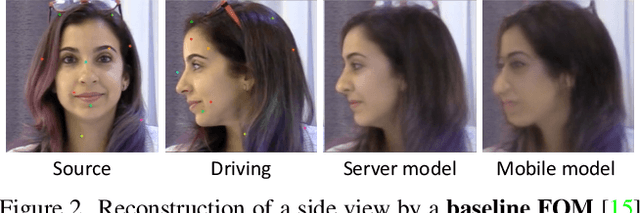
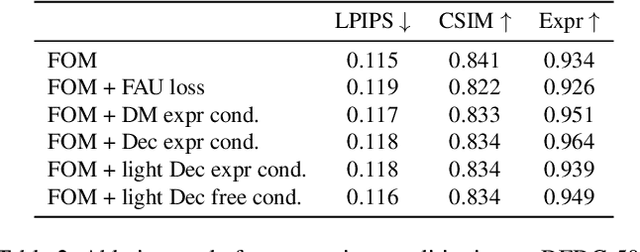
As the quality of few shot facial animation from landmarks increases, new applications become possible, such as ultra low bandwidth video chat compression with a high degree of realism. However, there are some important challenges to tackle in order to improve the experience in real world conditions. In particular, the current approaches fail to represent profile views without distortions, while running in a low compute regime. We focus on this key problem by introducing a multi-frames embedding dubbed Frontalizer to improve profile views rendering. In addition to this core improvement, we explore the learning of a latent code conditioning generations along with landmarks to better convey facial expressions. Our dense models achieves 22% of improvement in perceptual quality and 73% reduction of landmark error over the first order model baseline on a subset of DFDC videos containing head movements. Declined with mobile architectures, our models outperform the previous state-of-the-art (improving perceptual quality by more than 16% and reducing landmark error by more than 47% on two datasets) while running on real time on iPhone 8 with very low bandwidth requirements.