 Add to Chrome
 Add to Firefox
 Add to Edge
Safe Equilibrium Policy Optimization for Strategic Agent Policies
May 29, 2026
Language models fine-tuned with reinforcement learning typically optimize for task reward, ignoring multi-agent strategic structure. Because these agents condition on natural language game-state descriptions and emit actions through free-form generation, strategic failure modes -- exploiting weaker opponents, coordinating on harmful equilibria, and externalizing costs are inseparable from the language interface itself. We propose Safe Equilibrium Policy Optimization (\sepo{}), a training objective that augments expected payoff with explicit penalties for exploitability, collusion risk, and externality cost. We implement \sepo{} as a reward signal for Group Relative Policy Optimization (GRPO), applied to Gemma~4 E4B-it and Qwen~3.5-4B after supervised fine-tuning (SFT). Evaluated across five strategic domains: Iterated Prisoner's Dilemma, repeated auctions, two negotiation variants, and Kuhn Poker. \sepo{} achieves zero exploit-pool advantage in Kuhn Poker for both models, outperforms the base model on safety in four domains, and corrects the over-cooperative behavior introduced by SFT. In negotiation, \sepo{} achieves a positive-safety outcome and only the positive normalized relative advantage of any negotiation configuration. Ablation experiments confirm that per-rollout exploit computation is necessary: a shared constant penalty cancels in GRPO advantage normalization (constant control-variate property), producing zero gradient. To support further research in strategic safety for agents, we release our \href{https://anonymous.4open.science/r/sepo-2668/README.md}{code} and SFT datasets.

Alexa, play with robot: Introducing the First Alexa Prize SimBot Challenge on Embodied AI
Aug 09, 2023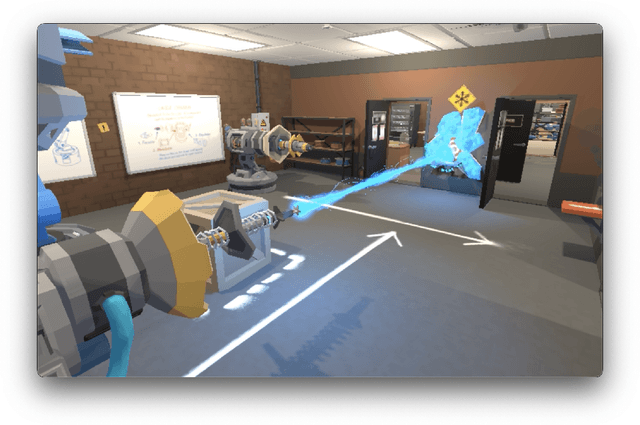

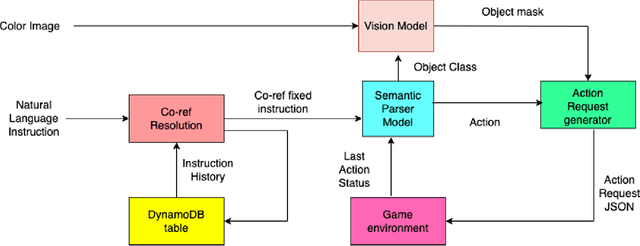

The Alexa Prize program has empowered numerous university students to explore, experiment, and showcase their talents in building conversational agents through challenges like the SocialBot Grand Challenge and the TaskBot Challenge. As conversational agents increasingly appear in multimodal and embodied contexts, it is important to explore the affordances of conversational interaction augmented with computer vision and physical embodiment. This paper describes the SimBot Challenge, a new challenge in which university teams compete to build robot assistants that complete tasks in a simulated physical environment. This paper provides an overview of the SimBot Challenge, which included both online and offline challenge phases. We describe the infrastructure and support provided to the teams including Alexa Arena, the simulated environment, and the ML toolkit provided to teams to accelerate their building of vision and language models. We summarize the approaches the participating teams took to overcome research challenges and extract key lessons learned. Finally, we provide analysis of the performance of the competing SimBots during the competition.
Alexa Arena: A User-Centric Interactive Platform for Embodied AI
Mar 02, 2023


We introduce Alexa Arena, a user-centric simulation platform for Embodied AI (EAI) research. Alexa Arena provides a variety of multi-room layouts and interactable objects, for the creation of human-robot interaction (HRI) missions. With user-friendly graphics and control mechanisms, Alexa Arena supports the development of gamified robotic tasks readily accessible to general human users, thus opening a new venue for high-efficiency HRI data collection and EAI system evaluation. Along with the platform, we introduce a dialog-enabled instruction-following benchmark and provide baseline results for it. We make Alexa Arena publicly available to facilitate research in building generalizable and assistive embodied agents.