 Add to Chrome
 Add to Firefox
 Add to Edge
VASAE: Naming SAE Dictionary Directions with Vocabulary-Aligned Anchoring
Jun 26, 2026
Sparse autoencoders (SAEs) provide useful decompositions of Transformer residual streams, but their learned features are usually named post hoc rather than directly connected to the Transformer's token vocabulary. We introduce Vocabulary-Aligned Sparse Autoencoder (VASAE), a method that trains SAE features under vocabulary-aligned anchoring and assigns each feature an intrinsic token name: the token string whose embedding is nearest to that feature. Without reducing reconstruction quality compared with a standard SAE, VASAE produces dictionaries with vocabulary-aligned features. Using a 0.8 cutoff on the nearest-token alignment score, dictionaries trained on GPT-2-small post-residual streams align about 90% of features in layers 0--10. In Llama-3.1-8B, representative shallow and middle-layer dictionaries contain strongly aligned features, including 92.8% in the shallow layer, while the representative final-layer dictionary shows limited alignment. After subtracting the sentence-level mean sparse code, case studies show that many remaining intrinsic token names are relevant to nearby input tokens. These results suggest that vocabulary-aligned anchoring can connect learned features to intrinsic token names during training, complementing post hoc interpretation of learned dictionaries.

LiveStarPro: Proactive Streaming Video Understanding with Hierarchical Memory for Long-Horizon Streams
Jun 16, 2026Despite the remarkable progress of Video Large Language Models (Video-LLMs), current online architectures still struggle to simultaneously process continuous video streams, decide autonomously when to respond, and preserve long-horizon contextual memory. These obstacles undermine real-time responsiveness and cause severe forgetting throughout prolonged interactions. In this work, we introduce LiveStarPro, a live streaming assistant that is designed for proactive video understanding over long-horizon streams. The design of LiveStarPro rests on three complementary components. The first component is Streaming Verification Decoding (SVeD), an inference framework that identifies the appropriate response timing through single-pass perplexity verification, thereby eliminating the dependency on explicit silence tokens. The second component is Streaming Causal Attention Masks (SCAM), a training strategy that enforces incremental video-language alignment over variable-length streams. The third component is Tree-Structured Hierarchical Memory (TSHM), a recursive memory architecture that organizes evicted historical information into event chains and consequently enables efficient retrieval from effectively unbounded video streams. To facilitate a comprehensive evaluation under realistic online conditions, we further present OmniStarPro, a large-scale benchmark that spans 15 diverse real-world scenarios and that extends to hour-scale streams for the assessment of long-term recall. Extensive experiments demonstrate that LiveStarPro consistently surpasses existing methods, attaining a 28.9% improvement in semantic correctness and an 18.2% reduction in timing error, while its streaming key-value cache further yields a 1.58x inference speedup over the same model without caching. The model and the code are publicly available at https://github.com/sotayang/LiveStarPro.
Don't Pause: Streaming Video-Language Synchrony for Online Video Understanding
Jun 05, 2026Online Video Large Language Models (Video-LLMs) have advanced toward seamless human-AI interaction through frame-by-frame processing and proactive responding. However, a critical challenge remains in streaming scenarios: existing models typically pause video perception while generating responses, breaking real-time video-language synchrony and causing stutters. To address this, we introduce a novel paradigm for online video understanding: Streaming Video-Language Synchrony (SVLS), and present LyraV, a live streaming assistant built upon a hierarchical control framework with two core innovations. First, the Frame-Driven Transition Controller (FDTC), a training-free verification-based finite-state machine, makes high-level semantic decisions on when to continue speaking, start a new response, or stay silent. Second, the Streaming Token Pacer (SToP), a plug-and-play lightweight predictive module, dynamically adapts the language generation rate to match the pace of the visual content. Concretely, LyraV performs \emph{per-frame incremental, sub-budget decoding}: within each frame interval it emits only a small chunk of tokens that fits the real-time budget, so perception is never blocked for a full sentence. Together, these components enable LyraV to seamlessly interleave incoming video frames with generated word tokens, achieving a fine-grained synchrony. Extensive experiments conducted on five online and three offline benchmarks demonstrate that LyraV preserves the backbone's general understanding ability while substantially improving streaming synchrony and narrative fluency, delivering a 98.29\% synchrony with video playback and a real-time processing speed of 3.89 FPS. Interestingly, we observe an empirical capability in LyraV: dynamic reasoning over streaming tokens, enabling continuous interpretation and "thinking" alongside visual input.
LiveStar: Live Streaming Assistant for Real-World Online Video Understanding
Nov 07, 2025Despite significant progress in Video Large Language Models (Video-LLMs) for offline video understanding, existing online Video-LLMs typically struggle to simultaneously process continuous frame-by-frame inputs and determine optimal response timing, often compromising real-time responsiveness and narrative coherence. To address these limitations, we introduce LiveStar, a pioneering live streaming assistant that achieves always-on proactive responses through adaptive streaming decoding. Specifically, LiveStar incorporates: (1) a training strategy enabling incremental video-language alignment for variable-length video streams, preserving temporal consistency across dynamically evolving frame sequences; (2) a response-silence decoding framework that determines optimal proactive response timing via a single forward pass verification; (3) memory-aware acceleration via peak-end memory compression for online inference on 10+ minute videos, combined with streaming key-value cache to achieve 1.53x faster inference. We also construct an OmniStar dataset, a comprehensive dataset for training and benchmarking that encompasses 15 diverse real-world scenarios and 5 evaluation tasks for online video understanding. Extensive experiments across three benchmarks demonstrate LiveStar's state-of-the-art performance, achieving an average 19.5% improvement in semantic correctness with 18.1% reduced timing difference compared to existing online Video-LLMs, while improving FPS by 12.0% across all five OmniStar tasks. Our model and dataset can be accessed at https://github.com/yzy-bupt/LiveStar.
TSCAN: Context-Aware Uplift Modeling via Two-Stage Training for Online Merchant Business Diagnosis
Apr 26, 2025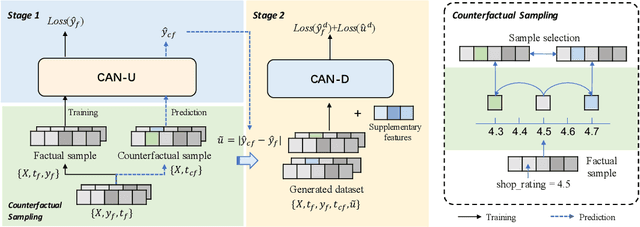
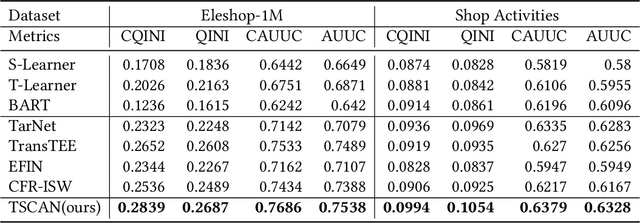
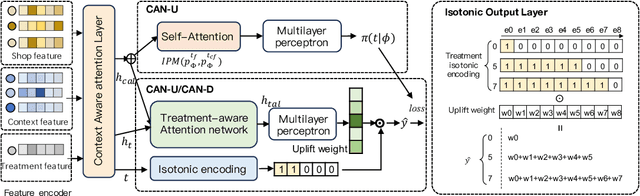
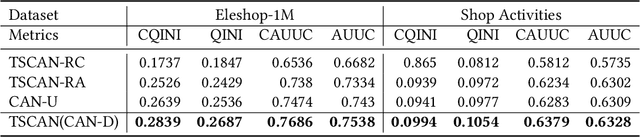
A primary challenge in ITE estimation is sample selection bias. Traditional approaches utilize treatment regularization techniques such as the Integral Probability Metrics (IPM), re-weighting, and propensity score modeling to mitigate this bias. However, these regularizations may introduce undesirable information loss and limit the performance of the model. Furthermore, treatment effects vary across different external contexts, and the existing methods are insufficient in fully interacting with and utilizing these contextual features. To address these issues, we propose a Context-Aware uplift model based on the Two-Stage training approach (TSCAN), comprising CAN-U and CAN-D sub-models. In the first stage, we train an uplift model, called CAN-U, which includes the treatment regularizations of IPM and propensity score prediction, to generate a complete dataset with counterfactual uplift labels. In the second stage, we train a model named CAN-D, which utilizes an isotonic output layer to directly model uplift effects, thereby eliminating the reliance on the regularization components. CAN-D adaptively corrects the errors estimated by CAN-U through reinforcing the factual samples, while avoiding the negative impacts associated with the aforementioned regularizations. Additionally, we introduce a Context-Aware Attention Layer throughout the two-stage process to manage the interactions between treatment, merchant, and contextual features, thereby modeling the varying treatment effect in different contexts. We conduct extensive experiments on two real-world datasets to validate the effectiveness of TSCAN. Ultimately, the deployment of our model for real-world merchant diagnosis on one of China's largest online food ordering platforms validates its practical utility and impact.