 Add to Chrome
 Add to Firefox
 Add to Edge
MeDocVL: A Visual Language Model for Medical Document Understanding and Parsing
Feb 06, 2026
Medical document OCR is challenging due to complex layouts, domain-specific terminology, and noisy annotations, while requiring strict field-level exact matching. Existing OCR systems and general-purpose vision-language models often fail to reliably parse such documents. We propose MeDocVL, a post-trained vision-language model for query-driven medical document parsing. Our framework combines Training-driven Label Refinement to construct high-quality supervision from noisy annotations, with a Noise-aware Hybrid Post-training strategy that integrates reinforcement learning and supervised fine-tuning to achieve robust and precise extraction. Experiments on medical invoice benchmarks show that MeDocVL consistently outperforms conventional OCR systems and strong VLM baselines, achieving state-of-the-art performance under noisy supervision.

Reinforcement Learning with Token-level Feedback for Controllable Text Generation
Mar 18, 2024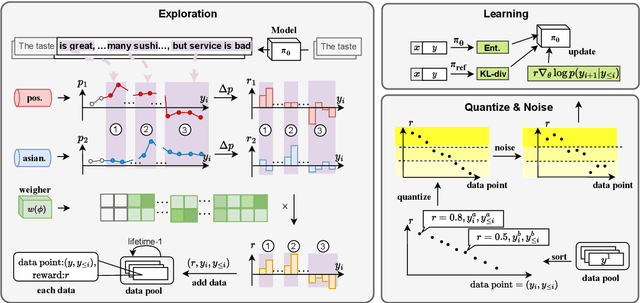
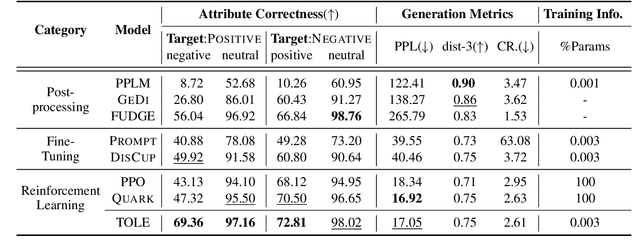
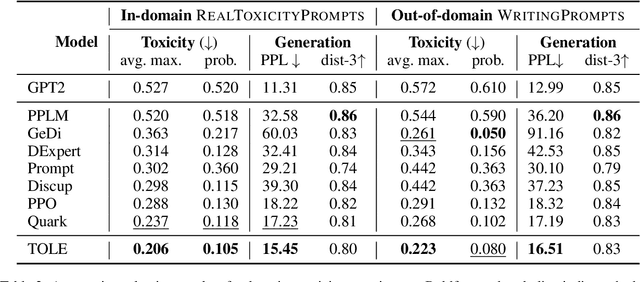
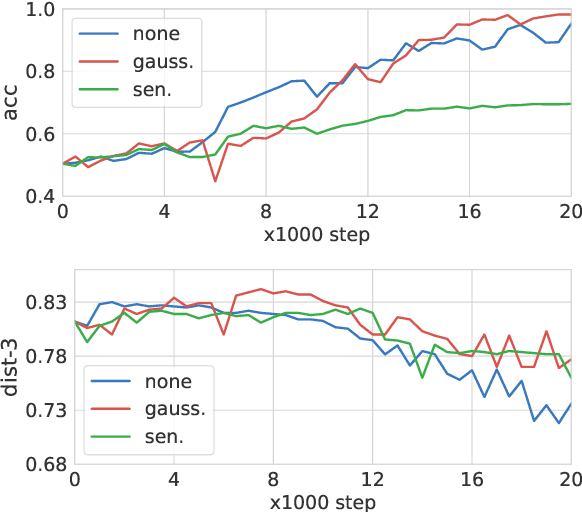
To meet the requirements of real-world applications, it is essential to control generations of large language models (LLMs). Prior research has tried to introduce reinforcement learning (RL) into controllable text generation while most existing methods suffer from overfitting issues (finetuning-based methods) or semantic collapse (post-processing methods). However, current RL methods are generally guided by coarse-grained (sentence/paragraph-level) feedback, which may lead to suboptimal performance owing to semantic twists or progressions within sentences. To tackle that, we propose a novel reinforcement learning algorithm named TOLE which formulates TOken-LEvel rewards for controllable text generation, and employs a "first-quantize-then-noise" paradigm to enhance the robustness of the RL algorithm.Furthermore, TOLE can be flexibly extended to multiple constraints with little computational expense. Experimental results show that our algorithm can achieve superior performance on both single-attribute and multi-attribute control tasks. We have released our codes at https://github.com/WindyLee0822/CTG