 Add to Chrome
 Add to Firefox
 Add to Edge
RoboStriker: Latent-Space Strategic Games for Autonomous Humanoid Boxing
Aug 17, 2026
Achieving human-level competitive intelligence and physical agility in humanoid robots remains a profound challenge, particularly in contact-rich and highly dynamic tasks such as boxing. While Multi-Agent Reinforcement Learning offers a principled framework for strategic interaction, its direct application to unstructured raw motor spaces inevitably leads to joint-level physical collapse, preventing the emergence of any viable combat tactics. To resolve this fundamental conflict between strategic exploration and physical feasibility, we formulate the humanoid combat task as a novel two-player latent-space zero-sum Markov game. Under standard regularity and approximate best-response assumptions, we show that the latent formulation induces an equivalent game over the decoder-reachable action manifold, providing an approximate-Nash interpretation of the resulting self-play dynamics. To instantiate this theoretical formulation, we propose RoboStriker, a hierarchical framework that decouples high-level reasoning from low-level execution. It first distills the tracking expertise of predefined boxing motions into a topologically bounded latent manifold. This structured latent foundation subsequently drives multi-agent co-evolution via Latent-Space Neural Fictitious Self-Play. Extensive experimental results demonstrate that gaming within this structured latent space substantially outperforms direct exploration. By constraining strategic exploration through a pretrained motion decoder, RoboStriker substantially reduces the catastrophic balance failures observed in raw action-space methods and achieves superior tactical performance in both competitive win rates and striking efficiency. Finally, we successfully deploy and validate our learned combat policies on real-world humanoid robots. Our code and video and supplementary materials are available at RoboStriker.

ECRM: Efficient Fault Tolerance for Recommendation Model Training via Erasure Coding
Apr 05, 2021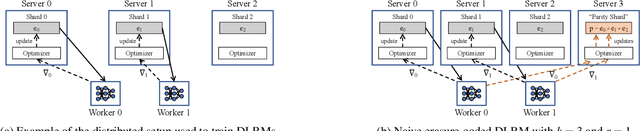
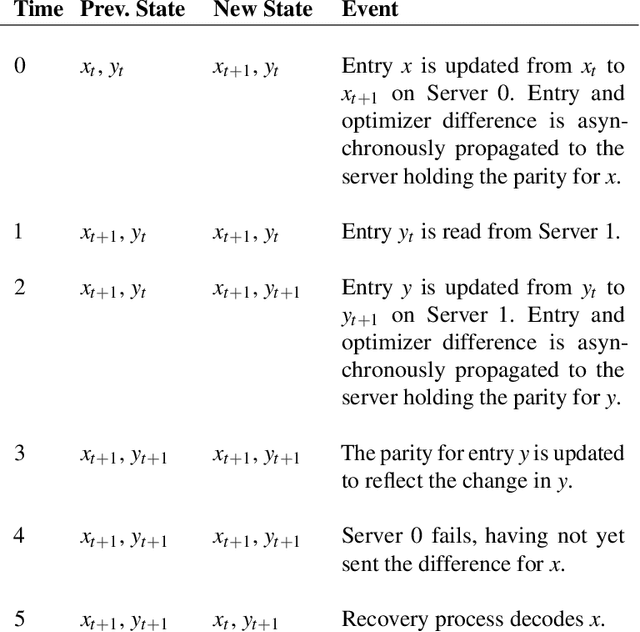
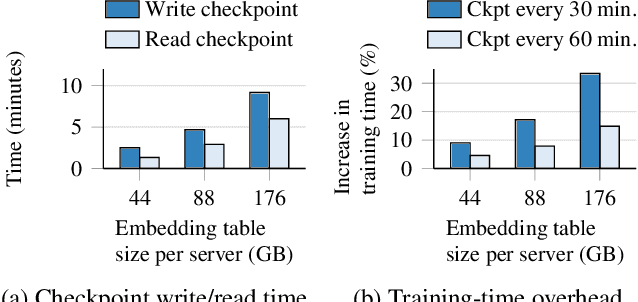
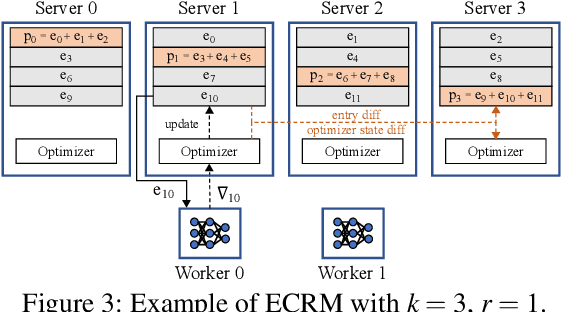
Deep-learning-based recommendation models (DLRMs) are widely deployed to serve personalized content to users. DLRMs are large in size due to their use of large embedding tables, and are trained by distributing the model across the memory of tens or hundreds of servers. Server failures are common in such large distributed systems and must be mitigated to enable training to progress. Checkpointing is the primary approach used for fault tolerance in these systems, but incurs significant training-time overhead both during normal operation and when recovering from failures. As these overheads increase with DLRM size, checkpointing is slated to become an even larger overhead for future DLRMs, which are expected to grow in size. This calls for rethinking fault tolerance in DLRM training. We present ECRM, a DLRM training system that achieves efficient fault tolerance using erasure coding. ECRM chooses which DLRM parameters to encode, correctly and efficiently updates parities, and enables training to proceed without any pauses, while maintaining consistency of the recovered parameters. We implement ECRM atop XDL, an open-source, industrial-scale DLRM training system. Compared to checkpointing, ECRM reduces training-time overhead for large DLRMs by up to 88%, recovers from failures up to 10.3$\times$ faster, and allows training to proceed during recovery. These results show the promise of erasure coding in imparting efficient fault tolerance to training current and future DLRMs.