 Add to Chrome
 Add to Firefox
 Add to Edge
Boosting Overlapping Organoid Instance Segmentation Using Pseudo-Label Unmixing and Synthesis-Assisted Learning
Jan 10, 2026
Organoids, sophisticated in vitro models of human tissues, are crucial for medical research due to their ability to simulate organ functions and assess drug responses accurately. Accurate organoid instance segmentation is critical for quantifying their dynamic behaviors, yet remains profoundly limited by high-quality annotated datasets and pervasive overlap in microscopy imaging. While semi-supervised learning (SSL) offers a solution to alleviate reliance on scarce labeled data, conventional SSL frameworks suffer from biases induced by noisy pseudo-labels, particularly in overlapping regions. Synthesis-assisted SSL (SA-SSL) has been proposed for mitigating training biases in semi-supervised semantic segmentation. We present the first adaptation of SA-SSL to organoid instance segmentation and reveal that SA-SSL struggles to disentangle intertwined organoids, often misrepresenting overlapping instances as a single entity. To overcome this, we propose Pseudo-Label Unmixing (PLU), which identifies erroneous pseudo-labels for overlapping instances and then regenerates organoid labels through instance decomposition. For image synthesis, we apply a contour-based approach to synthesize organoid instances efficiently, particularly for overlapping cases. Instance-level augmentations (IA) on pseudo-labels before image synthesis further enhances the effect of synthetic data (SD). Rigorous experiments on two organoid datasets demonstrate our method's effectiveness, achieving performance comparable to fully supervised models using only 10% labeled data, and state-of-the-art results. Ablation studies validate the contributions of PLU, contour-based synthesis, and augmentation-aware training. By addressing overlap at both pseudo-label and synthesis levels, our work advances scalable, label-efficient organoid analysis, unlocking new potential for high-throughput applications in precision medicine.

AU-Blendshape for Fine-grained Stylized 3D Facial Expression Manipulation
Jul 16, 2025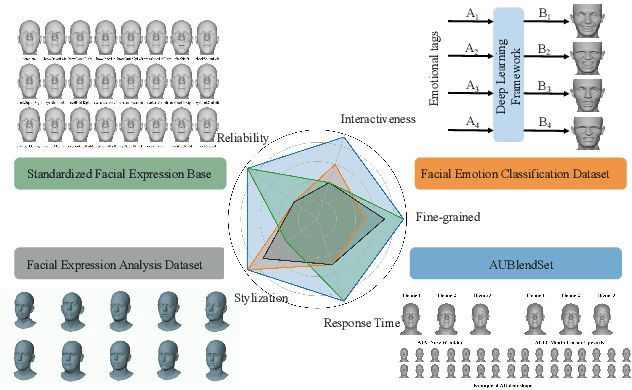
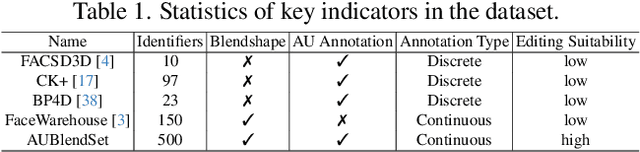
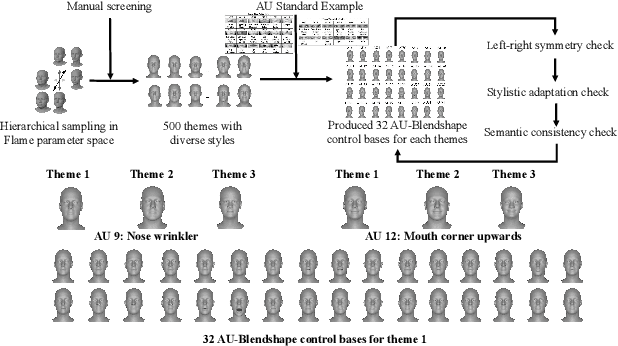

While 3D facial animation has made impressive progress, challenges still exist in realizing fine-grained stylized 3D facial expression manipulation due to the lack of appropriate datasets. In this paper, we introduce the AUBlendSet, a 3D facial dataset based on AU-Blendshape representation for fine-grained facial expression manipulation across identities. AUBlendSet is a blendshape data collection based on 32 standard facial action units (AUs) across 500 identities, along with an additional set of facial postures annotated with detailed AUs. Based on AUBlendSet, we propose AUBlendNet to learn AU-Blendshape basis vectors for different character styles. AUBlendNet predicts, in parallel, the AU-Blendshape basis vectors of the corresponding style for a given identity mesh, thereby achieving stylized 3D emotional facial manipulation. We comprehensively validate the effectiveness of AUBlendSet and AUBlendNet through tasks such as stylized facial expression manipulation, speech-driven emotional facial animation, and emotion recognition data augmentation. Through a series of qualitative and quantitative experiments, we demonstrate the potential and importance of AUBlendSet and AUBlendNet in 3D facial animation tasks. To the best of our knowledge, AUBlendSet is the first dataset, and AUBlendNet is the first network for continuous 3D facial expression manipulation for any identity through facial AUs. Our source code is available at https://github.com/wslh852/AUBlendNet.git.