 Add to Chrome
 Add to Firefox
 Add to Edge
SFR-GNN: Simple and Fast Robust GNNs against Structural Attacks
Sep 01, 2024
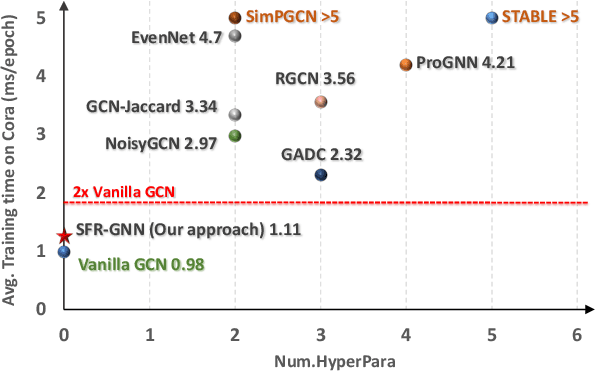
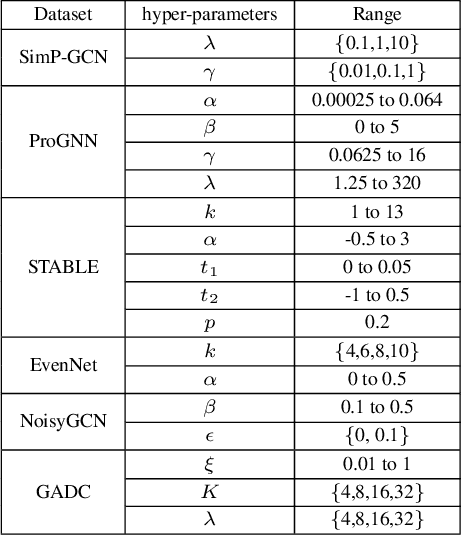
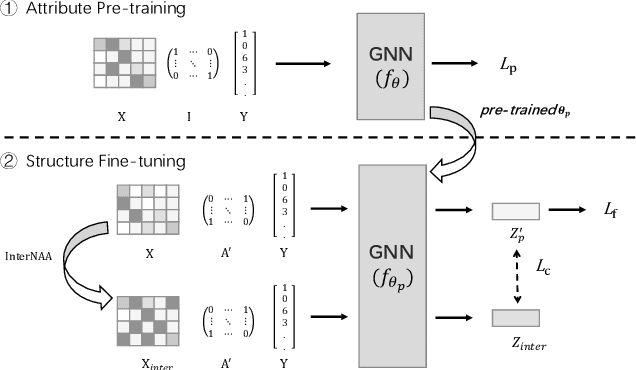
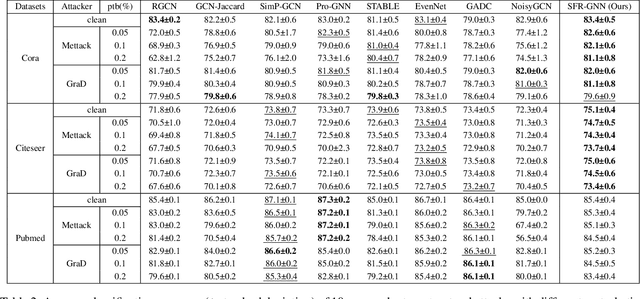
Graph Neural Networks (GNNs) have demonstrated commendable performance for graph-structured data. Yet, GNNs are often vulnerable to adversarial structural attacks as embedding generation relies on graph topology. Existing efforts are dedicated to purifying the maliciously modified structure or applying adaptive aggregation, thereby enhancing the robustness against adversarial structural attacks. It is inevitable for a defender to consume heavy computational costs due to lacking prior knowledge about modified structures. To this end, we propose an efficient defense method, called Simple and Fast Robust Graph Neural Network (SFR-GNN), supported by mutual information theory. The SFR-GNN first pre-trains a GNN model using node attributes and then fine-tunes it over the modified graph in the manner of contrastive learning, which is free of purifying modified structures and adaptive aggregation, thus achieving great efficiency gains. Consequently, SFR-GNN exhibits a 24%--162% speedup compared to advanced robust models, demonstrating superior robustness for node classification tasks.

Reconstruction of partially occluded objects with a physics-driven self-training neural network
Aug 23, 2024This study proposes a novel approach utilizing a physics-informed deep learning (DL) algorithm to reconstruct occluded objects in a terahertz (THz) holographic system. Taking the angular spectrum theory as prior knowledge, we generate a dataset consisting of a series of diffraction patterns that contain information about the objects. This dataset, combined with unlabeled data measured from experiments, are used for the self-training of a physics-informed neural network (NN). During the training process, the neural network iteratively predicts the outcomes of the unlabeled data and reincorporates these results back into the training set. This recursive strategy not only reduces noise but also minimizes mutual interference during object reconstruction, demonstrating its effectiveness even in data-scarce situations. The method has been validated with both simulated and experimental data, showcasing its significant potential to advance the field of terahertz three-dimensional (3D) imaging. Additionally, it sets a new benchmark for rapid, reference-free, and cost-effective power detection.
Band-Attention Modulated RetNet for Face Forgery Detection
Apr 09, 2024

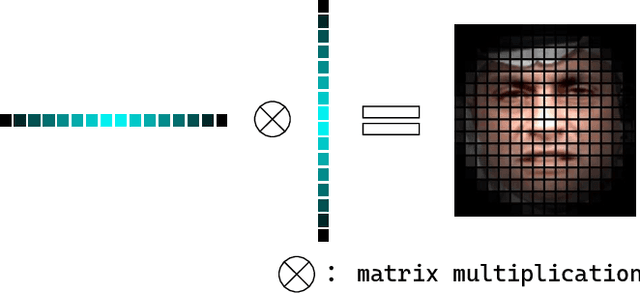

The transformer networks are extensively utilized in face forgery detection due to their scalability across large datasets.Despite their success, transformers face challenges in balancing the capture of global context, which is crucial for unveiling forgery clues, with computational complexity.To mitigate this issue, we introduce Band-Attention modulated RetNet (BAR-Net), a lightweight network designed to efficiently process extensive visual contexts while avoiding catastrophic forgetting.Our approach empowers the target token to perceive global information by assigning differential attention levels to tokens at varying distances. We implement self-attention along both spatial axes, thereby maintaining spatial priors and easing the computational burden.Moreover, we present the adaptive frequency Band-Attention Modulation mechanism, which treats the entire Discrete Cosine Transform spectrogram as a series of frequency bands with learnable weights.Together, BAR-Net achieves favorable performance on several face forgery datasets, outperforming current state-of-the-art methods.
Spikewhisper: Temporal Spike Backdoor Attacks on Federated Neuromorphic Learning over Low-power Devices
Mar 27, 2024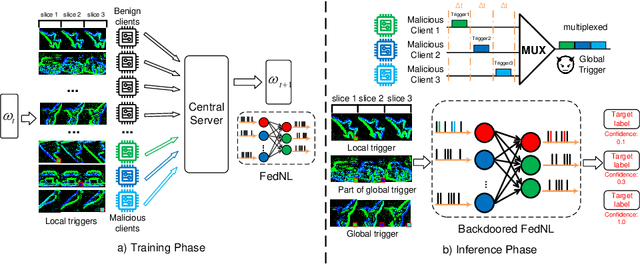
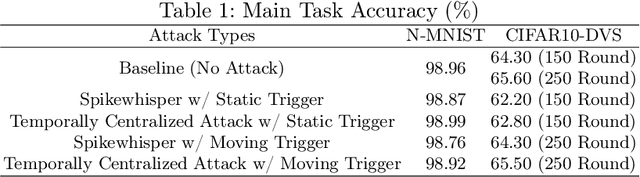
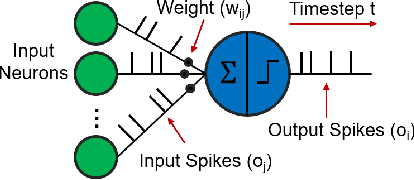
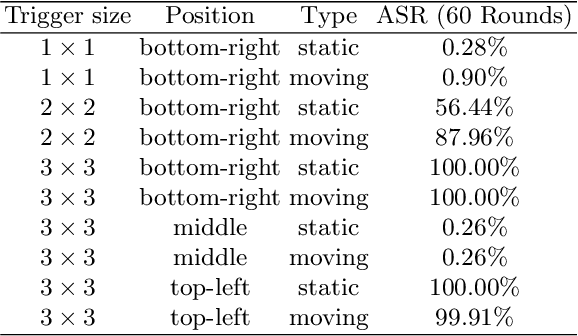
Federated neuromorphic learning (FedNL) leverages event-driven spiking neural networks and federated learning frameworks to effectively execute intelligent analysis tasks over amounts of distributed low-power devices but also perform vulnerability to poisoning attacks. The threat of backdoor attacks on traditional deep neural networks typically comes from time-invariant data. However, in FedNL, unknown threats may be hidden in time-varying spike signals. In this paper, we start to explore a novel vulnerability of FedNL-based systems with the concept of time division multiplexing, termed Spikewhisper, which allows attackers to evade detection as much as possible, as multiple malicious clients can imperceptibly poison with different triggers at different timeslices. In particular, the stealthiness of Spikewhisper is derived from the time-domain divisibility of global triggers, in which each malicious client pastes only one local trigger to a certain timeslice in the neuromorphic sample, and also the polarity and motion of each local trigger can be configured by attackers. Extensive experiments based on two different neuromorphic datasets demonstrate that the attack success rate of Spikewispher is higher than the temporally centralized attacks. Besides, it is validated that the effect of Spikewispher is sensitive to the trigger duration.
Collective Certified Robustness against Graph Injection Attacks
Mar 03, 2024We investigate certified robustness for GNNs under graph injection attacks. Existing research only provides sample-wise certificates by verifying each node independently, leading to very limited certifying performance. In this paper, we present the first collective certificate, which certifies a set of target nodes simultaneously. To achieve it, we formulate the problem as a binary integer quadratic constrained linear programming (BQCLP). We further develop a customized linearization technique that allows us to relax the BQCLP into linear programming (LP) that can be efficiently solved. Through comprehensive experiments, we demonstrate that our collective certification scheme significantly improves certification performance with minimal computational overhead. For instance, by solving the LP within 1 minute on the Citeseer dataset, we achieve a significant increase in the certified ratio from 0.0% to 81.2% when the injected node number is 5% of the graph size. Our step marks a crucial step towards making provable defense more practical.
Adversarially Robust Signed Graph Contrastive Learning from Balance Augmentation
Jan 19, 2024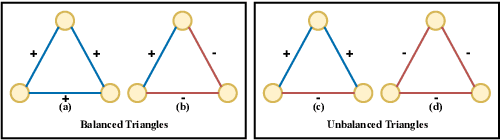
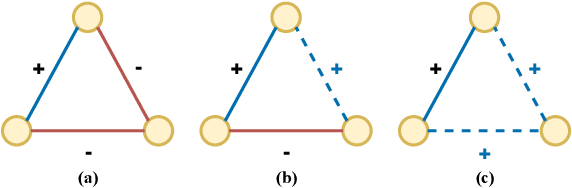
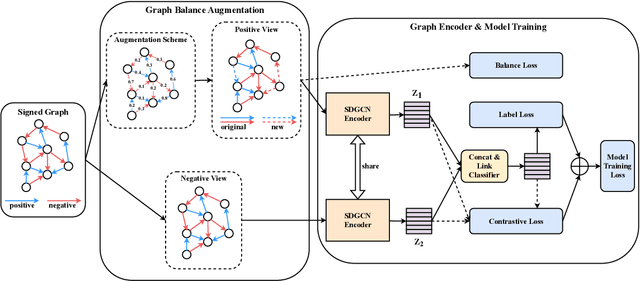
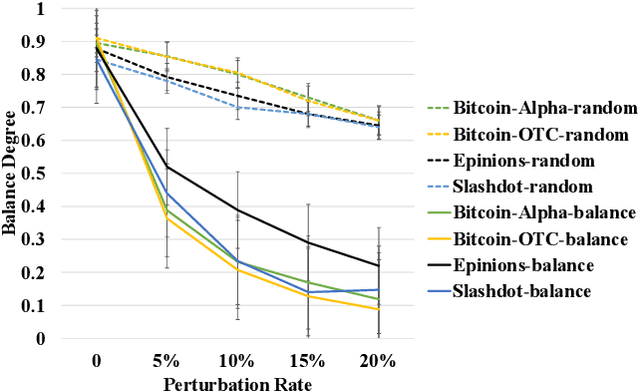
Signed graphs consist of edges and signs, which can be separated into structural information and balance-related information, respectively. Existing signed graph neural networks (SGNNs) typically rely on balance-related information to generate embeddings. Nevertheless, the emergence of recent adversarial attacks has had a detrimental impact on the balance-related information. Similar to how structure learning can restore unsigned graphs, balance learning can be applied to signed graphs by improving the balance degree of the poisoned graph. However, this approach encounters the challenge "Irreversibility of Balance-related Information" - while the balance degree improves, the restored edges may not be the ones originally affected by attacks, resulting in poor defense effectiveness. To address this challenge, we propose a robust SGNN framework called Balance Augmented-Signed Graph Contrastive Learning (BA-SGCL), which combines Graph Contrastive Learning principles with balance augmentation techniques. Experimental results demonstrate that BA-SGCL not only enhances robustness against existing adversarial attacks but also achieves superior performance on link sign prediction task across various datasets.
Universally Robust Graph Neural Networks by Preserving Neighbor Similarity
Jan 18, 2024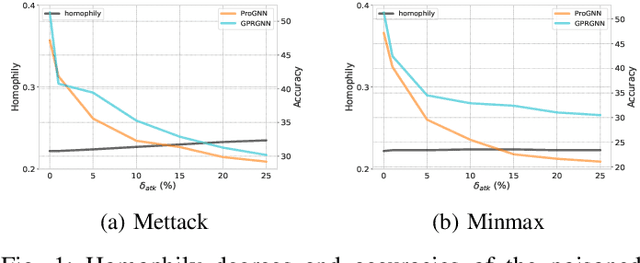
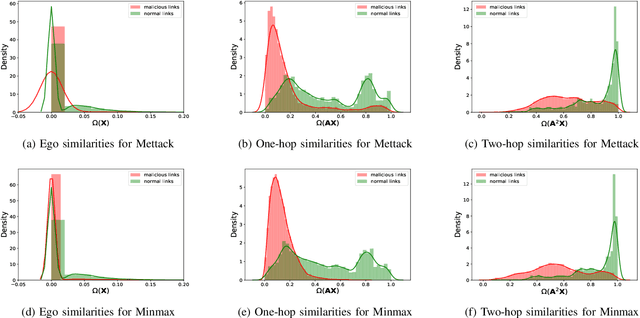
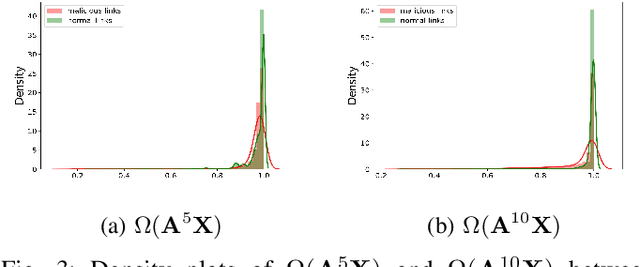
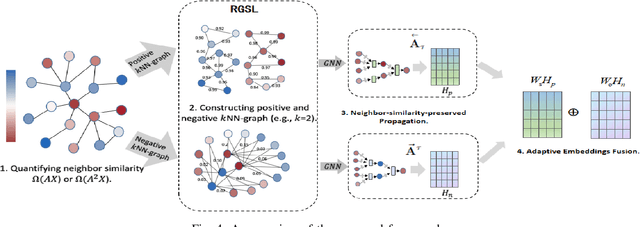
Despite the tremendous success of graph neural networks in learning relational data, it has been widely investigated that graph neural networks are vulnerable to structural attacks on homophilic graphs. Motivated by this, a surge of robust models is crafted to enhance the adversarial robustness of graph neural networks on homophilic graphs. However, the vulnerability based on heterophilic graphs remains a mystery to us. To bridge this gap, in this paper, we start to explore the vulnerability of graph neural networks on heterophilic graphs and theoretically prove that the update of the negative classification loss is negatively correlated with the pairwise similarities based on the powered aggregated neighbor features. This theoretical proof explains the empirical observations that the graph attacker tends to connect dissimilar node pairs based on the similarities of neighbor features instead of ego features both on homophilic and heterophilic graphs. In this way, we novelly introduce a novel robust model termed NSPGNN which incorporates a dual-kNN graphs pipeline to supervise the neighbor similarity-guided propagation. This propagation utilizes the low-pass filter to smooth the features of node pairs along the positive kNN graphs and the high-pass filter to discriminate the features of node pairs along the negative kNN graphs. Extensive experiments on both homophilic and heterophilic graphs validate the universal robustness of NSPGNN compared to the state-of-the-art methods.
Cost Aware Untargeted Poisoning Attack against Graph Neural Networks,
Dec 12, 2023
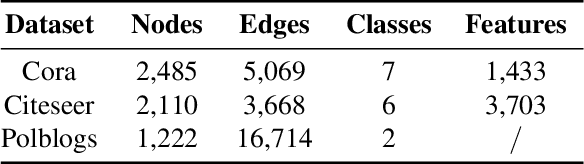


Graph Neural Networks (GNNs) have become widely used in the field of graph mining. However, these networks are vulnerable to structural perturbations. While many research efforts have focused on analyzing vulnerability through poisoning attacks, we have identified an inefficiency in current attack losses. These losses steer the attack strategy towards modifying edges targeting misclassified nodes or resilient nodes, resulting in a waste of structural adversarial perturbation. To address this issue, we propose a novel attack loss framework called the Cost Aware Poisoning Attack (CA-attack) to improve the allocation of the attack budget by dynamically considering the classification margins of nodes. Specifically, it prioritizes nodes with smaller positive margins while postponing nodes with negative margins. Our experiments demonstrate that the proposed CA-attack significantly enhances existing attack strategies
Node-aware Bi-smoothing: Certified Robustness against Graph Injection Attacks
Dec 07, 2023
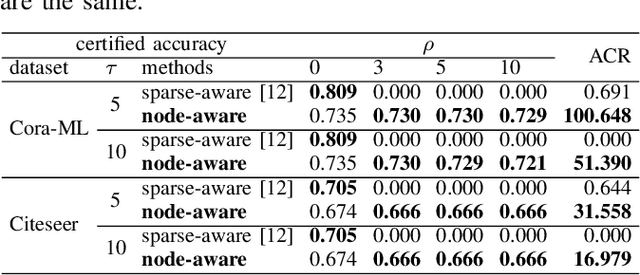
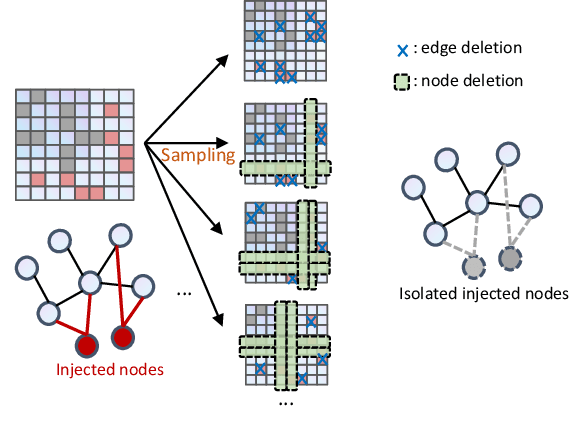
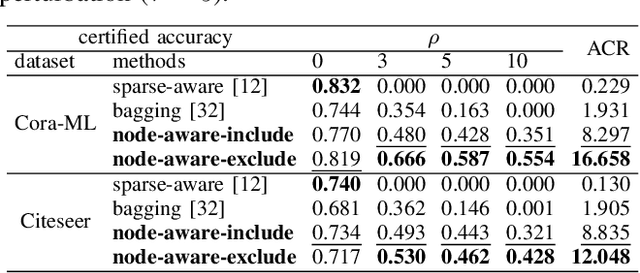
Deep Graph Learning (DGL) has emerged as a crucial technique across various domains. However, recent studies have exposed vulnerabilities in DGL models, such as susceptibility to evasion and poisoning attacks. While empirical and provable robustness techniques have been developed to defend against graph modification attacks (GMAs), the problem of certified robustness against graph injection attacks (GIAs) remains largely unexplored. To bridge this gap, we introduce the node-aware bi-smoothing framework, which is the first certifiably robust approach for general node classification tasks against GIAs. Notably, the proposed node-aware bi-smoothing scheme is model-agnostic and is applicable for both evasion and poisoning attacks. Through rigorous theoretical analysis, we establish the certifiable conditions of our smoothing scheme. We also explore the practical implications of our node-aware bi-smoothing schemes in two contexts: as an empirical defense approach against real-world GIAs and in the context of recommendation systems. Furthermore, we extend two state-of-the-art certified robustness frameworks to address node injection attacks and compare our approach against them. Extensive evaluations demonstrate the effectiveness of our proposed certificates.
Optimal Power Flow in Highly Renewable Power System Based on Attention Neural Networks
Nov 23, 2023The Optimal Power Flow (OPF) problem is pivotal for power system operations, guiding generator output and power distribution to meet demand at minimized costs, while adhering to physical and engineering constraints. The integration of renewable energy sources, like wind and solar, however, poses challenges due to their inherent variability. This variability, driven largely by changing weather conditions, demands frequent recalibrations of power settings, thus necessitating recurrent OPF resolutions. This task is daunting using traditional numerical methods, particularly for extensive power systems. In this work, we present a cutting-edge, physics-informed machine learning methodology, trained using imitation learning and historical European weather datasets. Our approach directly correlates electricity demand and weather patterns with power dispatch and generation, circumventing the iterative requirements of traditional OPF solvers. This offers a more expedient solution apt for real-time applications. Rigorous evaluations on aggregated European power systems validate our method's superiority over existing data-driven techniques in OPF solving. By presenting a quick, robust, and efficient solution, this research sets a new standard in real-time OPF resolution, paving the way for more resilient power systems in the era of renewable energy.