 Add to Chrome
 Add to Firefox
 Add to Edge
TRU: Targeted Reverse Update for Efficient Multimodal Recommendation Unlearning
Apr 02, 2026
Multimodal recommendation systems (MRS) jointly model user-item interaction graphs and rich item content, but this tight coupling makes user data difficult to remove once learned. Approximate machine unlearning offers an efficient alternative to full retraining, yet existing methods for MRS mainly rely on a largely uniform reverse update across the model. We show that this assumption is fundamentally mismatched to modern MRS: deleted-data influence is not uniformly distributed, but concentrated unevenly across \textit{ranking behavior}, \textit{modality branches}, and \textit{network layers}. This non-uniformity gives rise to three bottlenecks in MRS unlearning: target-item persistence in the collaborative graph, modality imbalance across feature branches, and layer-wise sensitivity in the parameter space. To address this mismatch, we propose \textbf{targeted reverse update} (TRU), a plug-and-play unlearning framework for MRS. Instead of applying a blind global reversal, TRU performs three coordinated interventions across the model hierarchy: a ranking fusion gate to suppress residual target-item influence in ranking, branch-wise modality scaling to preserve retained multimodal representations, and capacity-aware layer isolation to localize reverse updates to deletion-sensitive modules. Experiments across two representative backbones, three datasets, and three unlearning regimes show that TRU consistently achieves a better retain-forget trade-off than prior approximate baselines, while security audits further confirm deeper forgetting and behavior closer to a full retraining on the retained data.

When, Where, and What? A Novel Benchmark for Accident Anticipation and Localization with Large Language Models
Jul 26, 2024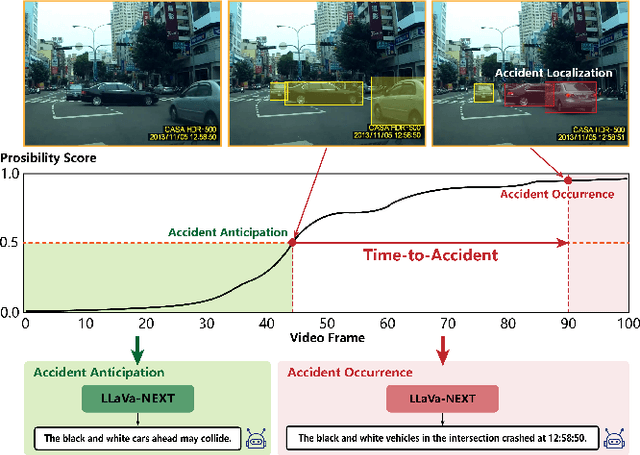
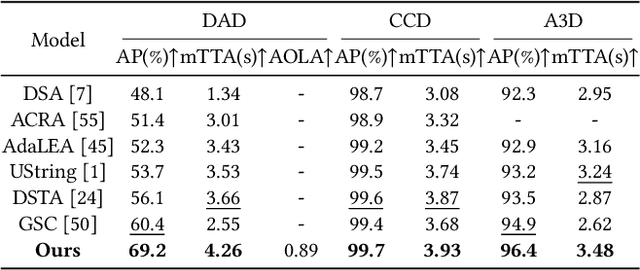
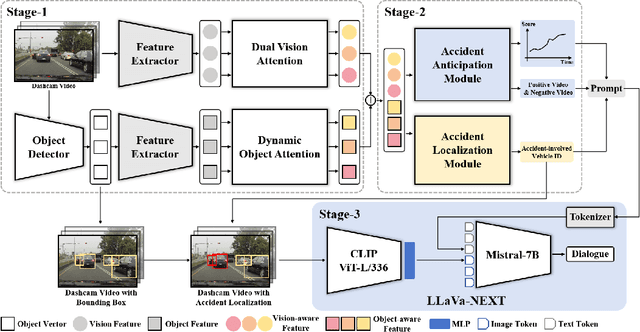
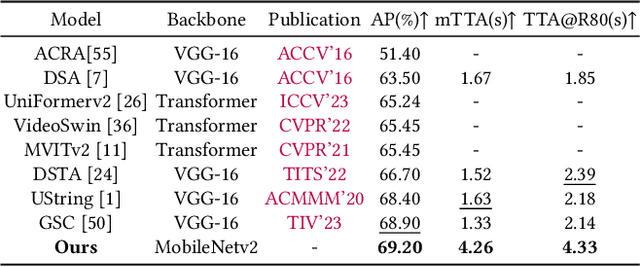
As autonomous driving systems increasingly become part of daily transportation, the ability to accurately anticipate and mitigate potential traffic accidents is paramount. Traditional accident anticipation models primarily utilizing dashcam videos are adept at predicting when an accident may occur but fall short in localizing the incident and identifying involved entities. Addressing this gap, this study introduces a novel framework that integrates Large Language Models (LLMs) to enhance predictive capabilities across multiple dimensions--what, when, and where accidents might occur. We develop an innovative chain-based attention mechanism that dynamically adjusts to prioritize high-risk elements within complex driving scenes. This mechanism is complemented by a three-stage model that processes outputs from smaller models into detailed multimodal inputs for LLMs, thus enabling a more nuanced understanding of traffic dynamics. Empirical validation on the DAD, CCD, and A3D datasets demonstrates superior performance in Average Precision (AP) and Mean Time-To-Accident (mTTA), establishing new benchmarks for accident prediction technology. Our approach not only advances the technological framework for autonomous driving safety but also enhances human-AI interaction, making predictive insights generated by autonomous systems more intuitive and actionable.
Characterized Diffusion and Spatial-Temporal Interaction Network for Trajectory Prediction in Autonomous Driving
May 03, 2024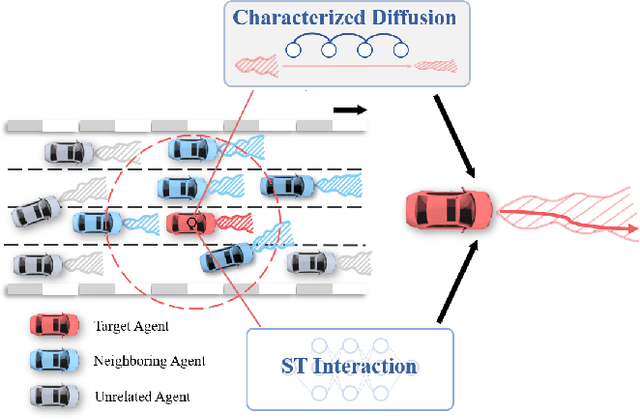
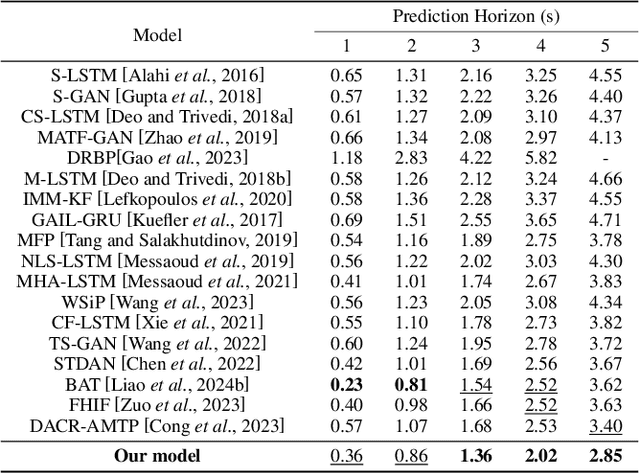
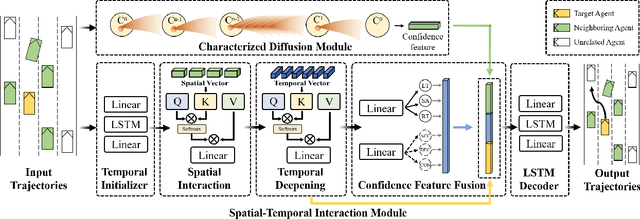
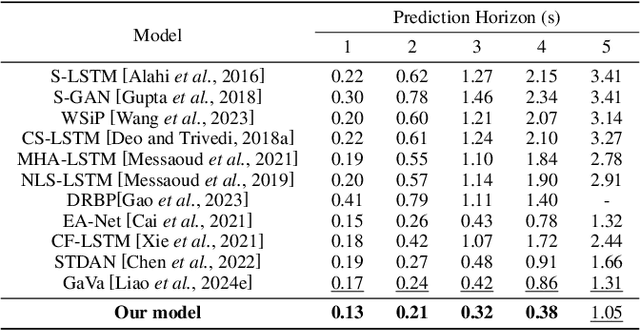
Trajectory prediction is a cornerstone in autonomous driving (AD), playing a critical role in enabling vehicles to navigate safely and efficiently in dynamic environments. To address this task, this paper presents a novel trajectory prediction model tailored for accuracy in the face of heterogeneous and uncertain traffic scenarios. At the heart of this model lies the Characterized Diffusion Module, an innovative module designed to simulate traffic scenarios with inherent uncertainty. This module enriches the predictive process by infusing it with detailed semantic information, thereby enhancing trajectory prediction accuracy. Complementing this, our Spatio-Temporal (ST) Interaction Module captures the nuanced effects of traffic scenarios on vehicle dynamics across both spatial and temporal dimensions with remarkable effectiveness. Demonstrated through exhaustive evaluations, our model sets a new standard in trajectory prediction, achieving state-of-the-art (SOTA) results on the Next Generation Simulation (NGSIM), Highway Drone (HighD), and Macao Connected Autonomous Driving (MoCAD) datasets across both short and extended temporal spans. This performance underscores the model's unparalleled adaptability and efficacy in navigating complex traffic scenarios, including highways, urban streets, and intersections.