 Add to Chrome
 Add to Firefox
 Add to Edge
CORE: Common Outcome Regularities from Action-Free Visual Demonstrations for Robot Manipulation
Jun 28, 2026
Robot imitation learning often relies on costly robot demonstrations, while abundant action-free visual demonstrations, such as human videos, are difficult to use because they lack robot-executable actions and suffer from embodiment gaps. We propose CORE, a policy learning framework that extracts Common Outcome Regularities from visual demonstrations. Rather than transferring explicit actions across embodiments, CORE exploits a key observation: although successful trajectories for the same task can be diverse, their terminal states often share stable object configurations, spatial relations, and contact constraints. CORE first trains a terminal outcome encoder with contrastive and auxiliary temporal objectives, then aggregates successful terminal embeddings into visual goal prototypes, and finally injects these prototypes as global goal conditions into robot policies. Compared with language instructions, visual goal prototypes provide more concrete geometric and physical constraints for task completion. Across Meta-World, RoboTwin 2.0, and real-world manipulation, CORE improves the average success rate of the corresponding policy backbones by up to +3.9, +11.1, and +17.0 percentage points, respectively, and outperforms text-conditioned variants under the evaluated settings.

Trustworthy Evaluation of Robotic Manipulation: A New Benchmark and AutoEval Methods
Jan 26, 2026Driven by the rapid evolution of Vision-Action and Vision-Language-Action models, imitation learning has significantly advanced robotic manipulation capabilities. However, evaluation methodologies have lagged behind, hindering the establishment of Trustworthy Evaluation for these behaviors. Current paradigms rely on binary success rates, failing to address the critical dimensions of trust: Source Authenticity (i.e., distinguishing genuine policy behaviors from human teleoperation) and Execution Quality (e.g., smoothness and safety). To bridge these gaps, we propose a solution that combines the Eval-Actions benchmark and the AutoEval architecture. First, we construct the Eval-Actions benchmark to support trustworthiness analysis. Distinct from existing datasets restricted to successful human demonstrations, Eval-Actions integrates VA and VLA policy execution trajectories alongside human teleoperation data, explicitly including failure scenarios. This dataset is structured around three core supervision signals: Expert Grading (EG), Rank-Guided preferences (RG), and Chain-of-Thought (CoT). Building on this, we propose the AutoEval architecture: AutoEval leverages Spatio-Temporal Aggregation for semantic assessment, augmented by an auxiliary Kinematic Calibration Signal to refine motion smoothness; AutoEval Plus (AutoEval-P) incorporates the Group Relative Policy Optimization (GRPO) paradigm to enhance logical reasoning capabilities. Experiments show AutoEval achieves Spearman's Rank Correlation Coefficients (SRCC) of 0.81 and 0.84 under the EG and RG protocols, respectively. Crucially, the framework possesses robust source discrimination capabilities, distinguishing between policy-generated and teleoperated videos with 99.6% accuracy, thereby establishing a rigorous standard for trustworthy robotic evaluation. Our project and code are available at https://term-bench.github.io/.
GPA-RAM: Grasp-Pretraining Augmented Robotic Attention Mamba for Spatial Task Learning
Apr 28, 2025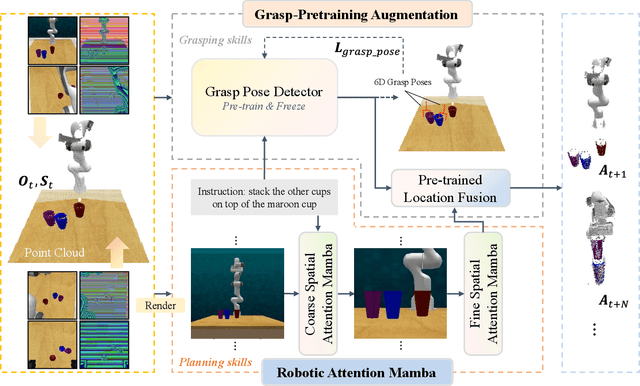
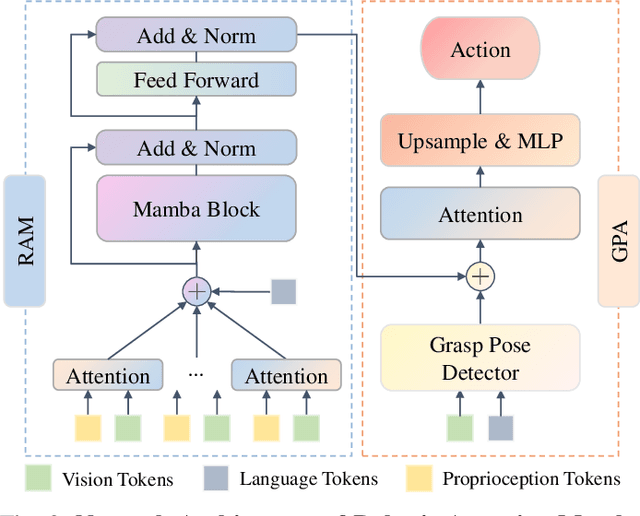
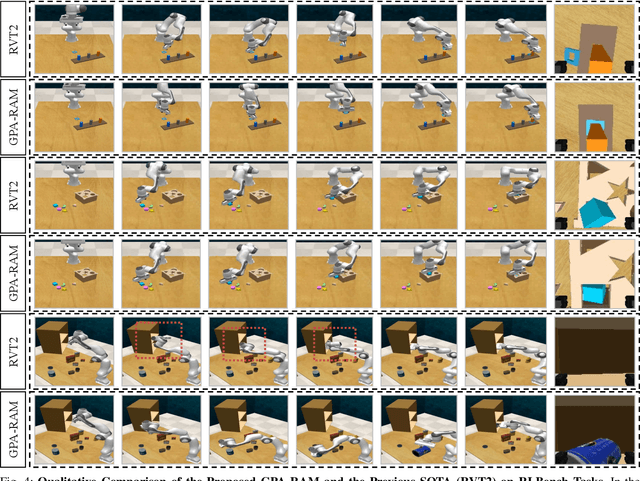
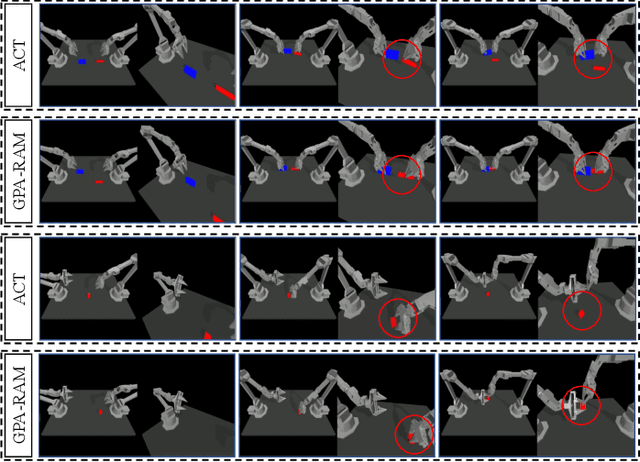
Most existing robot manipulation methods prioritize task learning by enhancing perception through complex deep network architectures. However, they face challenges in real-time collision-free planning. Hence, Robotic Attention Mamba (RAM) is designed for refined planning. Specifically, by integrating Mamba and parallel single-view attention, RAM aligns multi-view vision and task-related language features, ensuring efficient fine-grained task planning with linear complexity and robust real-time performance. Nevertheless, it has the potential for further improvement in high-precision grasping and manipulation. Thus, Grasp-Pretraining Augmentation (GPA) is devised, with a grasp pose feature extractor pretrained utilizing object grasp poses directly inherited from whole-task demonstrations. Subsequently, the extracted grasp features are fused with the spatially aligned planning features from RAM through attention-based Pre-trained Location Fusion, preserving high-resolution grasping cues overshadowed by an overemphasis on global planning. To summarize, we propose Grasp-Pretraining Augmented Robotic Attention Mamba (GPA-RAM), dividing spatial task learning into RAM for planning skill learning and GPA for grasping skill learning. GPA-RAM demonstrates superior performance across three robot systems with distinct camera configurations in simulation and the real world. Compared with previous state-of-the-art methods, it improves the absolute success rate by 8.2% (from 79.3% to 87.5%) on the RLBench multi-task benchmark and 40\% (from 16% to 56%), 12% (from 86% to 98%) on the ALOHA bimanual manipulation tasks, while delivering notably faster inference. Furthermore, experimental results demonstrate that both RAM and GPA enhance task learning, with GPA proving robust to different architectures of pretrained grasp pose feature extractors. The website is: https://logssim.github.io/GPA\_RAM\_website/.