 Add to Chrome
 Add to Firefox
 Add to Edge
Rethinking Supervision Granularity: Segment-Level Learning for LLM-Based Theorem Proving
May 12, 2026
Automated theorem proving with large language models in Lean 4 is commonly approached through either step-level tactic prediction with tree search or whole-proof generation. These two paradigms represent opposite granularities for constructing supervised training data: the former provides dense local signals but may fragment coherent proof processes, while the latter preserves global structure but requires complex end-to-end generation. In this paper, we revisit supervision granularity as a training set construction problem over proof trajectories and propose segment-level supervision, a training data construction strategy that extracts locally coherent proof segments for training policy models. We further reuse the same strategy at inference time to trigger short rollouts for existing step-level models. When trained with segment-level supervision on STP, LeanWorkbook, and NuminaMath-LEAN, the resulting policy models achieve proof success rates of 64.84%, 60.90%, and 66.31% on miniF2F, respectively, consistently outperforming both step-level and whole-proof baselines. Goal-aware rollout further improves existing step-level provers while reducing inference costs. It increases the proof success rate of BFS-Prover-V2-7B from 68.77% to 70.74% and that of InternLM2.5-StepProver from 59.59% to 60.33%, showing that appropriate supervision granularity better aligns model learning with proof structure and search. Code and models are available at https://github.com/NJUDeepEngine/SEG-ATP.

LLM-based Automated Theorem Proving Hinges on Scalable Synthetic Data Generation
May 17, 2025Recent advancements in large language models (LLMs) have sparked considerable interest in automated theorem proving and a prominent line of research integrates stepwise LLM-based provers into tree search. In this paper, we introduce a novel proof-state exploration approach for training data synthesis, designed to produce diverse tactics across a wide range of intermediate proof states, thereby facilitating effective one-shot fine-tuning of LLM as the policy model. We also propose an adaptive beam size strategy, which effectively takes advantage of our data synthesis method and achieves a trade-off between exploration and exploitation during tree search. Evaluations on the MiniF2F and ProofNet benchmarks demonstrate that our method outperforms strong baselines under the stringent Pass@1 metric, attaining an average pass rate of $60.74\%$ on MiniF2F and $21.18\%$ on ProofNet. These results underscore the impact of large-scale synthetic data in advancing automated theorem proving.
Executing Arithmetic: Fine-Tuning Large Language Models as Turing Machines
Oct 10, 2024


Large Language Models (LLMs) have demonstrated remarkable capabilities across a wide range of natural language processing and reasoning tasks. However, their performance in the foundational domain of arithmetic remains unsatisfactory. When dealing with arithmetic tasks, LLMs often memorize specific examples rather than learning the underlying computational logic, limiting their ability to generalize to new problems. In this paper, we propose a Composable Arithmetic Execution Framework (CAEF) that enables LLMs to learn to execute step-by-step computations by emulating Turing Machines, thereby gaining a genuine understanding of computational logic. Moreover, the proposed framework is highly scalable, allowing composing learned operators to significantly reduce the difficulty of learning complex operators. In our evaluation, CAEF achieves nearly 100% accuracy across seven common mathematical operations on the LLaMA 3.1-8B model, effectively supporting computations involving operands with up to 100 digits, a level where GPT-4o falls short noticeably in some settings.
MeteoRA: Multiple-tasks Embedded LoRA for Large Language Models
May 19, 2024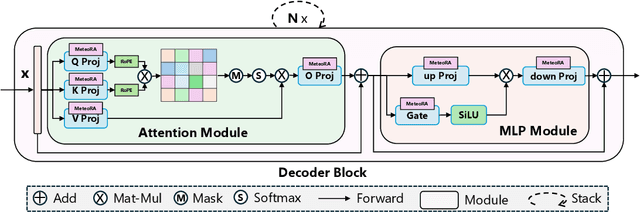
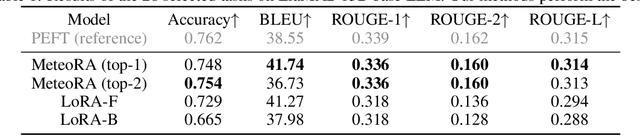
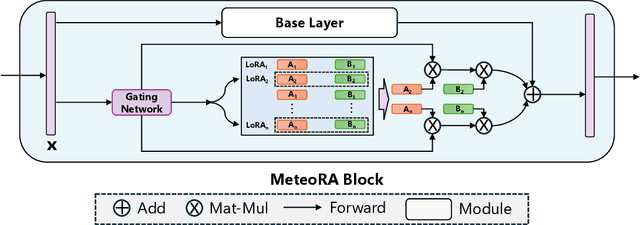
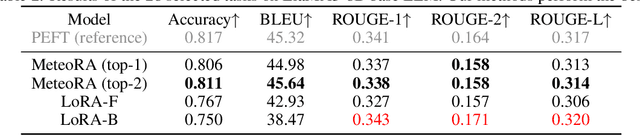
The \textit{pretrain+fine-tune} paradigm is foundational in deploying large language models (LLMs) across a diverse range of downstream applications. Among these, Low-Rank Adaptation (LoRA) stands out for its parameter-efficient fine-tuning (PEFT), producing numerous off-the-shelf task-specific LoRA adapters. However, this approach requires explicit task intention selection, posing challenges for automatic task sensing and switching during inference with multiple existing LoRA adapters embedded in a single LLM. In this work, we introduce \textbf{\method} (\textbf{M}ultiple-\textbf{T}asks embedded \textbf{LoRA}), a scalable multi-knowledge LoRA fusion framework designed for LLMs. \method\ integrates various LoRA adapters in a Mixture-of-Experts (MoE) style into the base LLM, enabling the model to automatically select the most pertinent adapter based on the task input. This advancement significantly enhances the LLM's capability to handle composite tasks that require different adapters to solve various components of the problem. Our evaluations, featuring the LlaMA2-13B and LlaMA3-8B base models equipped with off-the-shelf 28 LoRA adapters through \method, demonstrate equivalent performance with the individual adapters. Furthermore, both base models equipped with \method\ achieve superior performance in sequentially solving composite tasks with ten problems in only a single inference process, highlighting the ability of timely intention switching in \method\ embedded LLMs.
Advancing Transformer Architecture in Long-Context Large Language Models: A Comprehensive Survey
Nov 21, 2023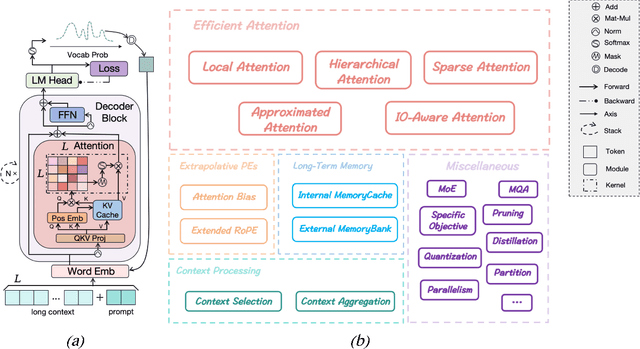
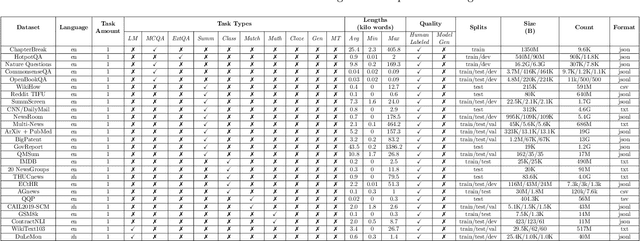
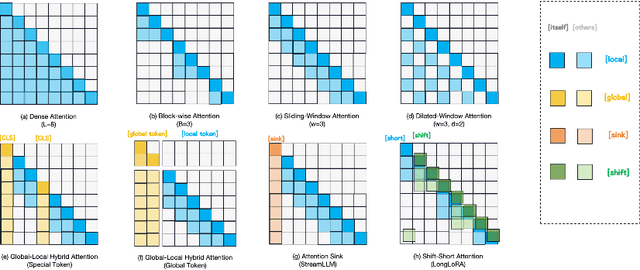
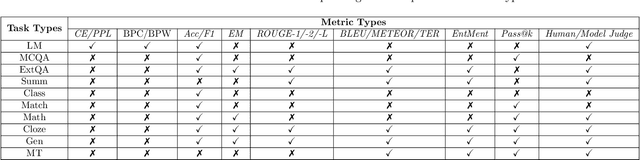
With the bomb ignited by ChatGPT, Transformer-based Large Language Models (LLMs) have paved a revolutionary path toward Artificial General Intelligence (AGI) and have been applied in diverse areas as knowledge bases, human interfaces, and dynamic agents. However, a prevailing limitation exists: many current LLMs, constrained by resources, are primarily pre-trained on shorter texts, rendering them less effective for longer-context prompts, commonly encountered in real-world settings. In this paper, we present a comprehensive survey focusing on the advancement of model architecture in Transformer-based LLMs to optimize long-context capabilities across all stages from pre-training to inference. We firstly delineate and analyze the problems of handling long-context input and output with the current Transformer-based models. Then, we mainly offer a holistic taxonomy to navigate the landscape of Transformer upgrades on architecture to solve these problems. Afterward, we provide the investigation on wildly used evaluation necessities tailored for long-context LLMs, including datasets, metrics, and baseline models, as well as some amazing optimization toolkits like libraries, systems, and compilers to augment LLMs' efficiency and efficacy across different stages. Finally, we further discuss the predominant challenges and potential avenues for future research in this domain. Additionally, we have established a repository where we curate relevant literature with real-time updates at https://github.com/Strivin0311/long-llms-learning.