 Add to Chrome
 Add to Firefox
 Add to Edge
Digital Twin-Aided Prescreening for User Scheduling in MU-MIMO Downlink Systems
Aug 11, 2026
In dense deployments, massive multi-user multiple-input multiple-output (MU-MIMO) base stations can acquire instantaneous channel state information (CSI) for only a limited subset of users per scheduling interval, restricting multiuser diversity. We therefore propose Digital Twin User pre-Screening (DiTUS), a digital-twin (DT)-aided framework that identifies promising users before instantaneous CSI acquisition. DiTUS forms spatial covariances from DT-inferred departure angles and path powers. Optional Gaussian-process (GP) calibration mitigates path-power bias, while the dominant rank-r eigenspace of the aggregate covariance yields common reference beams. It prescreens the pool using DiTUS-P, a low-complexity projection-energy rule, or DiTUS-L, a greedy log-determinant rule that promotes spatial compatibility. A two-level protocol collects scalar beam reports from shortlisted users and requests r-dimensional effective-channel vectors only from the scheduled set. The framework also supports proportional-fair scheduling. At 15 dB under DT imperfections, simulations with 128 candidates, a 64-user effective-CSI acquisition budget, and a 64-user shortlist show that DiTUS-L achieves 35.06 +/- 0.49 bps/Hz versus 30.28 +/- 0.60 bps/Hz for semi-orthogonal user selection (SUS) with full-dimensional CSI from 64 users, demonstrating that DT-based prescreening preserves substantial multiuser-diversity gains by identifying strong, spatially compatible users before acquiring effective-channel vectors.

LWM-Spectro: A Foundation Model for Wireless Baseband Signal Spectrograms
Jan 13, 2026The received in-phase and quadrature (I/Q) baseband signals inherently encode physical-layer and channel characteristics of wireless links. Learning robust and transferable representations directly from such raw signals, however, remains challenging due to heterogeneous communication systems, diverse propagation environments, and limited labeled data. To address this, we present LWM-Spectro, a transformer-based foundation model pretrained on large-scale I/Q data represented as time-frequency spectrograms. The model leverages self-supervised masked modeling, contrastive learning, and a mixture-of-experts (MoE) architecture to learn general-purpose wireless representations. These representations transfer effectively to downstream tasks such as modulation classification and joint SNR/mobility recognition, even with minimal supervision. Across tasks, LWM-Spectro consistently outperforms state-of-the-art deep learning baselines in both few-shot and data-rich regimes, providing a unified foundation for wireless learning.
Reducing Latency by Eliminating CSIT Feedback: FDD Downlink MIMO Precoding Without CSIT Feedback for Internet-of-Things Communications
Jan 13, 2025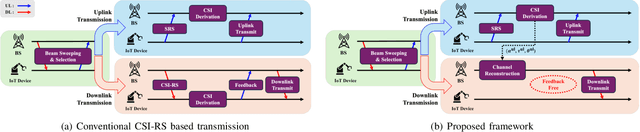
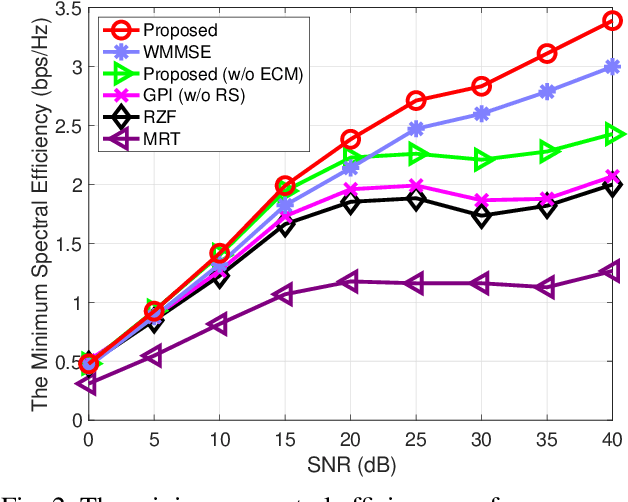
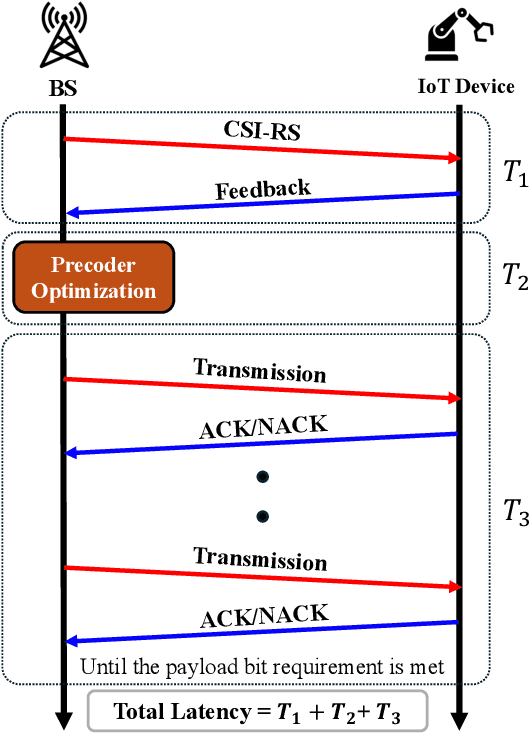
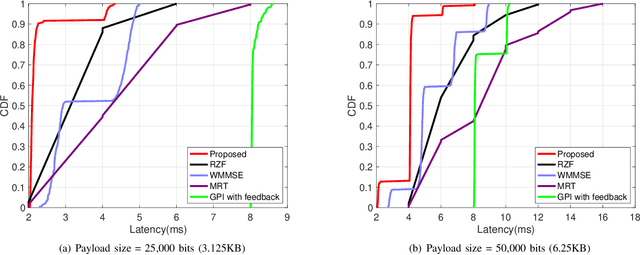
This paper presents a novel framework for low-latency frequency division duplex (FDD) multi-input multi-output (MIMO) transmission with Internet of Things (IoT) communications. Our key idea is eliminating feedback associated with downlink channel state information at the transmitter (CSIT) acquisition. Instead, we propose to reconstruct downlink CSIT from uplink reference signals by exploiting the frequency invariance property on channel parameters. Nonetheless, the frequency disparity between the uplink and downlink makes it impossible to get perfect downlink CSIT, resulting in substantial interference. To address this, we formulate a max-min fairness problem and propose a rate-splitting multiple access (RSMA)-aided efficient precoding method. In particular, to fully harness the potential benefits of RSMA, we propose a method that approximates the error covariance matrix and incorporates it into the precoder optimization process. This approach effectively accounts for the impact of imperfect CSIT, enabling the design of a robust precoder that efficiently handles CSIT inaccuracies. Simulation results demonstrate that our framework outperforms other baseline methods in terms of the minimum spectral efficiency when no direct CSI feedback is used. Moreover, we show that our framework significantly reduces communication latency compared to conventional CSI feedback-based methods, underscoring its effectiveness in enhancing latency performance for IoT communications.
Splitting Messages in the Dark- Rate-Splitting Multiple Access for FDD Massive MIMO Without CSI Feedback
May 02, 2024A critical hindrance to realize frequency division duplex (FDD) massive multi-input multi-output (MIMO) systems is overhead associated with downlink channel state information at the transmitter (CSIT) acquisition. To address this challenge, we propose a novel framework that achieves robust performances while completely eliminating downlink CSIT training and feedback. Specifically, by exploiting partial frequency invariance of channel parameters between the uplink (UL) and downlink (DL), we adopt the 2D-Newtonized orthogonal matching pursuit (2D-NOMP) algorithm to reconstruct DL CSIT from UL training. Due to inherent discrepancies arising from a carrier frequency difference between two disjoint bands, however, the multi-user interference is inevitable. To overcome this, we propose a precoding method that employs rate-splitting multiple access (RSMA) and also develop an error covariance matrix (ECM) estimation method by using the observed Fisher information matrix (O-FIM). We find that this ECM estimation is crucial for our precoding design in maximizing the sum spectral efficiency (SE). Simulation results show that our method significantly improves the sum SE compared to other state-of-the-art approaches, underscoring the importance of our ECM estimation.