 Add to Chrome
 Add to Firefox
 Add to Edge
Universal Thermodynamic Interatomic Potentials for Crystalline Materials
Aug 14, 2026
Free energies govern solid-state phase stability, yet computational materials discovery still relies largely on ground-state energies because free energy calculations require ensemble averages. We introduce the thermodynamic interatomic potential (TIP), which extends an interatomic potential from its static energy to a thermodynamically consistent Gibbs free energy model, with thermodynamic responses following from temperature and pressure by automatic differentiation. We implement TIP[UMA] using the universal potential UMA, train it on free energies from quasi-harmonic to molecular dynamics fidelity, and calibrate it to higher-resolution calculations or experiment. From a single evaluation, it returns the equation of state of a crystal and locates phase transitions among competing branches, including dynamically stabilized phases. Fine-tuning extends the model to alloy solubility limits and miscibility gaps. TIP makes the free energy as accessible as the potential energy, opening finite-temperature phase stability to high-throughput discovery.

Few-step Cofolding with All-Atom Flow Maps
Jun 07, 2026All-atom generative modeling of 3D biomolecular complexes has emerged as the dominant paradigm for predicting the structure of proteins and protein-ligand systems. Generating structures at the atomic level of fidelity, however, typically requires expensive iterative diffusion rollouts, making both conventional deployment and inference-time search techniques computationally costly. In this paper, we introduce the Denoiser Cofolding All-Atom Flowmap (DeCAF) framework for distilling state-of-the-art all-atom cofolding models into all-atom flow maps that produce high-quality samples in only a few inference steps. We build DeCAF on a denoiser-based formulation of flow maps with endpoint losses that naturally support SE(3) rigid alignment, which we show is critical for training accurate models. We further derive a simple change of variables that lets DeCAF operate in the σ-space noise schedule of EDM-style architectures, enabling direct distillation from pretrained cofolding diffusion models. Equipped with DeCAF's flowmap lookahead, we introduce a purpose-built inference-time framework that improves sampling through reward-guided search. Empirically, DeCAF-Boltz statistically improves over Boltz-1x in both accuracy (RMSD) and physical validity scores of protein-ligand poses at strict NFE budgets on the challenging Runs N' Poses, while also showing a more optimal Pareto frontier across all inference compute budgets on PoseBusters. Distilling the state-of-the-art Pearl cofolding model, DeCAF-Pearl outperforms diffusion-based cofolding models and matches its teacher on success rate while using 5x fewer NFEs. We release our code at https://github.com/genesistherapeutics/decaf.
MetaDNS: Enhancing Exploration in Discrete Neural Samplers via Well-Tempered Metadynamics
May 20, 2026Sampling from discrete distributions with multiple modes and energy barriers is fundamental to machine learning and computational physics. Recent discrete neural samplers like MDNS suffer from mode collapse and fail to sample high-energy barrier regions between modes, which is critical for free energy estimation and understanding phase transitions. We propose Metadynamics Discrete Neural Sampler (MetaDNS), a general framework integrating well-tempered metadynamics into discrete diffusion or autoregressive samplers. By maintaining an adaptive, history-dependent bias potential along selected low-dimensional coordinates, MetaDNS forces exploration of previously inaccessible regions, enabling free energy reconstruction infeasible with standard neural samplers due to a lack of high-energy samples. On challenging low-temperature benchmarks including Ising, Potts, and the copper-gold binary alloy, MetaDNS reproduces the thermodynamic distribution. Compared to MCMC-based metadynamics, MetaDNS also achieves comparable exploration requiring fewer bias deposition steps.
From Knowledge to Action: Outcomes of the 2025 Large Language Model (LLM) Hackathon for Applications in Materials Science and Chemistry
May 04, 2026Large language models (LLMs) are rapidly changing how researchers in materials science and chemistry discover, organize, and act on scientific knowledge. This paper analyzes a broad set of community-developed LLM applications in an effort to identify emerging patterns in how these systems can be used across the scientific research lifecycle. We organize the projects into two complementary categories: Knowledge Infrastructure, systems that structure, retrieve, synthesize, and validate scientific information; and Action Systems, systems that execute, coordinate, or automate scientific work across computational and experimental environments. The submissions reveal a shift from single-purpose LLM tools toward integrated, multi-agent workflows that combine retrieval, reasoning, tool use, and domain-specific validation. Prominent themes include retrieval-augmented generation as grounding infrastructure, persistent structured knowledge representations, multimodal and multilingual scientific inputs, and early progress toward laboratory-integrated closed-loop systems. Together, these results suggest that LLMs are evolving from general-purpose assistants into composable infrastructure for scientific reasoning and action. This work provides a community snapshot of that transition and a practical taxonomy for understanding emerging LLM-enabled workflows in materials science and chemistry.
Scaling Autoregressive Models for Lattice Thermodynamics
Mar 16, 2026Predicting how materials behave under realistic conditions requires understanding the statistical distribution of atomic configurations on crystal lattices, a problem central to alloy design, catalysis, and the study of phase transitions. Traditional Markov-chain Monte Carlo sampling suffers from slow convergence and critical slowing down near phase transitions, motivating the use of generative models that directly learn the thermodynamic distribution. Existing autoregressive models (ARMs), however, generate configurations in a fixed sequential order and incur high memory and training costs, limiting their applicability to realistic systems. Here, we develop a framework combining any-order ARMs, which generate configurations flexibly by conditioning on any known subset of lattice sites, with marginalization models (MAMs), which approximate the probability of any partial configuration in a single forward pass and substantially reduce memory requirements. This combination enables models trained on smaller lattices to be reused for sampling larger systems, while supporting expressive Transformer architectures with lattice-aware positional encodings at manageable computational cost. We demonstrate that Transformer-based any-order MAMs achieve more accurate free energies than multilayer perceptron-based ARMs on both the two-dimensional Ising model and CuAu alloys, faithfully capturing phase transitions and critical behavior. Overall, our framework scales from $10 \times 10$ to $20 \times 20$ Ising systems and from $2 \times 2 \times 4$ to $4 \times 4 \times 8$ CuAu supercells at reduced computational cost compared to conventional sampling methods.
Discrete Adjoint Schrödinger Bridge Sampler
Feb 09, 2026Learning discrete neural samplers is challenging due to the lack of gradients and combinatorial complexity. While stochastic optimal control (SOC) and Schrödinger bridge (SB) provide principled solutions, efficient SOC solvers like adjoint matching (AM), which excel in continuous domains, remain unexplored for discrete spaces. We bridge this gap by revealing that the core mechanism of AM is $\mathit{state}\text{-}\mathit{space~agnostic}$, and introduce $\mathbf{discrete~ASBS}$, a unified framework that extends AM and adjoint Schrödinger bridge sampler (ASBS) to discrete spaces. Theoretically, we analyze the optimality conditions of the discrete SB problem and its connection to SOC, identifying a necessary cyclic group structure on the state space to enable this extension. Empirically, discrete ASBS achieves competitive sample quality with significant advantages in training efficiency and scalability.
Generalized Schrödinger Bridge on Graphs
Feb 04, 2026Transportation on graphs is a fundamental challenge across many domains, where decisions must respect topological and operational constraints. Despite the need for actionable policies, existing graph-transport methods lack this expressivity. They rely on restrictive assumptions, fail to generalize across sparse topologies, and scale poorly with graph size and time horizon. To address these issues, we introduce Generalized Schrödinger Bridge on Graphs (GSBoG), a novel scalable data-driven framework for learning executable controlled continuous-time Markov chain (CTMC) policies on arbitrary graphs under state cost augmented dynamics. Notably, GSBoG learns trajectory-level policies, avoiding dense global solvers and thereby enhancing scalability. This is achieved via a likelihood optimization approach, satisfying the endpoint marginals, while simultaneously optimizing intermediate behavior under state-dependent running costs. Extensive experimentation on challenging real-world graph topologies shows that GSBoG reliably learns accurate, topology-respecting policies while optimizing application-specific intermediate state costs, highlighting its broad applicability and paving new avenues for cost-aware dynamical transport on general graphs.
FragmentFlow: Scalable Transition State Generation for Large Molecules
Feb 02, 2026Transition states (TSs) are central to understanding and quantitatively predicting chemical reactivity and reaction mechanisms. Although traditional TS generation methods are computationally expensive, recent generative modeling approaches have enabled chemically meaningful TS prediction for relatively small molecules. However, these methods fail to generalize to practically relevant reaction substrates because of distribution shifts induced by increasing molecular sizes. Furthermore, TS geometries for larger molecules are not available at scale, making it infeasible to train generative models from scratch on such molecules. To address these challenges, we introduce FragmentFlow: a divide-and-conquer approach that trains a generative model to predict TS geometries for the reactive core atoms, which define the reaction mechanism. The full TS structure is then reconstructed by re-attaching substituent fragments to the predicted core. By operating on reactive cores, whose size and composition remain relatively invariant across molecular contexts, FragmentFlow mitigates distribution shifts in generative modeling. Evaluated on a new curated dataset of reactions involving reactants with up to 33 heavy atoms, FragmentFlow correctly identifies 90% of TSs while requiring 30% fewer saddle-point optimization steps than classical initialization schemes. These results point toward scalable TS generation for high-throughput reactivity studies.
Transferable Learning of Reaction Pathways from Geometric Priors
Apr 21, 2025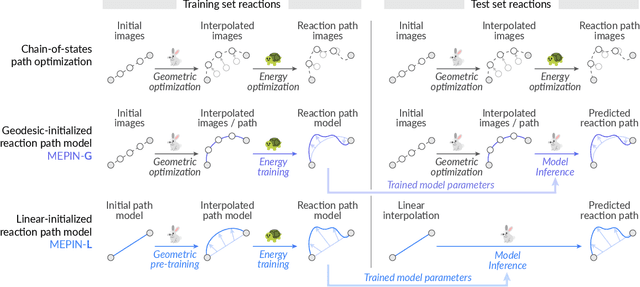
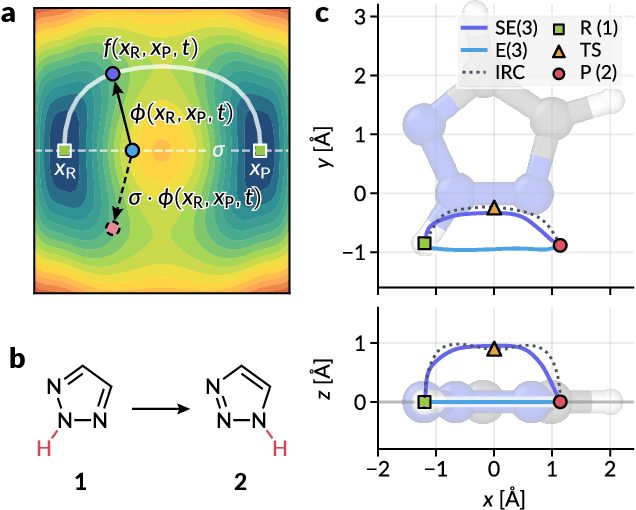
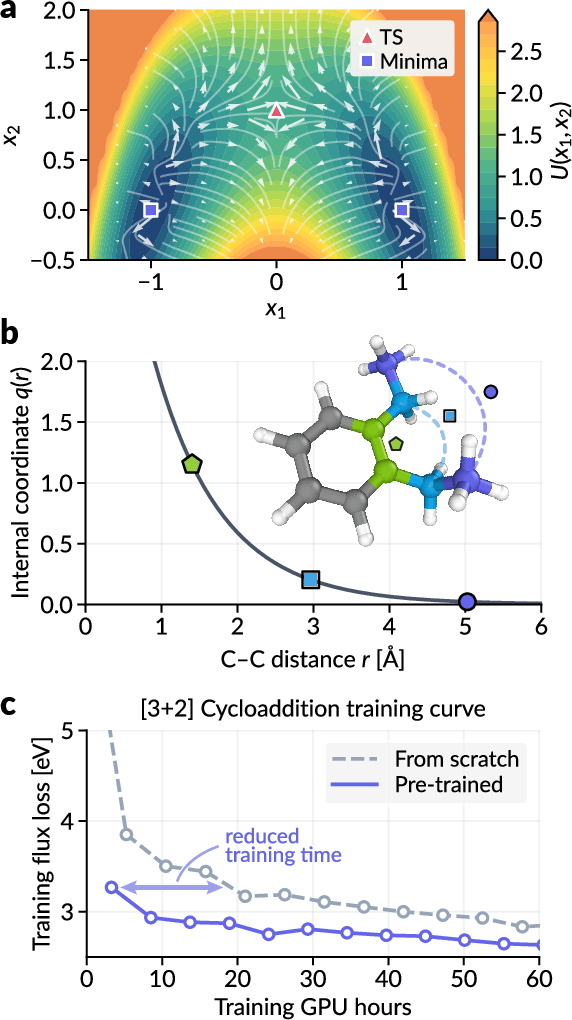
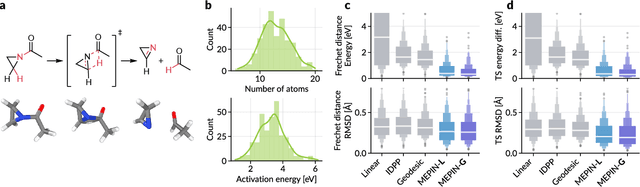
Identifying minimum-energy paths (MEPs) is crucial for understanding chemical reaction mechanisms but remains computationally demanding. We introduce MEPIN, a scalable machine-learning method for efficiently predicting MEPs from reactant and product configurations, without relying on transition-state geometries or pre-optimized reaction paths during training. The task is defined as predicting deviations from geometric interpolations along reaction coordinates. We address this task with a continuous reaction path model based on a symmetry-broken equivariant neural network that generates a flexible number of intermediate structures. The model is trained using an energy-based objective, with efficiency enhanced by incorporating geometric priors from geodesic interpolation as initial interpolations or pre-training objectives. Our approach generalizes across diverse chemical reactions and achieves accurate alignment with reference intrinsic reaction coordinates, as demonstrated on various small molecule reactions and [3+2] cycloadditions. Our method enables the exploration of large chemical reaction spaces with efficient, data-driven predictions of reaction pathways.
Symmetry-Constrained Generation of Diverse Low-Bandgap Molecules with Monte Carlo Tree Search
Oct 11, 2024


Organic optoelectronic materials are a promising avenue for next-generation electronic devices due to their solution processability, mechanical flexibility, and tunable electronic properties. In particular, near-infrared (NIR) sensitive molecules have unique applications in night-vision equipment and biomedical imaging. Molecular engineering has played a crucial role in developing non-fullerene acceptors (NFAs) such as the Y-series molecules, which have significantly improved the power conversion efficiency (PCE) of solar cells and enhanced spectral coverage in the NIR region. However, systematically designing molecules with targeted optoelectronic properties while ensuring synthetic accessibility remains a challenge. To address this, we leverage structural priors from domain-focused, patent-mined datasets of organic electronic molecules using a symmetry-aware fragment decomposition algorithm and a fragment-constrained Monte Carlo Tree Search (MCTS) generator. Our approach generates candidates that retain symmetry constraints from the patent dataset, while also exhibiting red-shifted absorption, as validated by TD-DFT calculations.