 Add to Chrome
 Add to Firefox
 Add to Edge
From Knowledge to Action: Outcomes of the 2025 Large Language Model (LLM) Hackathon for Applications in Materials Science and Chemistry
May 04, 2026
Large language models (LLMs) are rapidly changing how researchers in materials science and chemistry discover, organize, and act on scientific knowledge. This paper analyzes a broad set of community-developed LLM applications in an effort to identify emerging patterns in how these systems can be used across the scientific research lifecycle. We organize the projects into two complementary categories: Knowledge Infrastructure, systems that structure, retrieve, synthesize, and validate scientific information; and Action Systems, systems that execute, coordinate, or automate scientific work across computational and experimental environments. The submissions reveal a shift from single-purpose LLM tools toward integrated, multi-agent workflows that combine retrieval, reasoning, tool use, and domain-specific validation. Prominent themes include retrieval-augmented generation as grounding infrastructure, persistent structured knowledge representations, multimodal and multilingual scientific inputs, and early progress toward laboratory-integrated closed-loop systems. Together, these results suggest that LLMs are evolving from general-purpose assistants into composable infrastructure for scientific reasoning and action. This work provides a community snapshot of that transition and a practical taxonomy for understanding emerging LLM-enabled workflows in materials science and chemistry.

QuickBind: A Light-Weight And Interpretable Molecular Docking Model
Oct 21, 2024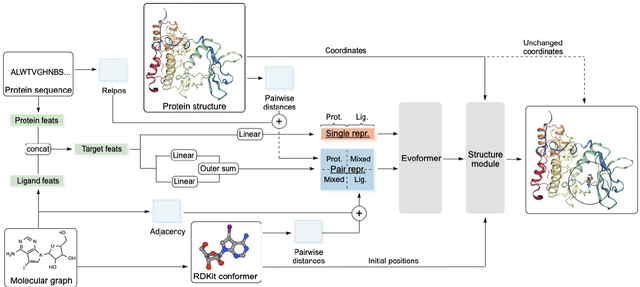
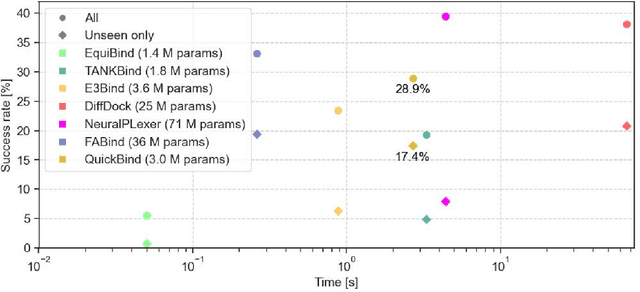
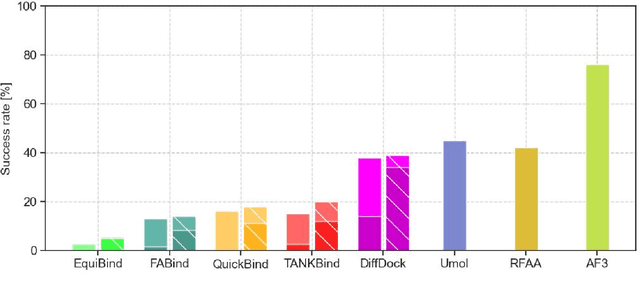
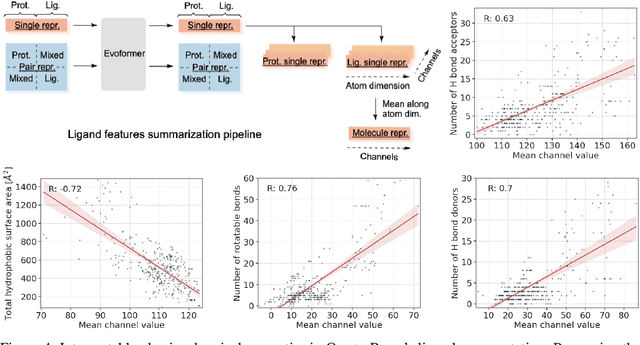
Predicting a ligand's bound pose to a target protein is a key component of early-stage computational drug discovery. Recent developments in machine learning methods have focused on improving pose quality at the cost of model runtime. For high-throughput virtual screening applications, this exposes a capability gap that can be filled by moderately accurate but fast pose prediction. To this end, we developed QuickBind, a light-weight pose prediction algorithm. We assess QuickBind on widely used benchmarks and find that it provides an attractive trade-off between model accuracy and runtime. To facilitate virtual screening applications, we augment QuickBind with a binding affinity module and demonstrate its capabilities for multiple clinically-relevant drug targets. Finally, we investigate the mechanistic basis by which QuickBind makes predictions and find that it has learned key physicochemical properties of molecular docking, providing new insights into how machine learning models generate protein-ligand poses. By virtue of its simplicity, QuickBind can serve as both an effective virtual screening tool and a minimal test bed for exploring new model architectures and innovations. Model code and weights are available at https://github.com/aqlaboratory/QuickBind .