 Add to Chrome
 Add to Firefox
 Add to Edge
DeCoRAG: Cognitive Decoupling and Semantic-Aware Cropping for Complex Document Understanding
Jul 27, 2026
Advancing multimodal retrieval-augmented generation (RAG) for complex document understanding presents a formidable dual dilemma of accuracy and efficiency, particularly in graph RAG. Processing structurally sparse yet visually dense layouts, such as extracting a tiny data marker from a financial chart, often incurs computationally prohibitive token overhead while still triggering catastrophic hallucination. However, multimodal Graph RAG pipelines rely on graph-construction stages that assume Vision-Language Models (VLMs) can resolve sparse semantics within high-density layouts. We challenge this assumption, revealing that forcing VLMs to localize visual evidence, interpret semantics, and extract relations triggers a "Visual Attention Sink," a mechanism driving catastrophic semantic loss, while full-page processing incurs massive computational overhead. Controlled interventions verify that this failure is boundary-driven rather than content-specific and that semantic anchoring mitigates it. To fundamentally correct this flawed paradigm, we introduce DeCoRAG, a multimodal Graph RAG pipeline that shifts knowledge processing from coupled visual-semantic reasoning to "Cognitive Decoupling." Rather than passively processing raw pixels, its graph-construction stage establishes a macroscopic Semantic Anchor to neutralize the attention sink. This anchor subsequently drives our Region-Aware Pruning and Cropping (RAP-Crop) mechanism, shifting the reasoning space from dense, noisy backgrounds to purified, intent-driven semantic clusters. The resulting graph supports hybrid retrieval and answer generation. Across complex document benchmarks, DeCoRAG improves the semantic pass rate by up to 12.5 percentage points over the strongest baseline and generalizes to DocVQA. RAP-Crop reduces offline graph-construction prompt tokens by 40.8% without sacrificing end-to-end accuracy.

KAP: Bridging the Knowledge Selection-Runtime Consumption Gap in LLM Systems
Jul 27, 2026Modern LLM systems increasingly rely on knowledge-selection processes that produce high-value structured priors, such as ranked evidence, graph topology, multimodal alignment, and confidence signals. Yet LLM serving remains fundamentally oblivious to this rich structure: once such signals are serialized into a prompt, the backend observes only a flat token sequence, forcing dense and uniform consumption of the full key-value (KV) state during decoding. We term this architectural mismatch the Knowledge Selection-Runtime Consumption (KSRC) gap: richer contexts enlarge the full-prompt KV footprint and decode-time memory traffic, increasing latency and degrading throughput even when reasoning depends on only a small fraction of the context. To bridge the gap, we propose Knowledge Access Planning (KAP), a paradigm-shifting execution abstraction that elevates structured knowledge priors from passive prompt-construction hints into first-class physical execution artifacts. KAP establishes a universal intermediate representation (IR)-the runtime access plan-which compiles structured knowledge signals to govern physical KV access without altering logical prompt semantics, model weights, or training procedures. Through this IR, KAP shifts LLM serving from token-aware context consumption to plan-driven, knowledge-aware runtime consumption. We instantiate KAP with GraphSpec, a compiler-executor realization connecting structured knowledge selection to an LLM serving backend. We derive a phase-boundary model for the positive-speedup regime of plan-guided execution. Across 4K-128K long-context QA workloads, GraphSpec maintains answer quality comparable to full-context decoding while decoupling physical KV consumption from prompt length, reducing proposal-time KV access to 5.5% of source KV state at 128K, and fundamentally shifting the scaling trajectory of long-context generation.
Adaptive Mix for Semi-Supervised Medical Image Segmentation
Jul 31, 2024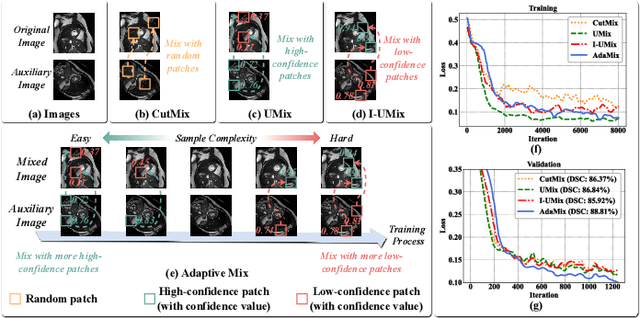

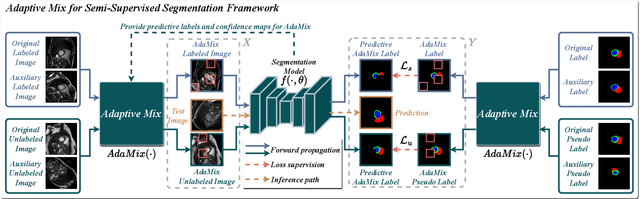

Mix-up is a key technique for consistency regularization-based semi-supervised learning methods, generating strong-perturbed samples for strong-weak pseudo-supervision. Existing mix-up operations are performed either randomly or with predefined rules, such as replacing low-confidence patches with high-confidence ones. The former lacks control over the perturbation degree, leading to overfitting on randomly perturbed samples, while the latter tends to generate images with trivial perturbations, both of which limit the effectiveness of consistency learning. This paper aims to answer the following question: How can image mix-up perturbation be adaptively performed during training? To this end, we propose an Adaptive Mix algorithm (AdaMix) for image mix-up in a self-paced learning manner. Given that, in general, a model's performance gradually improves during training, AdaMix is equipped with a self-paced curriculum that, in the initial training stage, provides relatively simple perturbed samples and then gradually increases the difficulty of perturbed images by adaptively controlling the perturbation degree based on the model's learning state estimated by a self-paced regularize. We develop three frameworks with our AdaMix, i.e., AdaMix-ST, AdaMix-MT, and AdaMix-CT, for semi-supervised medical image segmentation. Extensive experiments on three public datasets, including both 2D and 3D modalities, show that the proposed frameworks are capable of achieving superior performance. For example, compared with the state-of-the-art, AdaMix-CT achieves relative improvements of 2.62% in Dice and 48.25% in average surface distance on the ACDC dataset with 10% labeled data. The results demonstrate that mix-up operations with dynamically adjusted perturbation strength based on the segmentation model's state can significantly enhance the effectiveness of consistency regularization.
Self-Paced Sample Selection for Barely-Supervised Medical Image Segmentation
Jul 07, 2024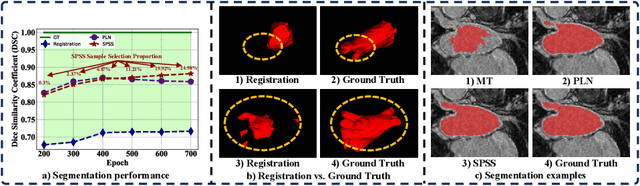
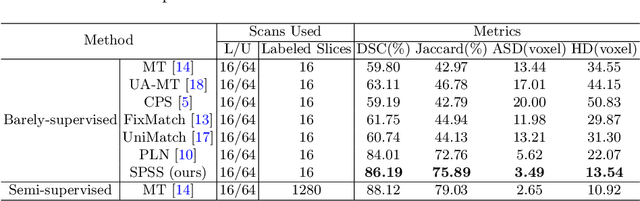
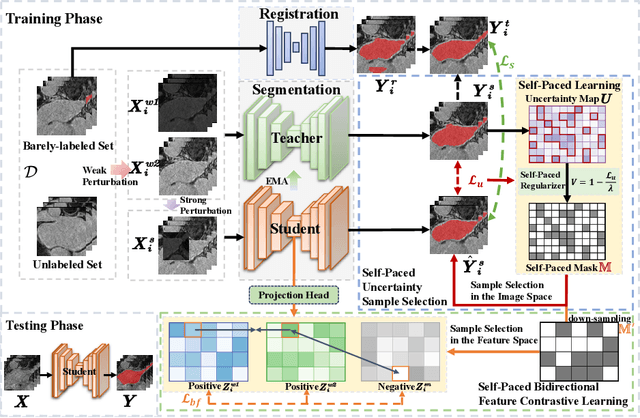
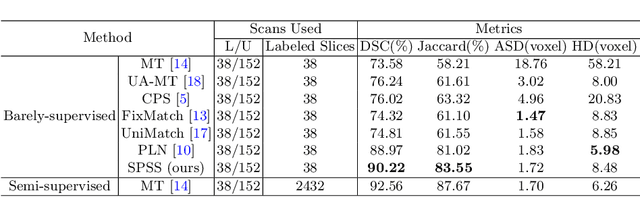
The existing barely-supervised medical image segmentation (BSS) methods, adopting a registration-segmentation paradigm, aim to learn from data with very few annotations to mitigate the extreme label scarcity problem. However, this paradigm poses a challenge: pseudo-labels generated by image registration come with significant noise. To address this issue, we propose a self-paced sample selection framework (SPSS) for BSS. Specifically, SPSS comprises two main components: 1) self-paced uncertainty sample selection (SU) for explicitly improving the quality of pseudo labels in the image space, and 2) self-paced bidirectional feature contrastive learning (SC) for implicitly improving the quality of pseudo labels through enhancing the separability between class semantics in the feature space. Both SU and SC are trained collaboratively in a self-paced learning manner, ensuring that SPSS can learn from high-quality pseudo labels for BSS. Extensive experiments on two public medical image segmentation datasets demonstrate the effectiveness and superiority of SPSS over the state-of-the-art. Our code is release at https://github.com/SuuuJM/SPSS.
Rethinking Barely-Supervised Segmentation from an Unsupervised Domain Adaptation Perspective
May 16, 2024This paper investigates an extremely challenging problem, barely-supervised medical image segmentation (BSS), where the training dataset comprises limited labeled data with only single-slice annotations and numerous unlabeled images. Currently, state-of-the-art (SOTA) BSS methods utilize a registration-based paradigm, depending on image registration to propagate single-slice annotations into volumetric pseudo labels for constructing a complete labeled set. However, this paradigm has a critical limitation: the pseudo labels generated by image registration are unreliable and noisy. Motivated by this, we propose a new perspective: training a model using only single-annotated slices as the labeled set without relying on image registration. To this end, we formulate BSS as an unsupervised domain adaptation (UDA) problem. Specifically, we first design a novel noise-free labeled data construction algorithm (NFC) for slice-to-volume labeled data synthesis, which may result in a side effect: domain shifts between the synthesized images and the original images. Then, a frequency and spatial mix-up strategy (FSX) is further introduced to mitigate the domain shifts for UDA. Extensive experiments demonstrate that our method provides a promising alternative for BSS. Remarkably, the proposed method with only one labeled slice achieves an 80.77% dice score on left atrial segmentation, outperforming the SOTA by 61.28%. The code will be released upon the publication of this paper.