 Add to Chrome
 Add to Firefox
 Add to Edge
UrbanAlign: Post-hoc Semantic Calibration for VLM-Human Preference Alignment
Feb 23, 2026
Aligning vision-language model (VLM) outputs with human preferences in domain-specific tasks typically requires fine-tuning or reinforcement learning, both of which demand labelled data and GPU compute. We show that for subjective perception tasks, this alignment can be achieved without any model training: VLMs are already strong concept extractors but poor decision calibrators, and the gap can be closed externally. We propose a training-free post-hoc concept-bottleneck pipeline consisting of three tightly coupled stages: concept mining, multi-agent structured scoring, and geometric calibration, unified by an end-to-end dimension optimization loop. Interpretable evaluation dimensions are mined from a handful of human annotations; an Observer-Debater-Judge chain extracts robust continuous concept scores from a frozen VLM; and locally-weighted ridge regression on a hybrid visual-semantic manifold calibrates these scores against human ratings. Applied to urban perception as UrbanAlign, the framework achieves 72.2% accuracy ($κ=0.45$) on Place Pulse 2.0 across six categories, outperforming the best supervised baseline by +15.1 pp and uncalibrated VLM scoring by +16.3 pp, with full dimension-level interpretability and zero model-weight modification.

DAPE: Dual-Stage Parameter-Efficient Fine-Tuning for Consistent Video Editing with Diffusion Models
May 11, 2025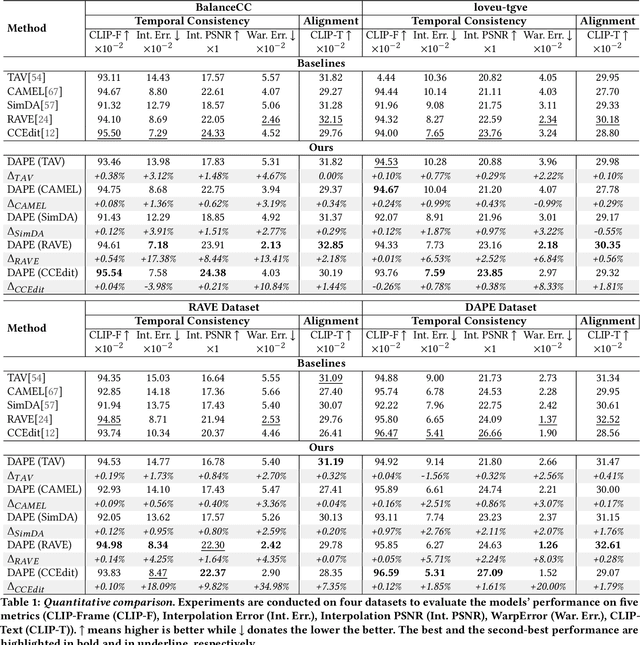
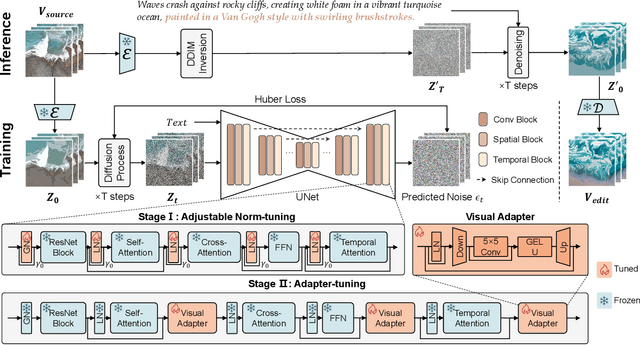
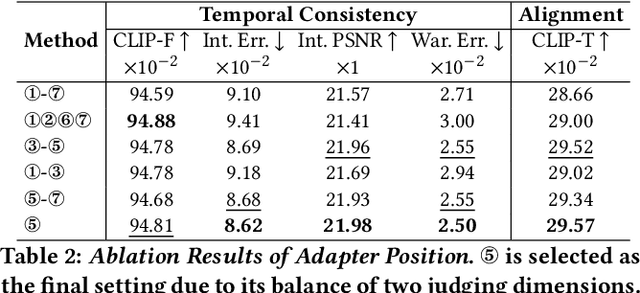
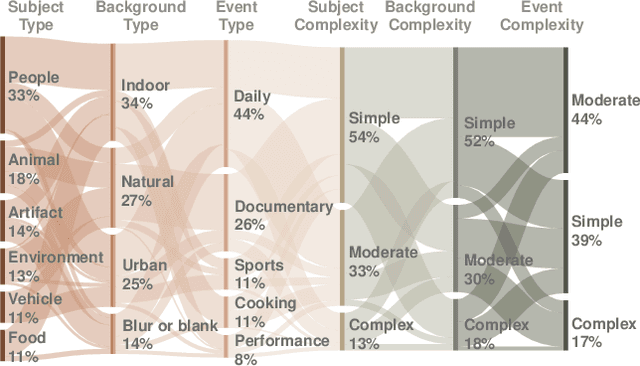
Video generation based on diffusion models presents a challenging multimodal task, with video editing emerging as a pivotal direction in this field. Recent video editing approaches primarily fall into two categories: training-required and training-free methods. While training-based methods incur high computational costs, training-free alternatives often yield suboptimal performance. To address these limitations, we propose DAPE, a high-quality yet cost-effective two-stage parameter-efficient fine-tuning (PEFT) framework for video editing. In the first stage, we design an efficient norm-tuning method to enhance temporal consistency in generated videos. The second stage introduces a vision-friendly adapter to improve visual quality. Additionally, we identify critical shortcomings in existing benchmarks, including limited category diversity, imbalanced object distribution, and inconsistent frame counts. To mitigate these issues, we curate a large dataset benchmark comprising 232 videos with rich annotations and 6 editing prompts, enabling objective and comprehensive evaluation of advanced methods. Extensive experiments on existing datasets (BalanceCC, LOVEU-TGVE, RAVE) and our proposed benchmark demonstrate that DAPE significantly improves temporal coherence and text-video alignment while outperforming previous state-of-the-art approaches.