 Add to Chrome
 Add to Firefox
 Add to Edge
SyncCache: Exploiting Asymmetric Dynamics for Fast Audio-Driven Portrait Animation
Jun 29, 2026
Diffusion Transformers (DiTs) have significantly advanced audio-driven portrait animation, but their high computational cost leads to substantial inference latency. Although training-free diffusion caching accelerates inference significant, existing methods are primarily developed for text-conditioned generation and overlook the spatial and modality imbalances inherent in audio-driven portrait animation. In this paper, we propose SyncCache, a training-free caching acceleration method tailored for DiT-based portrait animation that explicitly exploits asymmetric dynamics. Specifically, high-frequency dynamics driven by audio conditions and concentrated in human regions are more challenging and critical to cache and reuse than the low-frequency visual background in portrait animation. First, we introduce Spatially-Asymmetric Probing to prioritize error sensitivity in dynamic human region. Second, through Modality-Decoupled Caching, we bypass heavy DiT block by reusing stable inter-block residuals, while continuously recomputing lightweight audio blocks to preserve precise lip synchronization. Furthermore, we introduce a cache ratio to control cache capacity and formulate memory-adaptive cache selection as an offline dynamic programming problem without online overhead. Extensive experiments demonstrate that SyncCache achieves superior speed-quality trade-offs, delivering up to 4.12x acceleration on HunyuanVideo-Avatar and 3.75x on Wan-S2V with near-lossless visual fidelity and precise audio alignment.

PhysisForcing: Physics Reinforced World Simulator for Robotic Manipulation
Jun 26, 2026Video generation models have emerged as a promising paradigm for embodied world simulation. However, both general-domain video generators and robot-specific data fine-tuned models can still produce physically implausible manipulations, including discontinuous motion trajectories and inconsistent robot-object interactions, which limits their reliability as world simulators. Through extensive experiments, we find that such physical instability mainly arises from two factors: deformation of moving objects and implausible spatio-temporal correlations among interacting entities, particularly during contact. Building on this observation, we propose PhysisForcing, a scalable training framework that strengthens physical consistency by focusing supervision on physics-informative regions through joint optimization of pixel-level and semantic-level features. The framework consists of a pixel-level trajectory alignment loss, which supervises DiT features using reference point trajectories, and a semantic-level relational alignment loss, which aligns DiT features with inter-region relations extracted from a frozen video understanding encoder. Extensive experiments on R-Bench, PAI-Bench, and EZS-Bench show that PhysisForcing consistently improves embodied video generation over strong baselines, improving the Wan2.2-I2V-A14B and Cosmos3-Nano base models on R-Bench by 22.3\% and 9.2\% (7.1\% and 3.7\% over vanilla finetuning), with the Cosmos3-Nano variant attaining the best overall score. Beyond generation, as a world model under the WorldArena action-planner protocol it raises the closed-loop success rate from 16.0\% to 24.0\% and further improves downstream policy success, indicating that physically aligned video models yield stronger representations for robotic manipulation.
HumanScale: Egocentric Human Video Can Outperform Real-Robot Data for Embodied Pretraining
Jun 18, 2026Embodied foundation models are expected to benefit from data scaling like large language models, but face a much tighter data bottleneck. Teleoperated real-robot trajectories remain the dominant pretraining source due to their precise action supervision and embodiment alignment, yet their scalability is limited by high collection cost, acquisition difficulty, and low behavioral and environmental diversity. These limitations have sparked interest in egocentric human video as a scalable, substantially lower-cost, and more diverse alternative for embodied model pretraining. However, its effectiveness compared to teleoperated real-robot data remains underexplored. To address this question, we conduct a systematic study comparing egocentric human video and teleoperated real-robot trajectories as pretraining data sources for embodied foundation models, under fixed post-training and validation protocols. Surprisingly, we find that egocentric data, when processed through a carefully designed filtering and labeling pipeline, is not merely a viable substitute for model pretraining but can lead to superior performance. With the same amount of pretraining data, models pretrained on egocentric data achieve a 24% lower validation loss on real-robot action prediction, as well as 52.5% and 90% higher success rates on in-distribution and out-of-distribution real-robot task execution, respectively. This finding verifies a scalable paradigm for embodied foundation models: pretrain on egocentric human video to learn diverse world representations, then adapt with a small amount of labeled real-robot data for action-space alignment. We hope this study encourages broader exploration of egocentric data and offers guidance for data quality assessment before costly robot data collection.
Stepping Stones: A Progressive Training Strategy for Audio-Visual Semantic Segmentation
Jul 16, 2024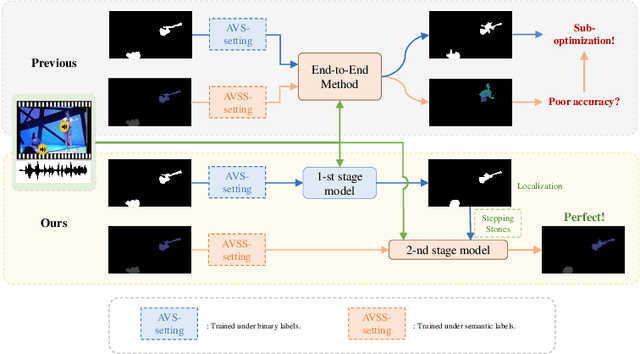
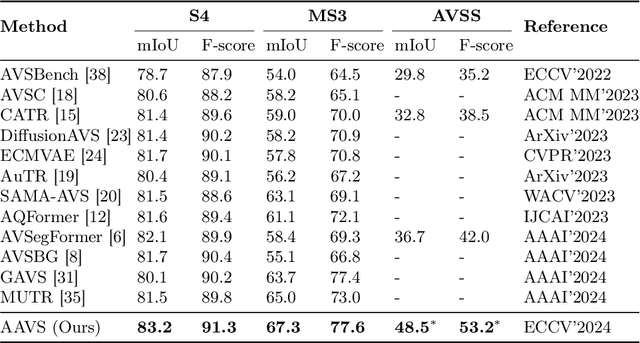
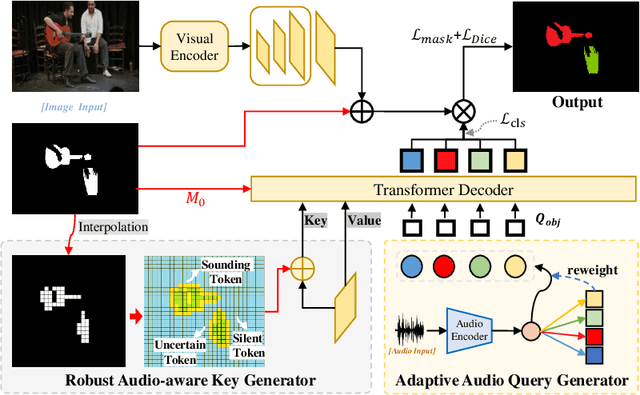
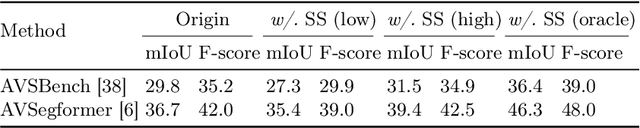
Audio-Visual Segmentation (AVS) aims to achieve pixel-level localization of sound sources in videos, while Audio-Visual Semantic Segmentation (AVSS), as an extension of AVS, further pursues semantic understanding of audio-visual scenes. However, since the AVSS task requires the establishment of audio-visual correspondence and semantic understanding simultaneously, we observe that previous methods have struggled to handle this mashup of objectives in end-to-end training, resulting in insufficient learning and sub-optimization. Therefore, we propose a two-stage training strategy called \textit{Stepping Stones}, which decomposes the AVSS task into two simple subtasks from localization to semantic understanding, which are fully optimized in each stage to achieve step-by-step global optimization. This training strategy has also proved its generalization and effectiveness on existing methods. To further improve the performance of AVS tasks, we propose a novel framework Adaptive Audio Visual Segmentation, in which we incorporate an adaptive audio query generator and integrate masked attention into the transformer decoder, facilitating the adaptive fusion of visual and audio features. Extensive experiments demonstrate that our methods achieve state-of-the-art results on all three AVS benchmarks. The project homepage can be accessed at https://gewu-lab.github.io/stepping_stones/.