 Add to Chrome
 Add to Firefox
 Add to Edge
MedPlex: Deep Vision-Language Co-Adaptation for Clinically Grounded Medical Segmentation
Aug 13, 2026
Medical image segmentation is still largely treated as a vision-only problem, although clinical interpretation often relies on textual knowledge of anatomy, location, appearance, and surrounding context. Existing text-guided segmentation methods within the Vision-Language Model (VLM) paradigm often use language only as a late conditioning signal, limiting its influence on visual representation learning. We introduce MedPlex (Medical Plexus of Vision and Language), an end-to-end VLM framework that makes text guidance a continuous, clinically grounded component of segmentation learning. Through Bi-Fusion (Bidirectional Fusion), visual and textual representations evolve jointly across the encoding hierarchy. MedPlex further introduces class-level and region-level concept alignment to organize the shared representation at complementary granularities. Class-level alignment anchors each anatomical target to an aggregated clinical concept profile, while region-level alignment preserves individual concepts, such as shape, location, appearance, and texture, through class-specific visual evidence. In this way, language provides structured supervision throughout the encoder rather than serving only as a late-stage cue. MedPlex achieves state-of-the-art performance across CT and MR benchmarks for multi-organ, cardiac substructure, and tumor segmentation, including settings with real free-text clinical supervision. Code: https://github.com/rafiibnsultan/MedPlex.

A Neighborhood Attention Transformer Network for Enhanced 3D Segmentation of the Left Anterior Descending Artery
Aug 12, 2026Background: Accurate segmentation of the Left Anterior Descending (LAD) artery in 3D free-breathing, non-contrast CT is critical for cardiac dose sparing in thoracic radiotherapy. The LAD is extremely small, has poor soft-tissue contrast, and varies substantially across patients; even manual contours show limited inter-observer agreement, underscoring the ambiguity of the vessel boundaries. Purpose: To develop a transformer-based framework that improves LAD delineation in low-contrast, imbalanced CT through local-global context modeling and uncertainty-guided optimization. Methods: We propose NA-UNETR, a 3D transformer-based segmentation model whose Neighborhood Attention (NA) and Dilated NA (DiNA) blocks jointly capture fine structural detail and long-range context. Given the scarcity of annotated LAD data, the model is pretrained on 1,000 CTA volumes of general coronary anatomy and fine-tuned with LoRA-based parameter-efficient adaptation on 20 free-breathing institutional CT scans. A composite Dice-Focal and Hausdorff loss, dynamically balanced via homoscedastic uncertainty, improves overlap and boundary accuracy. Results: NA-UNETR reached 45.64% Dice, 38.16 mm HD95, and 10.01 mm ASD, improving Dice by 3.10 percentage points over nnU-Net and reducing HD95 by 2.96 mm relative to Swin UNETR, with the strongest boundary accuracy among all models and improved centerline stability. On ImageCAS it achieved 79.49% Dice, 8.89 mm HD95, and 1.02 mm ASD. Ablations confirmed that residual blocks, variable kernels, and uncertainty-weighted loss each contributed. Conclusions: NA-UNETR balances local precision and global context for thin, low-contrast LAD structures, offering a computationally efficient framework for substructure-level cardiac segmentation in radiotherapy planning.
WalkGPT: Grounded Vision-Language Conversation with Depth-Aware Segmentation for Pedestrian Navigation
Mar 11, 2026Ensuring accessible pedestrian navigation requires reasoning about both semantic and spatial aspects of complex urban scenes, a challenge that existing Large Vision-Language Models (LVLMs) struggle to meet. Although these models can describe visual content, their lack of explicit grounding leads to object hallucinations and unreliable depth reasoning, limiting their usefulness for accessibility guidance. We introduce WalkGPT, a pixel-grounded LVLM for the new task of Grounded Navigation Guide, unifying language reasoning and segmentation within a single architecture for depth-aware accessibility guidance. Given a pedestrian-view image and a navigation query, WalkGPT generates a conversational response with segmentation masks that delineate accessible and harmful features, along with relative depth estimation. The model incorporates a Multi-Scale Query Projector (MSQP) that shapes the final image tokens by aggregating them along text tokens across spatial hierarchies, and a Calibrated Text Projector (CTP), guided by a proposed Region Alignment Loss, that maps language embeddings into segmentation-aware representations. These components enable fine-grained grounding and depth inference without user-provided cues or anchor points, allowing the model to generate complete and realistic navigation guidance. We also introduce PAVE, a large-scale benchmark of 41k pedestrian-view images paired with accessibility-aware questions and depth-grounded answers. Experiments show that WalkGPT achieves strong grounded reasoning and segmentation performance. The source code and dataset are available on the \href{https://sites.google.com/view/walkgpt-26/home}{project website}.
FluenceFormer: Transformer-Driven Multi-Beam Fluence Map Regression for Radiotherapy Planning
Dec 27, 2025Fluence map prediction is central to automated radiotherapy planning but remains an ill-posed inverse problem due to the complex relationship between volumetric anatomy and beam-intensity modulation. Convolutional methods in prior work often struggle to capture long-range dependencies, which can lead to structurally inconsistent or physically unrealizable plans. We introduce \textbf{FluenceFormer}, a backbone-agnostic transformer framework for direct, geometry-aware fluence regression. The model uses a unified two-stage design: Stage~1 predicts a global dose prior from anatomical inputs, and Stage~2 conditions this prior on explicit beam geometry to regress physically calibrated fluence maps. Central to the approach is the \textbf{Fluence-Aware Regression (FAR)} loss, a physics-informed objective that integrates voxel-level fidelity, gradient smoothness, structural consistency, and beam-wise energy conservation. We evaluate the generality of the framework across multiple transformer backbones, including Swin UNETR, UNETR, nnFormer, and MedFormer, using a prostate IMRT dataset. FluenceFormer with Swin UNETR achieves the strongest performance among the evaluated models and improves over existing benchmark CNN and single-stage methods, reducing Energy Error to $\mathbf{4.5\%}$ and yielding statistically significant gains in structural fidelity ($p < 0.05$).
BiPVL-Seg: Bidirectional Progressive Vision-Language Fusion with Global-Local Alignment for Medical Image Segmentation
Mar 30, 2025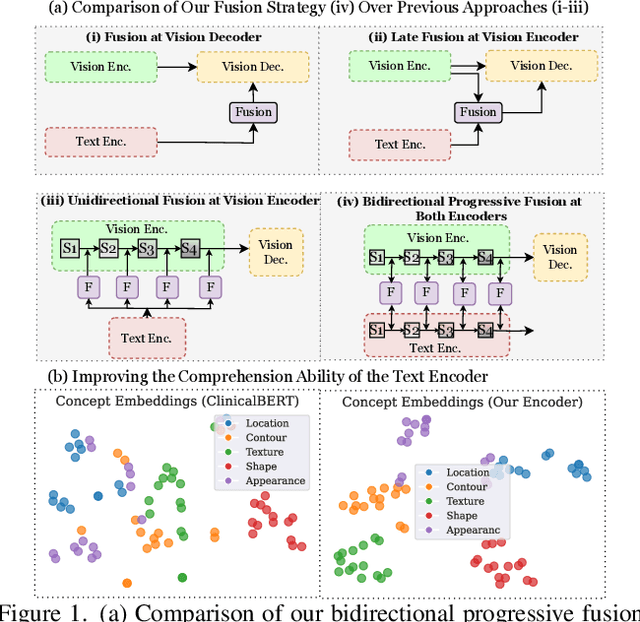

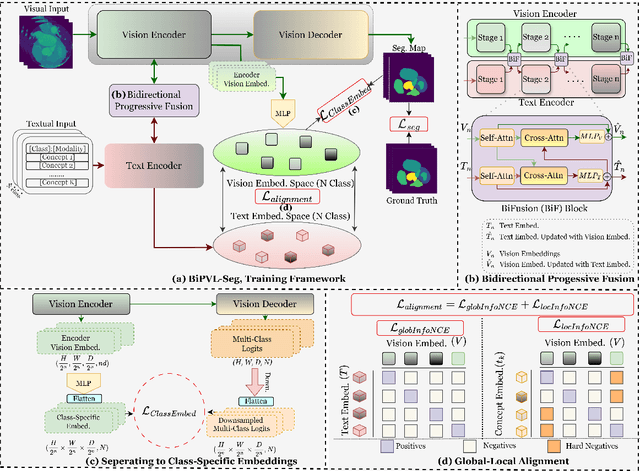
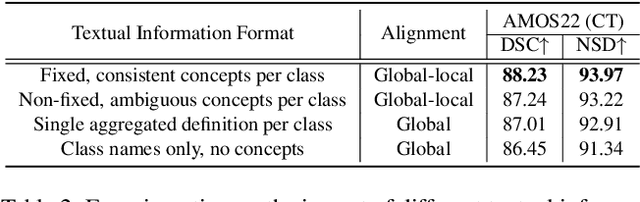
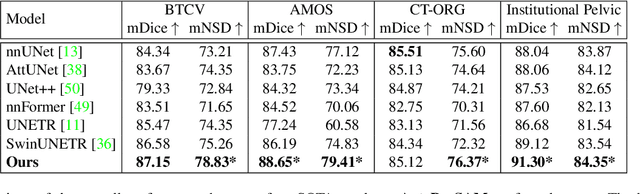
Medical image segmentation typically relies solely on visual data, overlooking the rich textual information clinicians use for diagnosis. Vision-language models attempt to bridge this gap, but existing approaches often process visual and textual features independently, resulting in weak cross-modal alignment. Simple fusion techniques fail due to the inherent differences between spatial visual features and sequential text embeddings. Additionally, medical terminology deviates from general language, limiting the effectiveness of off-the-shelf text encoders and further hindering vision-language alignment. We propose BiPVL-Seg, an end-to-end framework that integrates vision-language fusion and embedding alignment through architectural and training innovations, where both components reinforce each other to enhance medical image segmentation. BiPVL-Seg introduces bidirectional progressive fusion in the architecture, which facilitates stage-wise information exchange between vision and text encoders. Additionally, it incorporates global-local contrastive alignment, a training objective that enhances the text encoder's comprehension by aligning text and vision embeddings at both class and concept levels. Extensive experiments on diverse medical imaging benchmarks across CT and MR modalities demonstrate BiPVL-Seg's superior performance when compared with state-of-the-art methods in complex multi-class segmentation. Source code is available in this GitHub repository.
MulModSeg: Enhancing Unpaired Multi-Modal Medical Image Segmentation with Modality-Conditioned Text Embedding and Alternating Training
Nov 23, 2024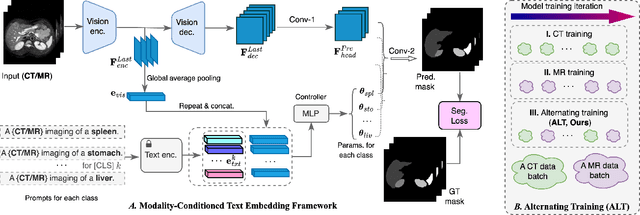
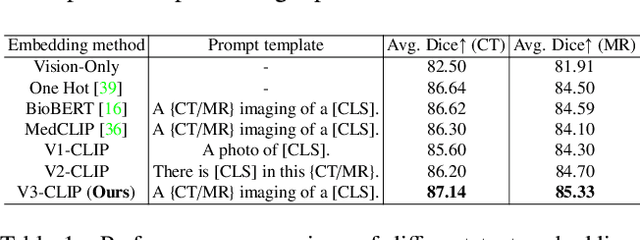
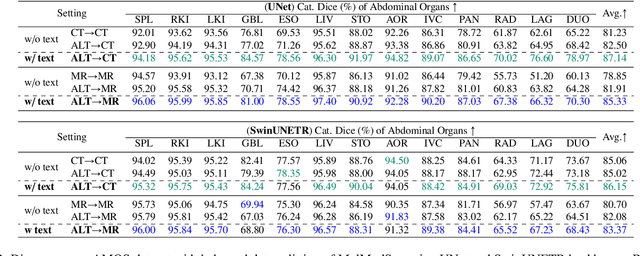
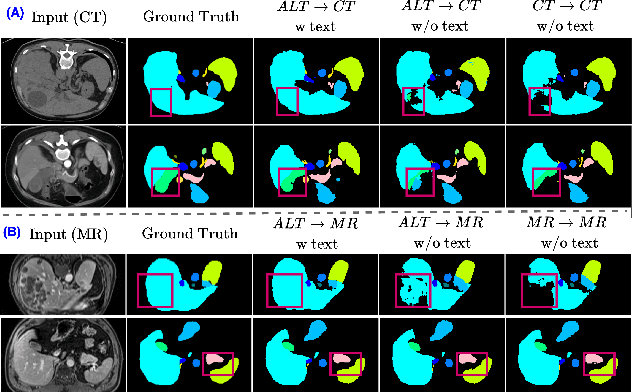
In the diverse field of medical imaging, automatic segmentation has numerous applications and must handle a wide variety of input domains, such as different types of Computed Tomography (CT) scans and Magnetic Resonance (MR) images. This heterogeneity challenges automatic segmentation algorithms to maintain consistent performance across different modalities due to the requirement for spatially aligned and paired images. Typically, segmentation models are trained using a single modality, which limits their ability to generalize to other types of input data without employing transfer learning techniques. Additionally, leveraging complementary information from different modalities to enhance segmentation precision often necessitates substantial modifications to popular encoder-decoder designs, such as introducing multiple branched encoding or decoding paths for each modality. In this work, we propose a simple Multi-Modal Segmentation (MulModSeg) strategy to enhance medical image segmentation across multiple modalities, specifically CT and MR. It incorporates two key designs: a modality-conditioned text embedding framework via a frozen text encoder that adds modality awareness to existing segmentation frameworks without significant structural modifications or computational overhead, and an alternating training procedure that facilitates the integration of essential features from unpaired CT and MR inputs. Through extensive experiments with both Fully Convolutional Network and Transformer-based backbones, MulModSeg consistently outperforms previous methods in segmenting abdominal multi-organ and cardiac substructures for both CT and MR modalities. The code is available in this {\href{https://github.com/ChengyinLee/MulModSeg_2024}{link}}.
FedDRO: Federated Compositional Optimization for Distributionally Robust Learning
Nov 21, 2023

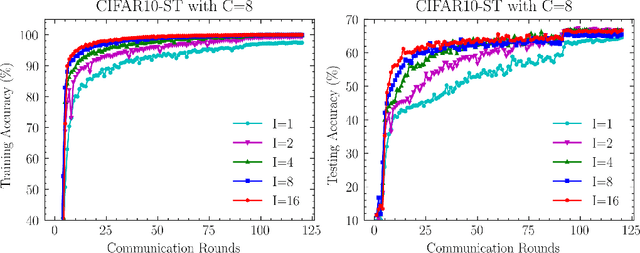
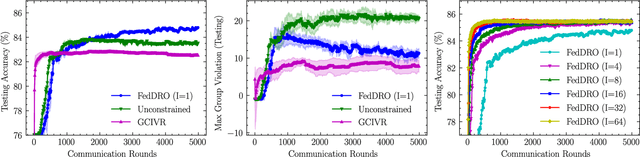
Recently, compositional optimization (CO) has gained popularity because of its applications in distributionally robust optimization (DRO) and many other machine learning problems. Large-scale and distributed availability of data demands the development of efficient federated learning (FL) algorithms for solving CO problems. Developing FL algorithms for CO is particularly challenging because of the compositional nature of the objective. Moreover, current state-of-the-art methods to solve such problems rely on large batch gradients (depending on the solution accuracy) not feasible for most practical settings. To address these challenges, in this work, we propose efficient FedAvg-type algorithms for solving non-convex CO in the FL setting. We first establish that vanilla FedAvg is not suitable to solve distributed CO problems because of the data heterogeneity in the compositional objective at each client which leads to the amplification of bias in the local compositional gradient estimates. To this end, we propose a novel FL framework FedDRO that utilizes the DRO problem structure to design a communication strategy that allows FedAvg to control the bias in the estimation of the compositional gradient. A key novelty of our work is to develop solution accuracy-independent algorithms that do not require large batch gradients (and function evaluations) for solving federated CO problems. We establish $\mathcal{O}(\epsilon^{-2})$ sample and $\mathcal{O}(\epsilon^{-3/2})$ communication complexity in the FL setting while achieving linear speedup with the number of clients. We corroborate our theoretical findings with empirical studies on large-scale DRO problems.
GeoSAM: Fine-tuning SAM with Sparse and Dense Visual Prompting for Automated Segmentation of Mobility Infrastructure
Nov 19, 2023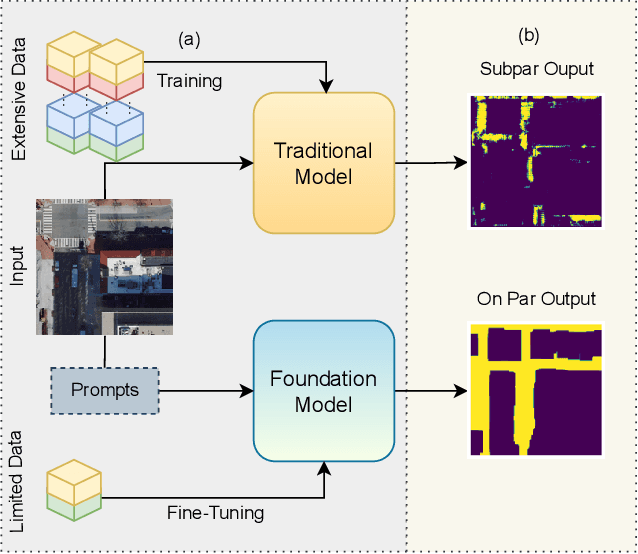
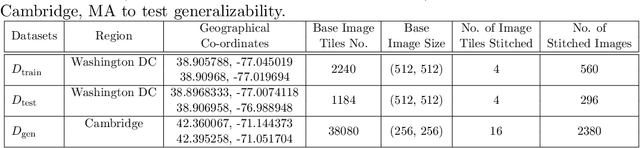
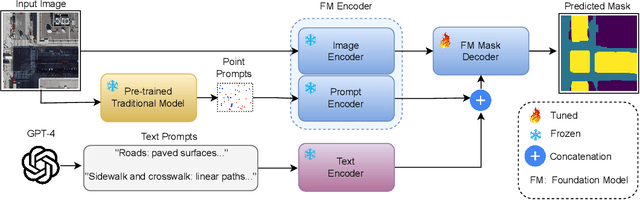
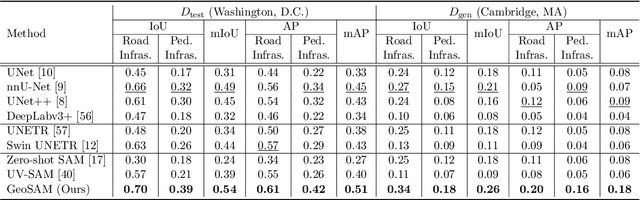
The Segment Anything Model (SAM) has shown impressive performance when applied to natural image segmentation. However, it struggles with geographical images like aerial and satellite imagery, especially when segmenting mobility infrastructure including roads, sidewalks, and crosswalks. This inferior performance stems from the narrow features of these objects, their textures blending into the surroundings, and interference from objects like trees, buildings, vehicles, and pedestrians - all of which can disorient the model to produce inaccurate segmentation maps. To address these challenges, we propose Geographical SAM (GeoSAM), a novel SAM-based framework that implements a fine-tuning strategy using the dense visual prompt from zero-shot learning, and the sparse visual prompt from a pre-trained CNN segmentation model. The proposed GeoSAM outperforms existing approaches for geographical image segmentation, specifically by 20%, 14.29%, and 17.65% for road infrastructure, pedestrian infrastructure, and on average, respectively, representing a momentous leap in leveraging foundation models to segment mobility infrastructure including both road and pedestrian infrastructure in geographical images.
Auto-Prompting SAM for Mobile Friendly 3D Medical Image Segmentation
Aug 28, 2023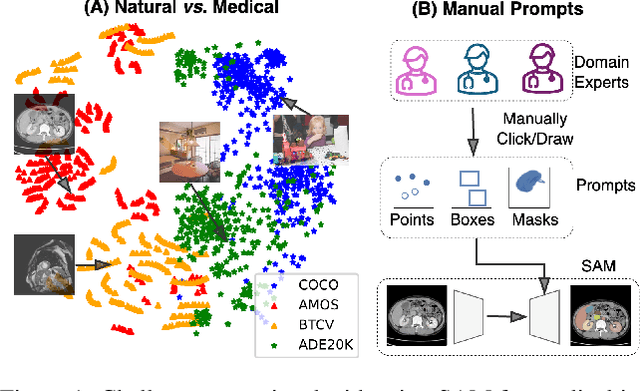
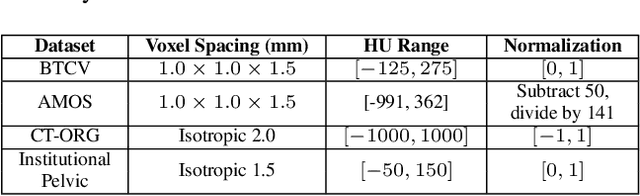
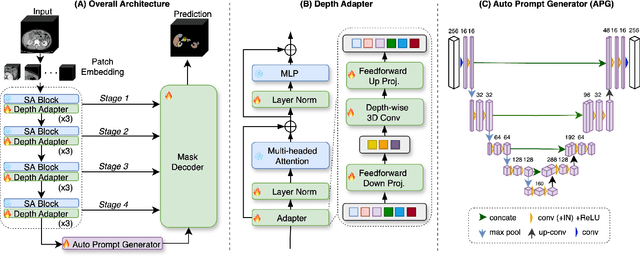
The Segment Anything Model (SAM) has rapidly been adopted for segmenting a wide range of natural images. However, recent studies have indicated that SAM exhibits subpar performance on 3D medical image segmentation tasks. In addition to the domain gaps between natural and medical images, disparities in the spatial arrangement between 2D and 3D images, the substantial computational burden imposed by powerful GPU servers, and the time-consuming manual prompt generation impede the extension of SAM to a broader spectrum of medical image segmentation applications. To address these challenges, in this work, we introduce a novel method, AutoSAM Adapter, designed specifically for 3D multi-organ CT-based segmentation. We employ parameter-efficient adaptation techniques in developing an automatic prompt learning paradigm to facilitate the transformation of the SAM model's capabilities to 3D medical image segmentation, eliminating the need for manually generated prompts. Furthermore, we effectively transfer the acquired knowledge of the AutoSAM Adapter to other lightweight models specifically tailored for 3D medical image analysis, achieving state-of-the-art (SOTA) performance on medical image segmentation tasks. Through extensive experimental evaluation, we demonstrate the AutoSAM Adapter as a critical foundation for effectively leveraging the emerging ability of foundation models in 2D natural image segmentation for 3D medical image segmentation.