 Add to Chrome
 Add to Firefox
 Add to Edge
Automated stereotactic radiosurgery planning using a human-in-the-loop reasoning large language model agent
Dec 23, 2025
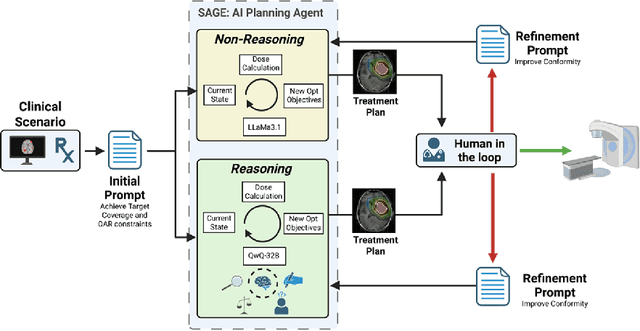
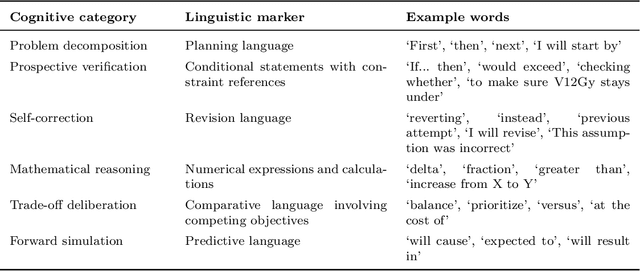
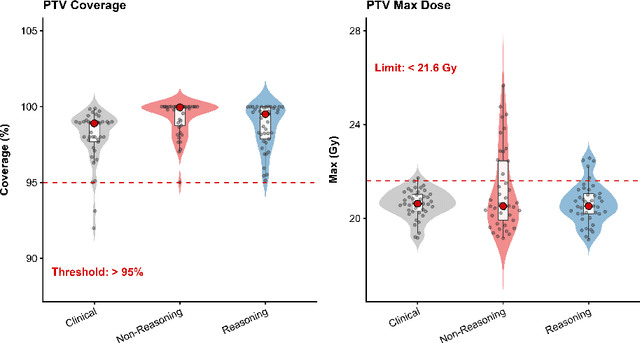
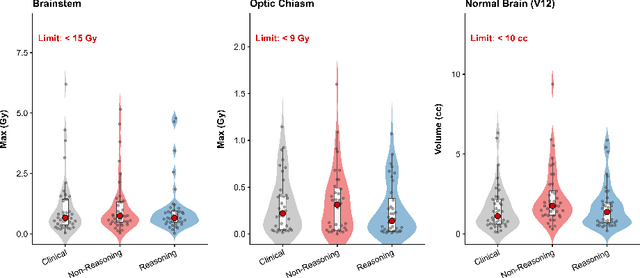
Stereotactic radiosurgery (SRS) demands precise dose shaping around critical structures, yet black-box AI systems have limited clinical adoption due to opacity concerns. We tested whether chain-of-thought reasoning improves agentic planning in a retrospective cohort of 41 patients with brain metastases treated with 18 Gy single-fraction SRS. We developed SAGE (Secure Agent for Generative Dose Expertise), an LLM-based planning agent for automated SRS treatment planning. Two variants generated plans for each case: one using a non-reasoning model, one using a reasoning model. The reasoning variant showed comparable plan dosimetry relative to human planners on primary endpoints (PTV coverage, maximum dose, conformity index, gradient index; all p > 0.21) while reducing cochlear dose below human baselines (p = 0.022). When prompted to improve conformity, the reasoning model demonstrated systematic planning behaviors including prospective constraint verification (457 instances) and trade-off deliberation (609 instances), while the standard model exhibited none of these deliberative processes (0 and 7 instances, respectively). Content analysis revealed that constraint verification and causal explanation concentrated in the reasoning agent. The optimization traces serve as auditable logs, offering a path toward transparent automated planning.

When AI Does Science: Evaluating the Autonomous AI Scientist KOSMOS in Radiation Biology
Nov 17, 2025Agentic AI "scientists" now use language models to search the literature, run analyses, and generate hypotheses. We evaluate KOSMOS, an autonomous AI scientist, on three problems in radiation biology using simple random-gene null benchmarks. Hypothesis 1: baseline DNA damage response (DDR) capacity across cell lines predicts the p53 transcriptional response after irradiation (GSE30240). Hypothesis 2: baseline expression of OGT and CDO1 predicts the strength of repressed and induced radiation-response modules in breast cancer cells (GSE59732). Hypothesis 3: a 12-gene expression signature predicts biochemical recurrence-free survival after prostate radiotherapy plus androgen deprivation therapy (GSE116918). The DDR-p53 hypothesis was not supported: DDR score and p53 response were weakly negatively correlated (Spearman rho = -0.40, p = 0.76), indistinguishable from random five-gene scores. OGT showed only a weak association (r = 0.23, p = 0.34), whereas CDO1 was a clear outlier (r = 0.70, empirical p = 0.0039). The 12-gene signature achieved a concordance index of 0.61 (p = 0.017) but a non-unique effect size. Overall, KOSMOS produced one well-supported discovery, one plausible but uncertain result, and one false hypothesis, illustrating that AI scientists can generate useful ideas but require rigorous auditing against appropriate null models.