 Add to Chrome
 Add to Firefox
 Add to Edge
Sparse Autoencoders for Interpretable Out-of-Distribution Detection
Jul 13, 2026
Reliable detection of out-of-distribution (OOD) samples is crucial for the safe deployment of machine learning models. Neural networks often produce overconfident predictions for inputs that deviate from their training data, leading to significant degradation in performance. While many OOD detection methods focus on the final output layer, they neglect the rich hierarchical information present in intermediate network layers. This paper introduces a novel approach that leverages sparse autoencoders (SAEs) to learn interpretable features from these intermediate activations. We find that in-distribution (ID) and OOD data activate distinct sets of these sparse features. We propose a new OOD score derived from the cosine similarity between the sparse feature activations of a test sample and the mean activations of ID classes. Our post-hoc detection method not only achieves state-of-the-art performance on standard OOD detection benchmarks, but yields interpretable insights into how distribution shift affects learned representations.

PoseShield: Neural Collision Fields for Human Self-Collision Resolution
Jul 01, 2026Self-collision remains a persistent challenge in SMPL-based human pose estimation and motion generation. Under extreme articulations or stochastic motion synthesis, generated meshes frequently exhibit self-penetrations, leading to physically implausible results. We propose PoseShield, a neural collision constraint defined directly in SMPL pose space. We formulate collision correction as a constrained optimization problem and connect the learned constraint with the Eikonal equation. Enforcing Eikonal regularization ensures non-vanishing gradients near the collision boundary, improving numerical stability and robustness of the optimization process. Unlike prior methods that operate in the mesh space or rely on heuristic penalties, our approach operates directly in the low-dimensional space of human poses and is theoretically grounded. The same learned constraint extends to human motion sequences, providing a generator-agnostic post-hoc collision corrector without retraining the underlying motion model. Experiments on a newly constructed SMPL pose benchmark show that our method achieves a 95.8% success rate and outperforms state-of-the-art baselines.
MAPL: Multi-Objective Preference Learning for Robot Locomotion
Jun 24, 2026Reward design remains a major bottleneck in reinforcement learning for robot locomotion, where successful policies often depend on carefully tuned, task-specific reward functions. Preference-based reinforcement learning offers an alternative, but existing LLM-based methods typically ask for a single overall judgment between behaviors, making it difficult to capture the multiple competing objectives that underlie high-quality locomotion. We present Multi-Objective AI-Informed Preference Learning (MAPL), a framework that learns locomotion rewards from high-level natural language objectives rather than manually engineered reward equations. MAPL prompts a large language model to compare trajectories independently along semantically meaningful criteria, using generic language descriptions that are terrain-invariant and require little domain expertise. These objective-wise preferences are used to train a multi-head preference scoring model, whose outputs are aggregated to form a scalar reward for policy optimization. Across four quadruped locomotion environments, MAPL trains policies using only LLM-generated preferences and achieves performance comparable to or better than expert-designed rewards, while eliminating task-specific reward engineering.
Model-Agnostic Policy Explanations with Large Language Models
Apr 08, 2025Intelligent agents, such as robots, are increasingly deployed in real-world, human-centric environments. To foster appropriate human trust and meet legal and ethical standards, these agents must be able to explain their behavior. However, state-of-the-art agents are typically driven by black-box models like deep neural networks, limiting their interpretability. We propose a method for generating natural language explanations of agent behavior based only on observed states and actions -- without access to the agent's underlying model. Our approach learns a locally interpretable surrogate model of the agent's behavior from observations, which then guides a large language model to generate plausible explanations with minimal hallucination. Empirical results show that our method produces explanations that are more comprehensible and correct than those from baselines, as judged by both language models and human evaluators. Furthermore, we find that participants in a user study more accurately predicted the agent's future actions when given our explanations, suggesting improved understanding of agent behavior.
Sparse Mixture-of-Experts for Non-Uniform Noise Reduction in MRI Images
Jan 24, 2025Magnetic Resonance Imaging (MRI) is an essential diagnostic tool in clinical settings, but its utility is often hindered by noise artifacts introduced during the imaging process.Effective denoising is critical for enhancing image quality while preserving anatomical structures. However, traditional denoising methods, which often assume uniform noise distributions, struggle to handle the non-uniform noise commonly present in MRI images. In this paper, we introduce a novel approach leveraging a sparse mixture-of-experts framework for MRI image denoising. Each expert is a specialized denoising convolutional neural network fine-tuned to target specific noise characteristics associated with different image regions. Our method demonstrates superior performance over state-of-the-art denoising techniques on both synthetic and real-world brain MRI datasets. Furthermore, we show that it generalizes effectively to unseen datasets, highlighting its robustness and adaptability.
Symbolic Graph Inference for Compound Scene Understanding
Oct 30, 2024
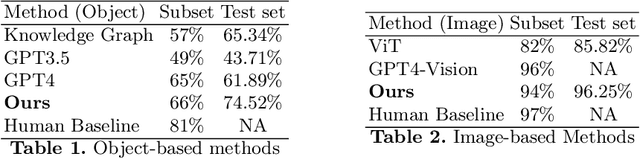
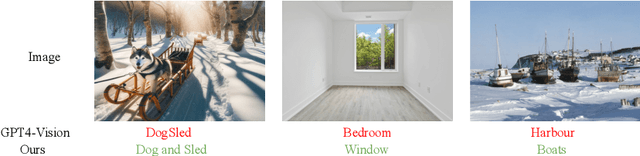
Scene understanding is a fundamental capability needed in many domains, ranging from question-answering to robotics. Unlike recent end-to-end approaches that must explicitly learn varying compositions of the same scene, our method reasons over their constituent objects and analyzes their arrangement to infer a scene's meaning. We propose a novel approach that reasons over a scene's scene- and knowledge-graph, capturing spatial information while being able to utilize general domain knowledge in a joint graph search. Empirically, we demonstrate the feasibility of our method on the ADE20K dataset and compare it to current scene understanding approaches.
Navigating Noisy Feedback: Enhancing Reinforcement Learning with Error-Prone Language Models
Oct 22, 2024The correct specification of reward models is a well-known challenge in reinforcement learning. Hand-crafted reward functions often lead to inefficient or suboptimal policies and may not be aligned with user values. Reinforcement learning from human feedback is a successful technique that can mitigate such issues, however, the collection of human feedback can be laborious. Recent works have solicited feedback from pre-trained large language models rather than humans to reduce or eliminate human effort, however, these approaches yield poor performance in the presence of hallucination and other errors. This paper studies the advantages and limitations of reinforcement learning from large language model feedback and proposes a simple yet effective method for soliciting and applying feedback as a potential-based shaping function. We theoretically show that inconsistent rankings, which approximate ranking errors, lead to uninformative rewards with our approach. Our method empirically improves convergence speed and policy returns over commonly used baselines even with significant ranking errors, and eliminates the need for complex post-processing of reward functions.
Multi-Agent Transfer Learning via Temporal Contrastive Learning
Jun 03, 2024This paper introduces a novel transfer learning framework for deep multi-agent reinforcement learning. The approach automatically combines goal-conditioned policies with temporal contrastive learning to discover meaningful sub-goals. The approach involves pre-training a goal-conditioned agent, finetuning it on the target domain, and using contrastive learning to construct a planning graph that guides the agent via sub-goals. Experiments on multi-agent coordination Overcooked tasks demonstrate improved sample efficiency, the ability to solve sparse-reward and long-horizon problems, and enhanced interpretability compared to baselines. The results highlight the effectiveness of integrating goal-conditioned policies with unsupervised temporal abstraction learning for complex multi-agent transfer learning. Compared to state-of-the-art baselines, our method achieves the same or better performances while requiring only 21.7% of the training samples.
* 6 pages, 6 figures
ShapeGrasp: Zero-Shot Task-Oriented Grasping with Large Language Models through Geometric Decomposition
Mar 26, 2024Task-oriented grasping of unfamiliar objects is a necessary skill for robots in dynamic in-home environments. Inspired by the human capability to grasp such objects through intuition about their shape and structure, we present a novel zero-shot task-oriented grasping method leveraging a geometric decomposition of the target object into simple, convex shapes that we represent in a graph structure, including geometric attributes and spatial relationships. Our approach employs minimal essential information - the object's name and the intended task - to facilitate zero-shot task-oriented grasping. We utilize the commonsense reasoning capabilities of large language models to dynamically assign semantic meaning to each decomposed part and subsequently reason over the utility of each part for the intended task. Through extensive experiments on a real-world robotics platform, we demonstrate that our grasping approach's decomposition and reasoning pipeline is capable of selecting the correct part in 92% of the cases and successfully grasping the object in 82% of the tasks we evaluate. Additional videos, experiments, code, and data are available on our project website: https://shapegrasp.github.io/.
HiKER-SGG: Hierarchical Knowledge Enhanced Robust Scene Graph Generation
Mar 18, 2024Being able to understand visual scenes is a precursor for many downstream tasks, including autonomous driving, robotics, and other vision-based approaches. A common approach enabling the ability to reason over visual data is Scene Graph Generation (SGG); however, many existing approaches assume undisturbed vision, i.e., the absence of real-world corruptions such as fog, snow, smoke, as well as non-uniform perturbations like sun glare or water drops. In this work, we propose a novel SGG benchmark containing procedurally generated weather corruptions and other transformations over the Visual Genome dataset. Further, we introduce a corresponding approach, Hierarchical Knowledge Enhanced Robust Scene Graph Generation (HiKER-SGG), providing a strong baseline for scene graph generation under such challenging setting. At its core, HiKER-SGG utilizes a hierarchical knowledge graph in order to refine its predictions from coarse initial estimates to detailed predictions. In our extensive experiments, we show that HiKER-SGG does not only demonstrate superior performance on corrupted images in a zero-shot manner, but also outperforms current state-of-the-art methods on uncorrupted SGG tasks. Code is available at https://github.com/zhangce01/HiKER-SGG.