 Add to Chrome
 Add to Firefox
 Add to Edge
Ambig-DS: A Benchmark for Task-Framing Ambiguity in Data-Science Agents
May 10, 2026
As data-science agents shift from co-pilots to auto-pilots, silent misframing becomes a critical failure mode. Agents quietly commit to plausible but unintended task framings, producing clean, executable artifacts that hide their incorrect assessment of the task. Existing benchmarks score whether the pipeline runs, ignoring whether the agent recognized the task was underspecified. We introduce Ambig-DS, two diagnostic suites: one for prediction-target ambiguity (Ambig-DS-Target, 51 tasks built on DSBench, a tabular modeling benchmark) and one for evaluation-objective ambiguity (Ambig-DS-Objective, 61 tasks built on MLE-bench, a Kaggle-style ML competition benchmark), constructed so that scoring uses each source benchmark's original evaluator. For every task we pair the original, fully specified version with an ambiguous variant produced by controlled edits; a human-and-LLM verification pipeline confirms each variant admits multiple plausible interpretations with decision-relevant consequences. The suites are analyzed independently and ambiguity lowers performance in both. Across five agents spanning efficient to frontier-class models, we find in our controlled diagnostic setting: (i) failures are silent commitments: wrong-target submissions on Target, wrong-metric or non-committal baseline submissions on Objective, rather than execution errors; (ii) allowing the agent to ask one clarifying question recovers much of the loss under idealized conditions, suggesting missing framing information drives a substantial part of the observed degradation; but (iii) agents cannot reliably tell when to use it: permissive prompts induce over-asking on clear tasks, while conservative prompts induce silent defaulting on ambiguous ones. Recognizing target and objective underspecification, not pipeline execution, is the bottleneck missing from standard DS-agent evaluations.

Measuring Black-Box Confidence via Reasoning Trajectories: Geometry, Coverage, and Verbalization
May 07, 2026Reliable confidence estimation enables safe deployment of chain-of-thought (CoT) reasoning through text-only APIs. Yet the dominant black-box baseline, self-consistency over K samples, is linearly expensive and ignores the geometry of the trace. We propose a black-box trajectory-confidence score: we embed a CoT as a sliding-window trajectory and measure its convergence to external answer anchors with a one-parameter softmax. The method needs no logits, hidden states, or supervised calibrators. Across six (benchmark, reasoner) settings on MedQA-USMLE, GPQA Diamond, and MMLU-Pro with Gemini 3.1 Pro and Claude Sonnet 4.6, fusing this score with coverage and verbalized-confidence channels at K=4 yields Pareto improvements over self-consistency at K=8 in 6/6 settings (median AUC 0.78 vs 0.71, deltaAUC=+0.075). A fixed-pick control (+0.060) and E5 cross-embedder replication rule out answer switching and single-vendor artifacts. Geometry peaks in the penultimate window across benchmarks and reasoners, and inverts at the terminal window on GPQA Diamond. Three unscaffolded regimes separate black-box confidence into a judge-mediated Coverage prior (C), within-trace Geometry (G), and a conditional Verbalization channel (V). Across 18 benchmark x reasoner x proposer settings, C and G provide independent signal in 18/18 and 16/18, while V contributes residual signal in 6/18. Swapping the judge from GPT-5-mini to Claude Sonnet 4.6 leaves G-only AUC unchanged (|delta|<=0.013) and shifts C-only AUC by at most +/-0.02 (kappa=0.82). Fusion beats the best single channel in 17/18 settings (median AUC 0.78, max 0.92).
MechPert: Mechanistic Consensus as an Inductive Bias for Unseen Perturbation Prediction
Feb 14, 2026Predicting transcriptional responses to unseen genetic perturbations is essential for understanding gene regulation and prioritizing large-scale perturbation experiments. Existing approaches either rely on static, potentially incomplete knowledge graphs, or prompt language models for functionally similar genes, retrieving associations shaped by symmetric co-occurrence in scientific text rather than directed regulatory logic. We introduce MechPert, a lightweight framework that encourages LLM agents to generate directed regulatory hypotheses rather than relying solely on functional similarity. Multiple agents independently propose candidate regulators with associated confidence scores; these are aggregated through a consensus mechanism that filters spurious associations, producing weighted neighborhoods for downstream prediction. We evaluate MechPert on Perturb-seq benchmarks across four human cell lines. For perturbation prediction in low-data regimes ($N=50$ observed perturbations), MechPert improves Pearson correlation by up to 10.5\% over similarity-based baselines. For experimental design, MechPert-selected anchor genes outperform standard network centrality heuristics by up to 46\% in well-characterized cell lines.
Sparks of Tabular Reasoning via Text2SQL Reinforcement Learning
Apr 23, 2025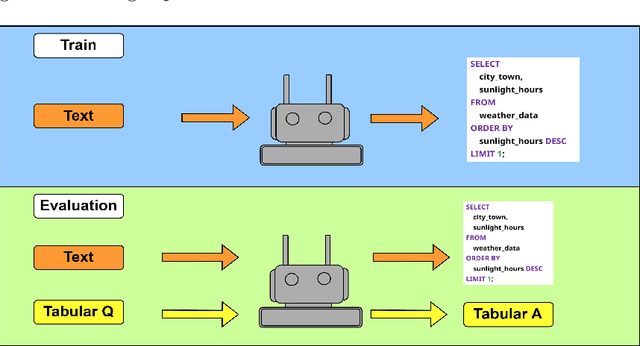
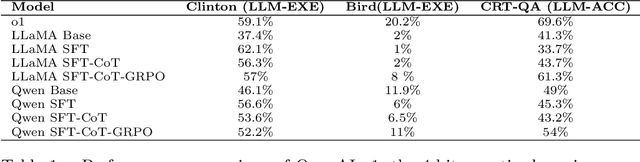
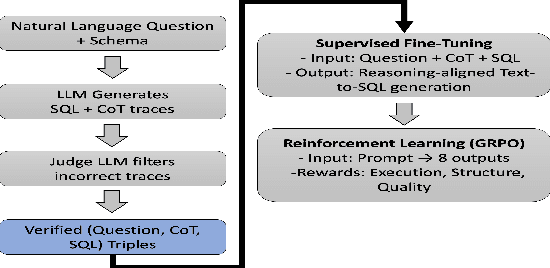

This work reframes the Text-to-SQL task as a pathway for teaching large language models (LLMs) to reason over and manipulate tabular data--moving beyond the traditional focus on query generation. We propose a two-stage framework that leverages SQL supervision to develop transferable table reasoning capabilities. First, we synthesize detailed chain-of-thought (CoT) traces from real-world SQL queries, providing step-by-step, clause-level supervision that teaches the model how to traverse, filter, and aggregate table fields. Second, we introduce a Group Relative Policy Optimization (GRPO) reinforcement learning objective that connects SQL execution accuracy to generalizable reasoning by encouraging steps that extend beyond task-specific syntax and transfer across datasets. Empirically, our approach improves performance on standard Text-to-SQL benchmarks and achieves substantial gains on reasoning-intensive datasets such as BIRD and CRT-QA, demonstrating enhanced generalization and interpretability. Specifically, the distilled-quantized LLaMA model achieved a 20\% increase in accuracy when trained on Text-to-SQL tasks, while Qwen achieved a 5\% increase. These results suggest that SQL can serve not only as a target formalism but also as an effective scaffold for learning robust, transferable reasoning over structured data.