 Add to Chrome
 Add to Firefox
 Add to Edge
Microdiversity and Vegetation Influence on Forward Scattering at 60 GHz and 80 GHz
Mar 19, 2026
Understanding the impact of vegetation and small-scale antenna movements on signal propagation is important for the design and optimization of high-frequency wireless communication systems. This paper presents an experimental study analyzing signal propagation at 60 GHz and 80 GHz in the presence of vegetation, with a focus on forward scattering and microdiversity effects. A controlled measurement campaign was conducted in an indoor environment, where the influence of a potted plant placed in the line-of-sight (LOS) path between the transmitter and receiver was investigated. The study examines the effects of antenna micro-shifts on the channel impulse response (CIR), highlighting variations in received power due to small positional changes of the antennas. The results indicate that the 80 GHz band exhibits higher sensitivity to micro-movements compared to the 60 GHz band, leading to greater fluctuations in received power.
* 6 pages, 8 figures, 3 tables

Angularly-Resolved 3D Foliage Modeling and Measurements at 60 and 80 GHz: From Stochastic Geometry to Deterministic Channel Characterization
Mar 19, 2026In this paper, we show a stochastic approach to generate a 3D model of a foliage, which is then used for deterministic ray-tracing channel modeling. This approach is verified by a measurement campaign at 60 and 80 GHz with 2 GHz bandwidth. The wireless channel is characterized by path-loss and RMS delay spread and we show the angular dependency of those parameters when the receiver is placed on a half-circle around the tree. Besides electromagnetic material properties, the 3D model is characterized by several interpretable parameters, including tree volume, leaf size, leaf density, and the tree crown shape parameter.
* 6 pages, 5 figures, 1 table
Stochastic 3-D Foliage Modeling at 80 GHz: Experimental Validation and Ray-Tracing Simulations
Mar 19, 2026A stochastic modeling methodology for 3-D foliage is presented, aimed at enhancing ray-tracing simulations. The model supports adjustable stochastic geometry, density, and shape to capture variability in foliage structures. The model is validated through experimental measurements of representative vegetation. The influence of foliage density and size on path loss and root mean square delay spread is analyzed to demonstrate the applicability of the model in the 80 GHz frequency band.
* 5 pages, 5 figures, 2 tables
Comparison of 60 GHz and 80 GHz Vehicle-to-Vehicle Channels Using Delay and Doppler Characteristics
Mar 18, 2026The aim of this paper is to provide a comparison of channel characteristics for vehicle-to-vehicle (V2V) communication at 60 GHz and 80 GHz frequency bands in a high-mobility scenario where two vehicles pass each other in opposite directions. The study is based on measurements of the time-varying channel impulse response capturing the behavior of multi-path propagation during vehicle motion. By directly comparing these two frequency bands under identical measurement conditions, we attempt to quantify the differences in power delay profile, root mean square (RMS) delay spread, RMS Doppler spread, and intervals (regions) of stationarity in time domain. The results show that these bands do not differ significantly, but the 80 GHz band exhibits somewhat greater RMS delay spread and RMS Doppler spread when calculated over the entire delay-Doppler spectrum, and conversely exhibits shorter stationarity regions. However, the characteristics of the measurement setup in the two bands and their influence on comparative measurements must be considered. In particular, attention must be paid to the impact of antennas.
* 7 pages, 8 figures, 2 tables
Vehicle-to-Vehicle Millimeter-Wave Channel Characterization at 60 and 80 GHz
Mar 18, 2026This paper presents results from a vehicle-to-vehicle channel measurement campaign conducted in the millimeter-wave (MMW) frequency bands at center frequencies of 60GHz and 80GHz, each with a bandwidth of 2GHz. The measurements were performed in a dynamic oncoming-vehicle scenario using a time-domain channel sounder with high-resolution data acquisition. Power delay profiles were extracted to study the temporal evolution of multipath components, and the root mean square (RMS) delay spread was analyzed to characterize the temporal dispersion of the channel. The results demonstrate differences between the two frequency bands. At 60GHz, the RMS delay spread is well approximated by a Gaussian distribution with a higher median value, while at 80GHz it follows a lognormal distribution with a lower median. Furthermore, the number of resolvable multipath components was found to be nearly twice as high at 60\,GHz compared to 80GHz, highlighting the impact of antenna beamwidth and frequency-dependent propagation mechanisms.
* 6 pages, 7 figures
Channel impulse response peak clustering using neural networks
Mar 26, 2025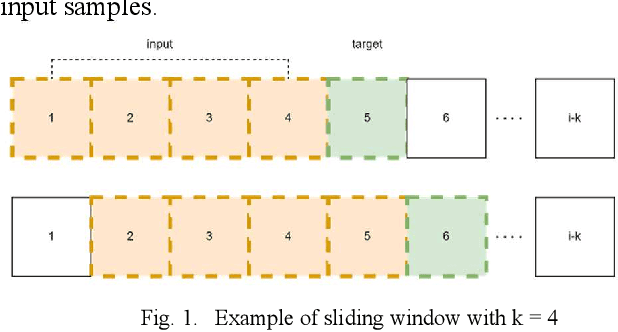
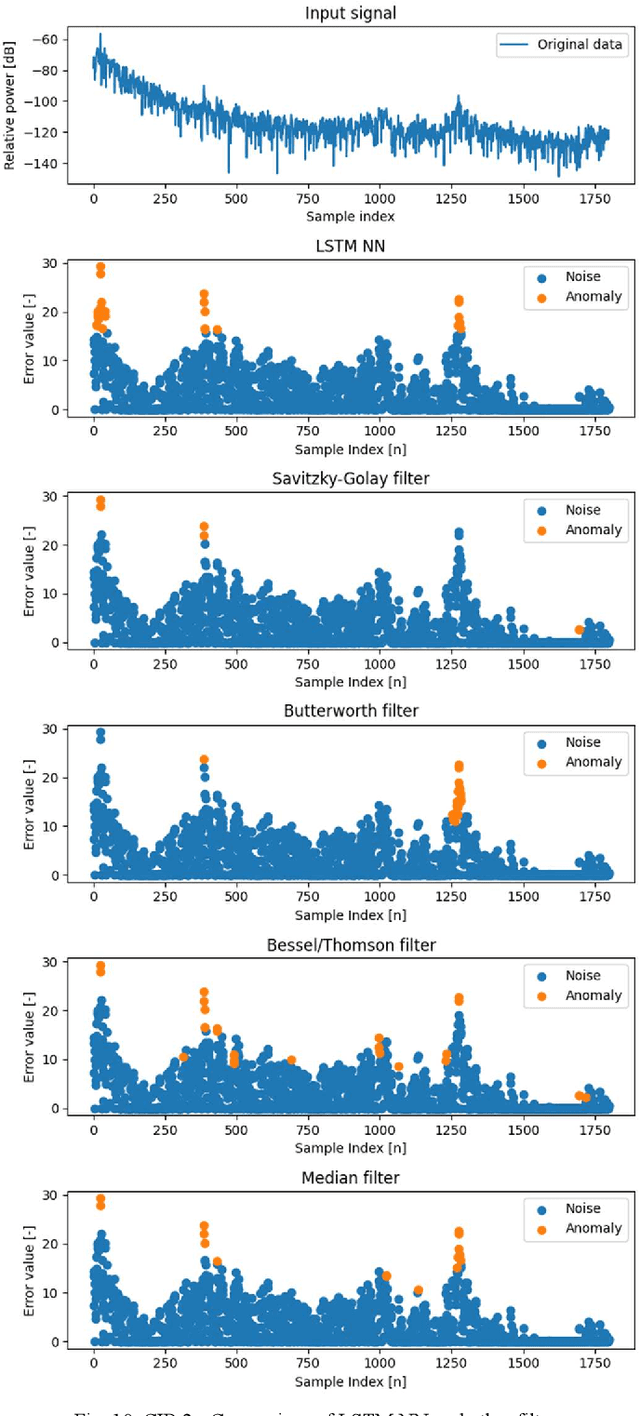
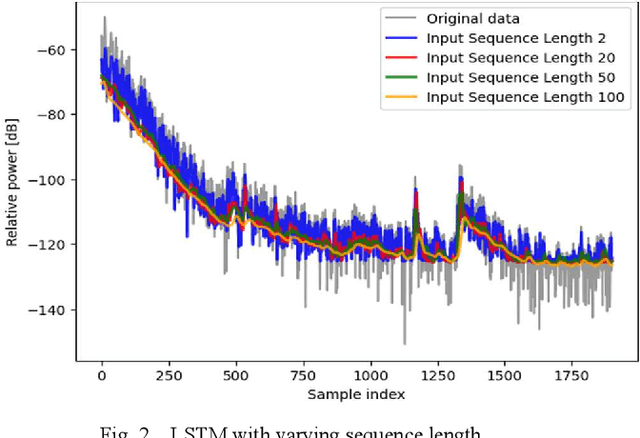
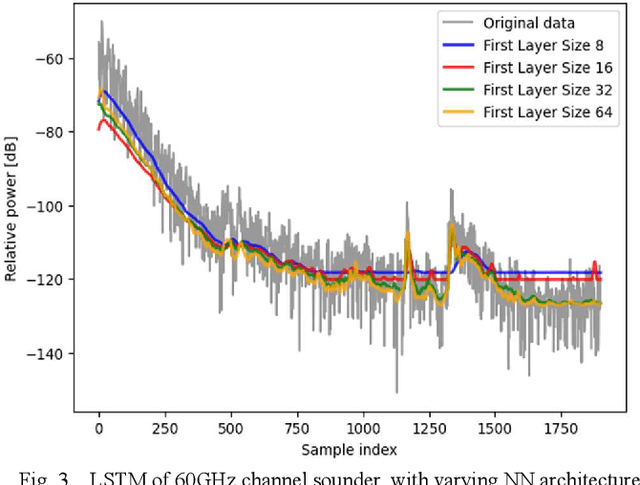
This paper introduces an approach to process channel sounder data acquired from Channel Impulse Response (CIR) of 60GHz and 80GHz channel sounder systems, through the integration of Long Short-Term Memory (LSTM) Neural Network (NN) and Fully Connected Neural Network (FCNN). The primary goal is to enhance and automate cluster detection within peaks from noised CIR data. The study initially compares the performance of LSTM NN and FCNN across different input sequence lengths. Notably, LSTM surpasses FCNN due to its incorporation of memory cells, which prove beneficial for handling longer series.Additionally, the paper investigates the robustness of LSTM NN through various architectural configurations. The findings suggest that robust neural networks tend to closely mimic the input function, whereas smaller neural networks are better at generalizing trends in time series data, which is desirable for anomaly detection, where function peaks are regarded as anomalies.Finally, the selected LSTM NN is compared with traditional signal filters, including Butterworth, Savitzky-Golay, Bessel/Thomson, and median filters. Visual observations indicate that the most effective methods for peak detection within channel impulse response data are either the LSTM NN or median filter, as they yield similar results.
* 7 pages, 10 figures, 5 tables
Comparative analysis of clustering methods for power delay profile in MMW bands and in-vehicle scenarios
Mar 26, 2025The spatial statistics of radio wave propagation in specific environments and scenarios, as well as being able to recognize important signal components, are prerequisites for dependable connectivity. There are several reasons why in-vehicle communication is unique, including safety considerations and vehicle-to-vehicle/infrastructure communication.The paper examines the characteristics of clustering power delay profiles to investigate in-vehicle communication. It has been demonstrated that the Saleh-Valenzuela channel model can also be adapted for in-vehicle communication, and that the signal is received in clusters with exponential decay. A measurement campaign was conducted, capturing the power delay profile inside the vehicle cabin, and the reweighted l1 minimization method was compared with the traditional k-means clustering techniques.
* 6 pages, 10 figures
Long-term channel analysis at 60 and 80 GHz for autonomous ground vehicles
Mar 24, 2025This paper presents a comprehensive measurement campaign aimed at evaluating indoor-to-indoor radio channels in dynamic scenarios, with a particular focus on applications such as autonomous ground vehicles (AGV). These scenarios are characterized by the height of the antennas, addressing the unique challenges of near-ground communication. Our study involves long-term measurements (20 minutes of continuous recording per measurement) of the channel impulse response (CIR) in the 60 GHz and 80 GHz frequency bands, each with a bandwidth of 2.048 GHz. We investigate the variations in channel characteristics, focusing on parameters such as root mean square (RMS) delay spread and the Rician factor.
* 6 pages, 9 figures, 2 tables