 Add to Chrome
 Add to Firefox
 Add to Edge
LSTM-Based Power Delay Profile Predictions for Intra-Bus Wireless Propagation
Mar 20, 2026
Longlshort-term memory (LSTM) is a deep learning model that can capture long-term dependencies of wireless channel models and is highly adaptable to short-term changes in a wireless environment. This paper proposes a simple LSTM model to predict the channel transfer function (CTF) for a given transmitter-receiver location inside a bus for the 60 GHz millimetre wave band. The average error of the derived power delay profile (PDP) taps, obtained from the predicted CTFs, was less than 10% compared to the ground truth.
* 5 pages, 5 figures, 1 table

Framework for Indoor Wireless Propagation Modeling Through Wireless Insite
Mar 20, 2026Multipaths, reflections, diffractions, and material interactions complicate indoor wireless propagation modelling. More than 80% of wireless data is consumed indoors; hence, planning successful deployments and maximizing network performance depends on accurate propagation modelling of indoor environments. This work explains a complete framework for indoor wireless propagation modelling via ray tracing simulation in a step-by-step manner. The ray tracing simulations are conducted with Wireless Insite, a proprietary electromagnetic propagation software, whereas SketchUp is used at the input side for layout construction from the field measurements, and MATLAB is used at the output side for portraying channel model parameters such as power delay profile (PDP). A whole floor of the authors' department is modelled, and different transmitter-receiver locations were tested for possible use cases such as coverage hole prediction.
* 6 pages, 10 figures
Microdiversity and Vegetation Influence on Forward Scattering at 60 GHz and 80 GHz
Mar 19, 2026Understanding the impact of vegetation and small-scale antenna movements on signal propagation is important for the design and optimization of high-frequency wireless communication systems. This paper presents an experimental study analyzing signal propagation at 60 GHz and 80 GHz in the presence of vegetation, with a focus on forward scattering and microdiversity effects. A controlled measurement campaign was conducted in an indoor environment, where the influence of a potted plant placed in the line-of-sight (LOS) path between the transmitter and receiver was investigated. The study examines the effects of antenna micro-shifts on the channel impulse response (CIR), highlighting variations in received power due to small positional changes of the antennas. The results indicate that the 80 GHz band exhibits higher sensitivity to micro-movements compared to the 60 GHz band, leading to greater fluctuations in received power.
* 6 pages, 8 figures, 3 tables
Stochastic 3-D Foliage Modeling at 80 GHz: Experimental Validation and Ray-Tracing Simulations
Mar 19, 2026A stochastic modeling methodology for 3-D foliage is presented, aimed at enhancing ray-tracing simulations. The model supports adjustable stochastic geometry, density, and shape to capture variability in foliage structures. The model is validated through experimental measurements of representative vegetation. The influence of foliage density and size on path loss and root mean square delay spread is analyzed to demonstrate the applicability of the model in the 80 GHz frequency band.
* 5 pages, 5 figures, 2 tables
Angularly-Resolved 3D Foliage Modeling and Measurements at 60 and 80 GHz: From Stochastic Geometry to Deterministic Channel Characterization
Mar 19, 2026In this paper, we show a stochastic approach to generate a 3D model of a foliage, which is then used for deterministic ray-tracing channel modeling. This approach is verified by a measurement campaign at 60 and 80 GHz with 2 GHz bandwidth. The wireless channel is characterized by path-loss and RMS delay spread and we show the angular dependency of those parameters when the receiver is placed on a half-circle around the tree. Besides electromagnetic material properties, the 3D model is characterized by several interpretable parameters, including tree volume, leaf size, leaf density, and the tree crown shape parameter.
* 6 pages, 5 figures, 1 table
Millimeter Wave Path Loss for Diverse Antenna Patterns in Outdoor Environment
Mar 17, 2026Empirical path loss models are defined for a specific antenna system used during measurements and characterized by a particular radiation pattern and main lobe beam width. In this paper, we propose a novel approach to modifying such a model to estimate path loss for antenna systems with different radiation patterns and beam widths. This method is based on a multi-elliptical propagation model, enabling a more flexible adaptation of the path loss model. The paper presents the general concept of the proposed method and numerical study results demonstrating the influence of the antenna pattern shape and its beam width on path loss estimation.
* 4 pages, 6 figures, 1 table
Spectral efficiency for mmWave downlink with beam misalignment in urban macro scenario
Mar 16, 2025In this paper, we analyze the spectral efficiency for millimeter wave downlink with beam misalignment in urban macro scenario. For this purpose, we use a new approach based on the modified Shannon formula, which considers the propagation environment and antenna system coefficients. These factors are determined based on a multi-ellipsoidal propagation model. The obtained results show that under non-line-of-sight conditions, the appropriate selection of the antenna beam orientation may increase the spectral efficiency in relation to the direct line to a user.
* 4 pages, 6 figures, 4 equations; 2024 4th URSI Atlantic Radio Science Meeting (ATRASC), Meloneras, Spain, 19-24 May 2024
Power angular spectrum versus Doppler spectrum -- Measurements and analysis
Mar 16, 2025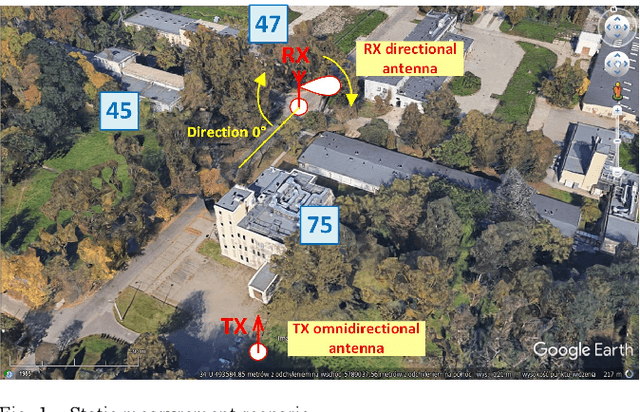
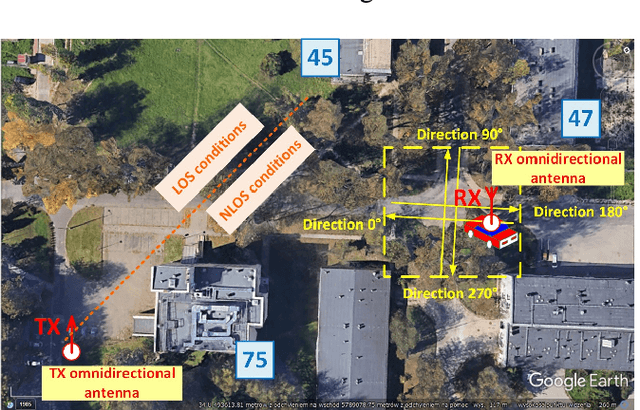
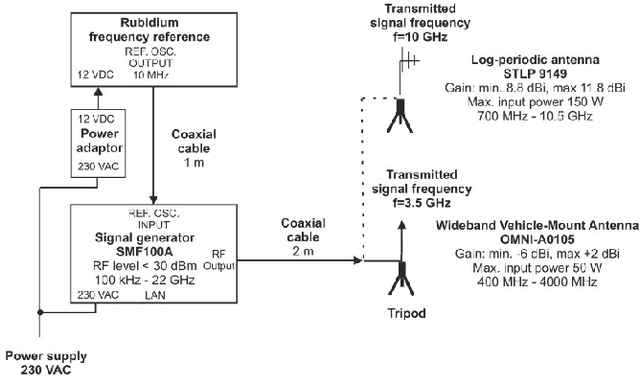
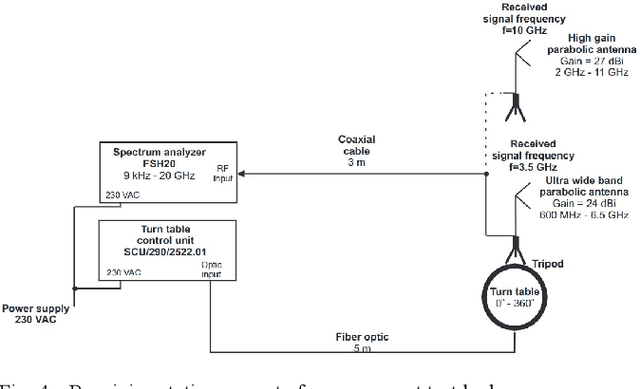
In this paper, we present an empirical verification of the method of determining the Doppler spectrum (DS) from the power angular spectrum (PAS). Measurements were made for the frequency of 3.5 GHz, under non-line-of-sight conditions in suburban areas characteristic of a university campus. In the static scenario, the measured PAS was the basis for the determination of DSs, which were compared with the DSs measured in the mobile scenario. The obtained results show that the proposed method gives some approximation to DS determined with the classic methods used so far.
* 5 pages, 7 figures, 1 table, 8 equations; 2023 17th European Conference on Antennas and Propagation (EuCAP), Florence, Italy, 26-31 Mar. 2023