 Add to Chrome
 Add to Firefox
 Add to Edge
Vehicle-to-Vehicle Millimeter-Wave Channel Characterization at 60 and 80 GHz
Mar 18, 2026
This paper presents results from a vehicle-to-vehicle channel measurement campaign conducted in the millimeter-wave (MMW) frequency bands at center frequencies of 60GHz and 80GHz, each with a bandwidth of 2GHz. The measurements were performed in a dynamic oncoming-vehicle scenario using a time-domain channel sounder with high-resolution data acquisition. Power delay profiles were extracted to study the temporal evolution of multipath components, and the root mean square (RMS) delay spread was analyzed to characterize the temporal dispersion of the channel. The results demonstrate differences between the two frequency bands. At 60GHz, the RMS delay spread is well approximated by a Gaussian distribution with a higher median value, while at 80GHz it follows a lognormal distribution with a lower median. Furthermore, the number of resolvable multipath components was found to be nearly twice as high at 60\,GHz compared to 80GHz, highlighting the impact of antenna beamwidth and frequency-dependent propagation mechanisms.
* 6 pages, 7 figures

Long-term channel analysis at 60 and 80 GHz for autonomous ground vehicles
Mar 24, 2025This paper presents a comprehensive measurement campaign aimed at evaluating indoor-to-indoor radio channels in dynamic scenarios, with a particular focus on applications such as autonomous ground vehicles (AGV). These scenarios are characterized by the height of the antennas, addressing the unique challenges of near-ground communication. Our study involves long-term measurements (20 minutes of continuous recording per measurement) of the channel impulse response (CIR) in the 60 GHz and 80 GHz frequency bands, each with a bandwidth of 2.048 GHz. We investigate the variations in channel characteristics, focusing on parameters such as root mean square (RMS) delay spread and the Rician factor.
* 6 pages, 9 figures, 2 tables
Large-scale Outdoor Cell-free mMIMO Channel Measurement in an Urban Scenario at 3.5 GHz
May 31, 2024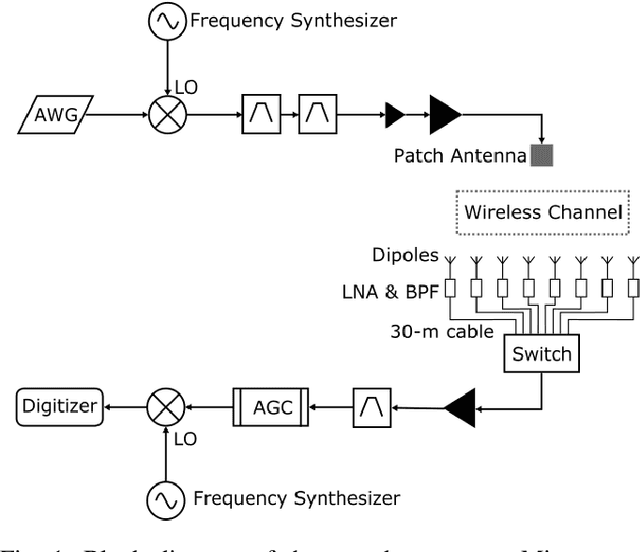
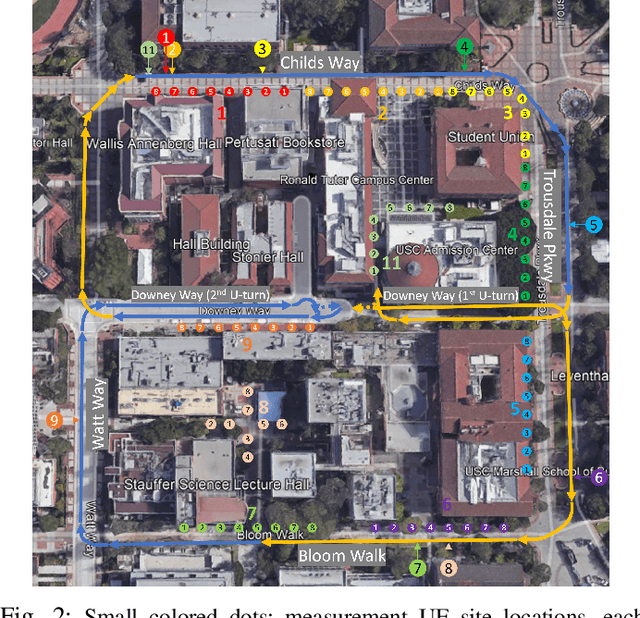
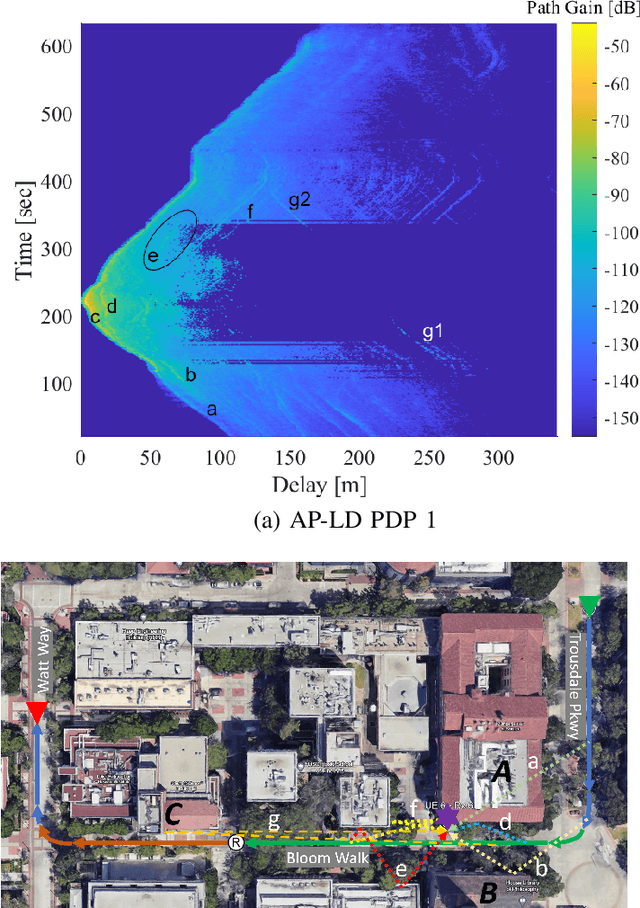
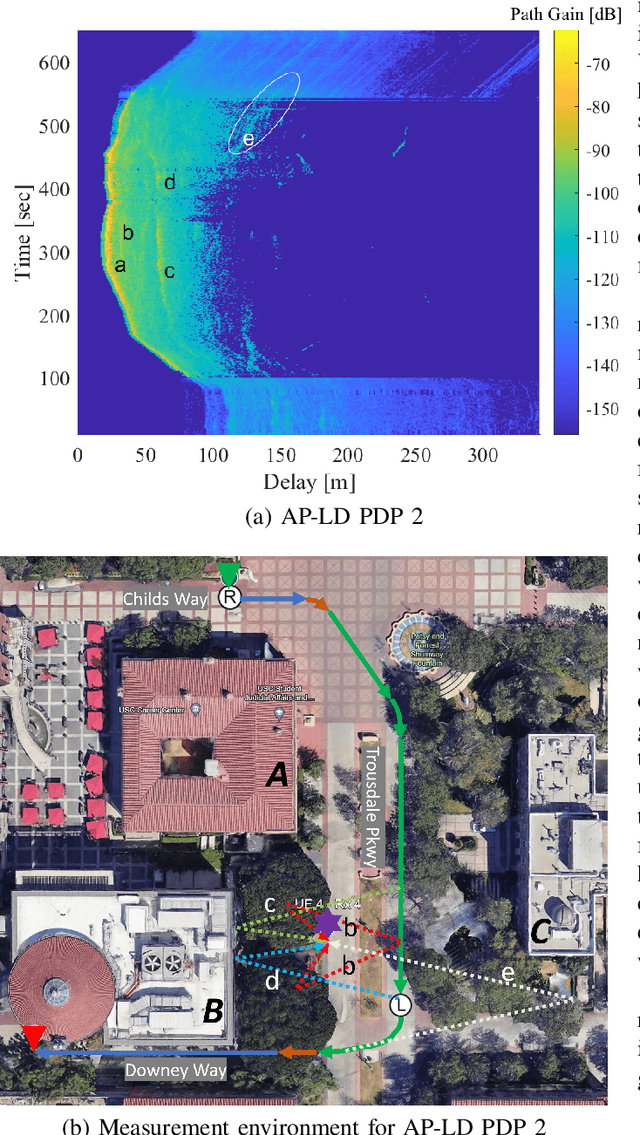
The design of cell-free massive MIMO (CF-mMIMO) systems requires accurate, measurement-based channel models. This paper provides the first results from the by far most extensive outdoor measurement campaign for CF-mMIMO channels in an urban environment. We measured impulse responses between over 20,000 potential access point (AP) locations and 80 user equipments (UEs) at 3.5 GHz with 350 MHz bandwidth (BW). Measurements use a "virtual array" approach at the AP and a hybrid switched/virtual approach at the UE. This paper describes the sounder design, measurement environment, data processing, and sample results, particularly the evolution of the power-delay profiles (PDPs) as a function of the AP locations, and its relation to the propagation environment.