 Add to Chrome
 Add to Firefox
 Add to Edge
DreamSampler: Unifying Diffusion Sampling and Score Distillation for Image Manipulation
Mar 18, 2024
Reverse sampling and score-distillation have emerged as main workhorses in recent years for image manipulation using latent diffusion models (LDMs). While reverse diffusion sampling often requires adjustments of LDM architecture or feature engineering, score distillation offers a simple yet powerful model-agnostic approach, but it is often prone to mode-collapsing. To address these limitations and leverage the strengths of both approaches, here we introduce a novel framework called {\em DreamSampler}, which seamlessly integrates these two distinct approaches through the lens of regularized latent optimization. Similar to score-distillation, DreamSampler is a model-agnostic approach applicable to any LDM architecture, but it allows both distillation and reverse sampling with additional guidance for image editing and reconstruction. Through experiments involving image editing, SVG reconstruction and etc, we demonstrate the competitive performance of DreamSampler compared to existing approaches, while providing new applications.

DreamMotion: Space-Time Self-Similarity Score Distillation for Zero-Shot Video Editing
Mar 18, 2024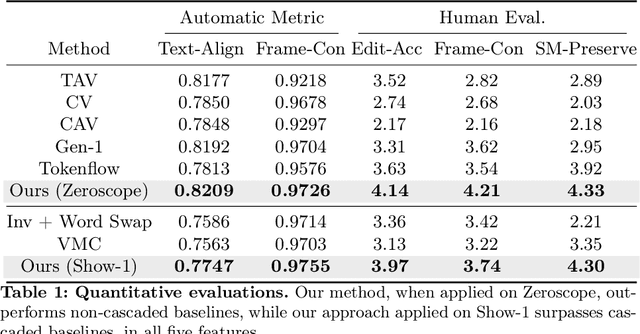


Text-driven diffusion-based video editing presents a unique challenge not encountered in image editing literature: establishing real-world motion. Unlike existing video editing approaches, here we focus on score distillation sampling to circumvent the standard reverse diffusion process and initiate optimization from videos that already exhibit natural motion. Our analysis reveals that while video score distillation can effectively introduce new content indicated by target text, it can also cause significant structure and motion deviation. To counteract this, we propose to match space-time self-similarities of the original video and the edited video during the score distillation. Thanks to the use of score distillation, our approach is model-agnostic, which can be applied for both cascaded and non-cascaded video diffusion frameworks. Through extensive comparisons with leading methods, our approach demonstrates its superiority in altering appearances while accurately preserving the original structure and motion.
UNICORN: Ultrasound Nakagami Imaging via Score Matching and Adaptation
Mar 10, 2024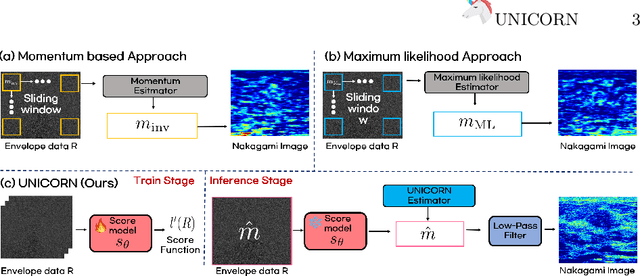
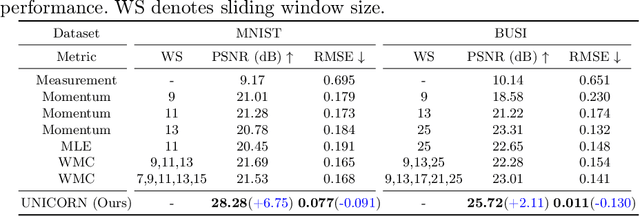
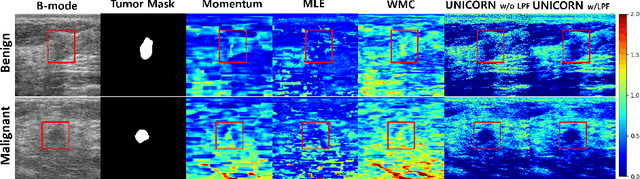
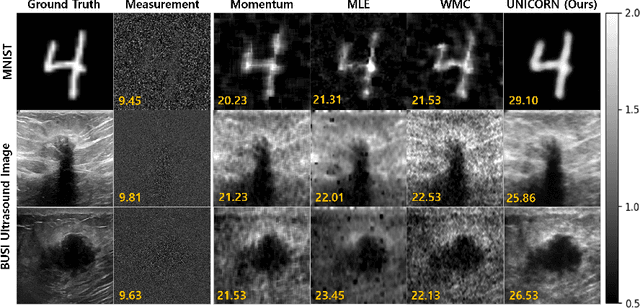
Nakagami imaging holds promise for visualizing and quantifying tissue scattering in ultrasound waves, with potential applications in tumor diagnosis and fat fraction estimation which are challenging to discern by conventional ultrasound B-mode images. Existing methods struggle with optimal window size selection and suffer from estimator instability, leading to degraded resolution images. To address this, here we propose a novel method called UNICORN (Ultrasound Nakagami Imaging via Score Matching and Adaptation), that offers an accurate, closed-form estimator for Nakagami parameter estimation in terms of the score function of ultrasonic envelope. Extensive experiments using simulation and real ultrasound RF data demonstrate UNICORN's superiority over conventional approaches in accuracy and resolution quality.
Latent Inversion with Timestep-aware Sampling for Training-free Non-rigid Editing
Feb 14, 2024


Text-guided non-rigid editing involves complex edits for input images, such as changing motion or compositions within their surroundings. Since it requires manipulating the input structure, existing methods often struggle with preserving object identity and background, particularly when combined with Stable Diffusion. In this work, we propose a training-free approach for non-rigid editing with Stable Diffusion, aimed at improving the identity preservation quality without compromising editability. Our approach comprises three stages: text optimization, latent inversion, and timestep-aware text injection sampling. Inspired by the recent success of Imagic, we employ their text optimization for smooth editing. Then, we introduce latent inversion to preserve the input image's identity without additional model fine-tuning. To fully utilize the input reconstruction ability of latent inversion, we suggest timestep-aware text inject sampling. This effectively retains the structure of the input image by injecting the source text prompt in early sampling steps and then transitioning to the target prompt in subsequent sampling steps. This strategic approach seamlessly harmonizes with text optimization, facilitating complex non-rigid edits to the input without losing the original identity. We demonstrate the effectiveness of our method in terms of identity preservation, editability, and aesthetic quality through extensive experiments.
Defining Neural Network Architecture through Polytope Structures of Dataset
Feb 04, 2024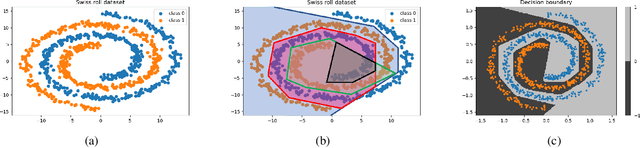
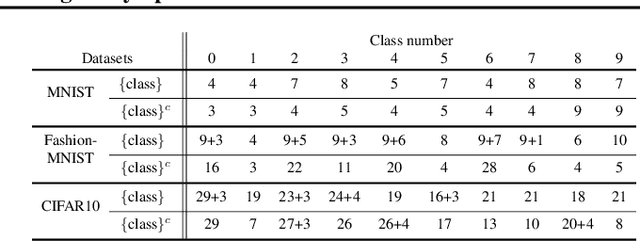
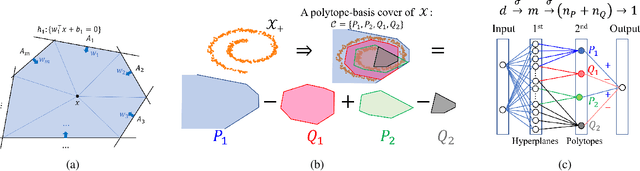
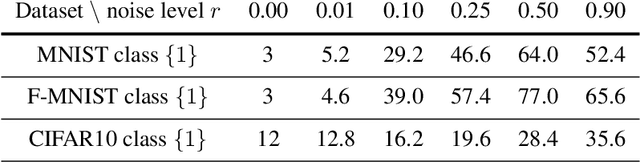
Current theoretical and empirical research in neural networks suggests that complex datasets require large network architectures for thorough classification, yet the precise nature of this relationship remains unclear. This paper tackles this issue by defining upper and lower bounds for neural network widths, which are informed by the polytope structure of the dataset in question. We also delve into the application of these principles to simplicial complexes and specific manifold shapes, explaining how the requirement for network width varies in accordance with the geometric complexity of the dataset. Moreover, we develop an algorithm to investigate a converse situation where the polytope structure of a dataset can be inferred from its corresponding trained neural networks. Through our algorithm, it is established that popular datasets such as MNIST, Fashion-MNIST, and CIFAR10 can be efficiently encapsulated using no more than two polytopes with a small number of faces.
Patch-wise Graph Contrastive Learning for Image Translation
Dec 13, 2023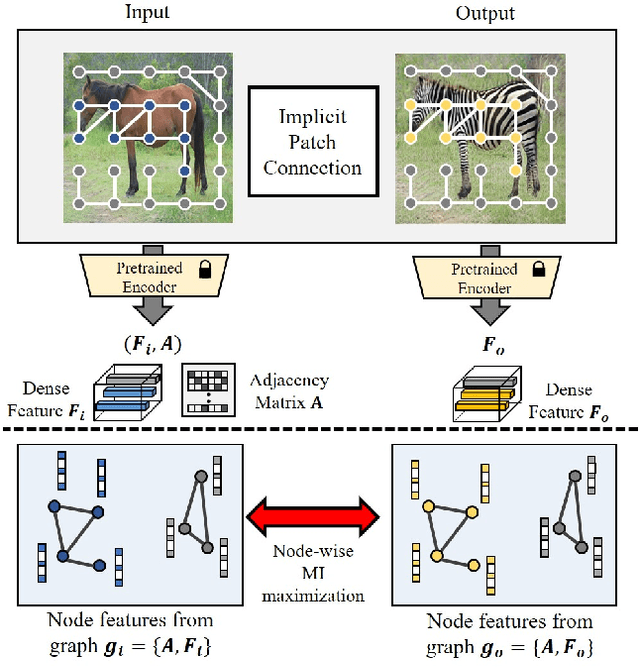
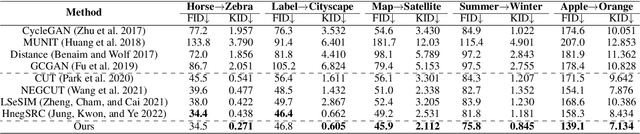
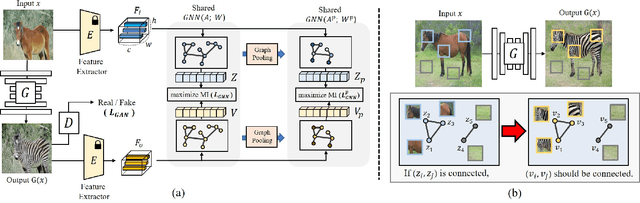
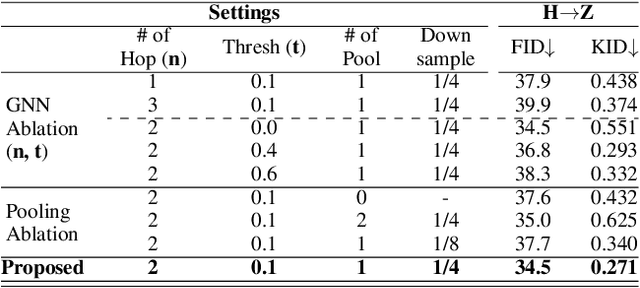
Recently, patch-wise contrastive learning is drawing attention for the image translation by exploring the semantic correspondence between the input and output images. To further explore the patch-wise topology for high-level semantic understanding, here we exploit the graph neural network to capture the topology-aware features. Specifically, we construct the graph based on the patch-wise similarity from a pretrained encoder, whose adjacency matrix is shared to enhance the consistency of patch-wise relation between the input and the output. Then, we obtain the node feature from the graph neural network, and enhance the correspondence between the nodes by increasing mutual information using the contrastive loss. In order to capture the hierarchical semantic structure, we further propose the graph pooling. Experimental results demonstrate the state-of-art results for the image translation thanks to the semantic encoding by the constructed graphs.
Breast Ultrasound Report Generation using LangChain
Dec 05, 2023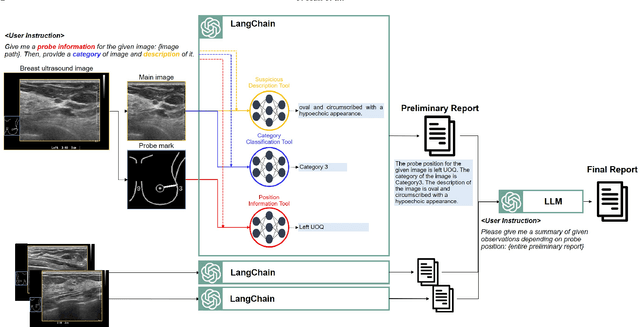
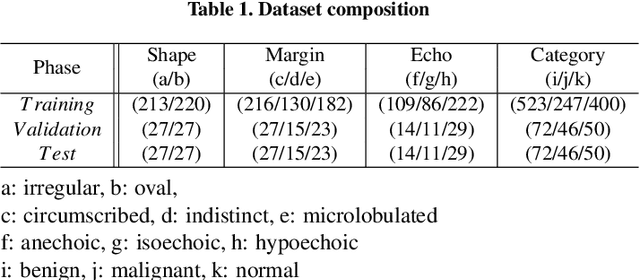
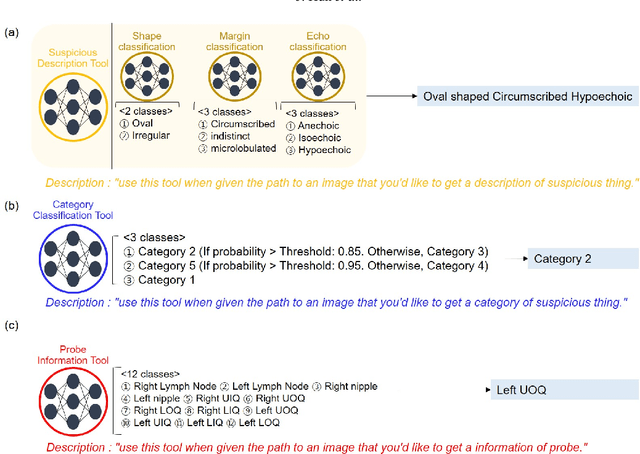
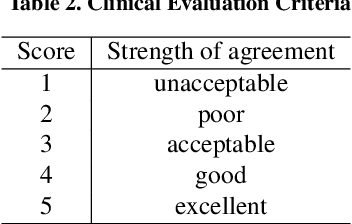
Breast ultrasound (BUS) is a critical diagnostic tool in the field of breast imaging, aiding in the early detection and characterization of breast abnormalities. Interpreting breast ultrasound images commonly involves creating comprehensive medical reports, containing vital information to promptly assess the patient's condition. However, the ultrasound imaging system necessitates capturing multiple images of various parts to compile a single report, presenting a time-consuming challenge. To address this problem, we propose the integration of multiple image analysis tools through a LangChain using Large Language Models (LLM), into the breast reporting process. Through a combination of designated tools and text generation through LangChain, our method can accurately extract relevant features from ultrasound images, interpret them in a clinical context, and produce comprehensive and standardized reports. This approach not only reduces the burden on radiologists and healthcare professionals but also enhances the consistency and quality of reports. The extensive experiments shows that each tools involved in the proposed method can offer qualitatively and quantitatively significant results. Furthermore, clinical evaluation on the generated reports demonstrates that the proposed method can make report in clinically meaningful way.
VMC: Video Motion Customization using Temporal Attention Adaption for Text-to-Video Diffusion Models
Dec 01, 2023Text-to-video diffusion models have advanced video generation significantly. However, customizing these models to generate videos with tailored motions presents a substantial challenge. In specific, they encounter hurdles in (a) accurately reproducing motion from a target video, and (b) creating diverse visual variations. For example, straightforward extensions of static image customization methods to video often lead to intricate entanglements of appearance and motion data. To tackle this, here we present the Video Motion Customization (VMC) framework, a novel one-shot tuning approach crafted to adapt temporal attention layers within video diffusion models. Our approach introduces a novel motion distillation objective using residual vectors between consecutive frames as a motion reference. The diffusion process then preserves low-frequency motion trajectories while mitigating high-frequency motion-unrelated noise in image space. We validate our method against state-of-the-art video generative models across diverse real-world motions and contexts. Our codes, data and the project demo can be found at https://video-motion-customization.github.io
Contrastive Denoising Score for Text-guided Latent Diffusion Image Editing
Nov 30, 2023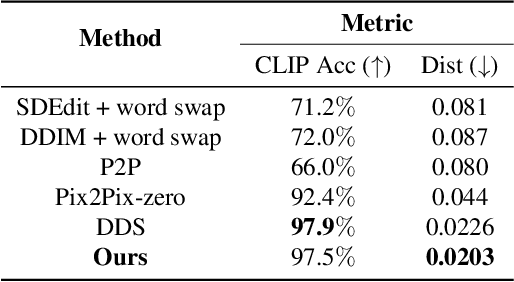
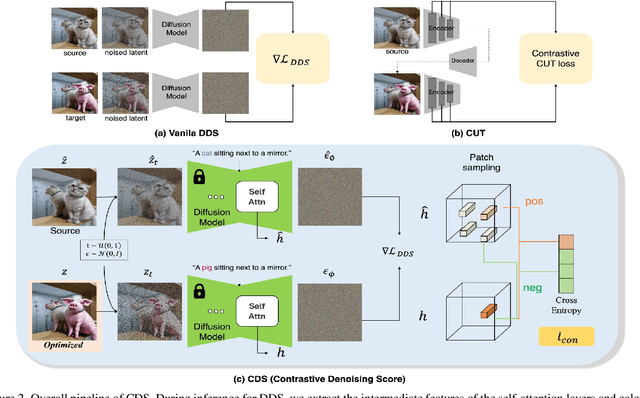
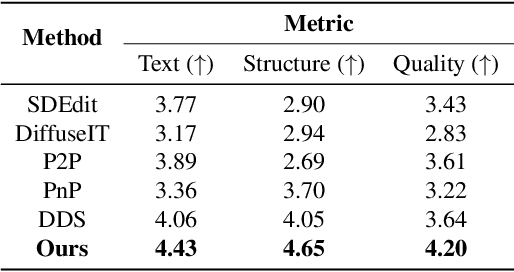
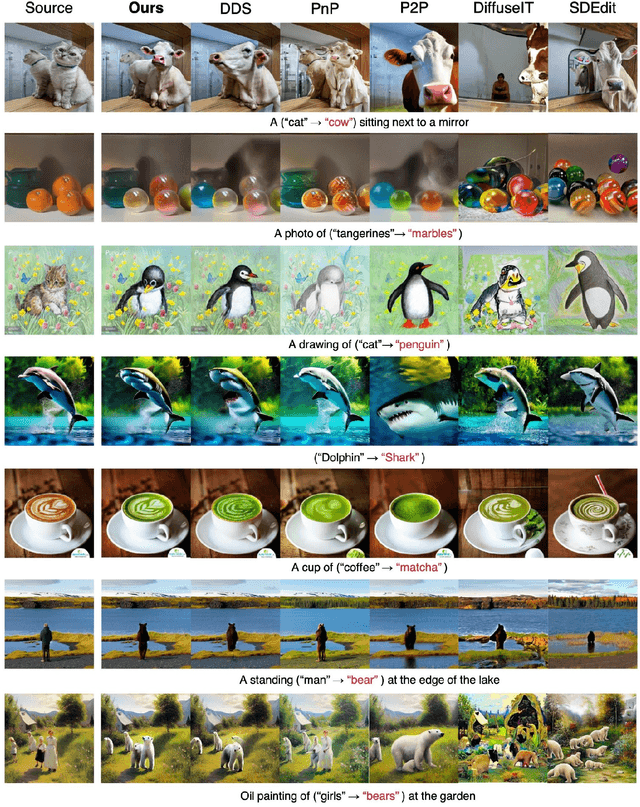
With the remarkable advent of text-to-image diffusion models, image editing methods have become more diverse and continue to evolve. A promising recent approach in this realm is Delta Denoising Score (DDS) - an image editing technique based on Score Distillation Sampling (SDS) framework that leverages the rich generative prior of text-to-image diffusion models. However, relying solely on the difference between scoring functions is insufficient for preserving specific structural elements from the original image, a crucial aspect of image editing. Inspired by the similarity and importance differences between DDS and the contrastive learning for unpaired image-to-image translation (CUT), here we present an embarrassingly simple yet very powerful modification of DDS, called Contrastive Denoising Score (CDS), for latent diffusion models (LDM). Specifically, to enforce structural correspondence between the input and output while maintaining the controllability of contents, we introduce a straightforward approach to regulate structural consistency using CUT loss within the DDS framework. To calculate this loss, instead of employing auxiliary networks, we utilize the intermediate features of LDM, in particular, those from the self-attention layers, which possesses rich spatial information. Our approach enables zero-shot image-to-image translation and neural radiance field (NeRF) editing, achieving a well-balanced interplay between maintaining the structural details and transforming content. Qualitative results and comparisons demonstrates the effectiveness of our proposed method. Project page with code is available at https://hyelinnam.github.io/CDS/.
Regularization by Texts for Latent Diffusion Inverse Solvers
Nov 27, 2023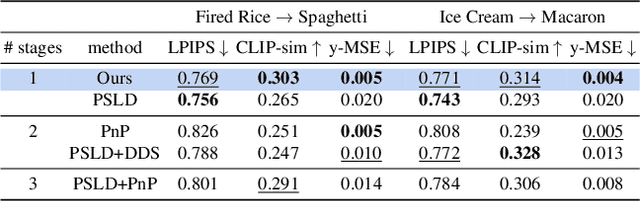
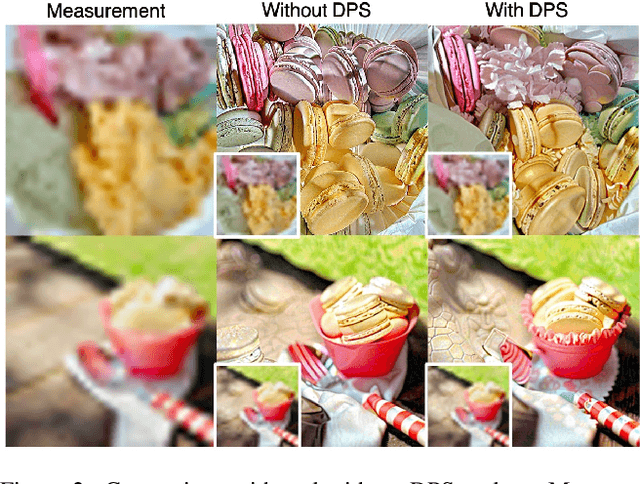
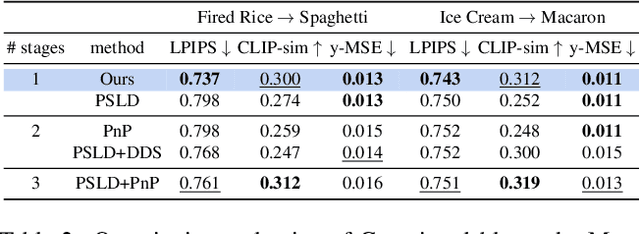
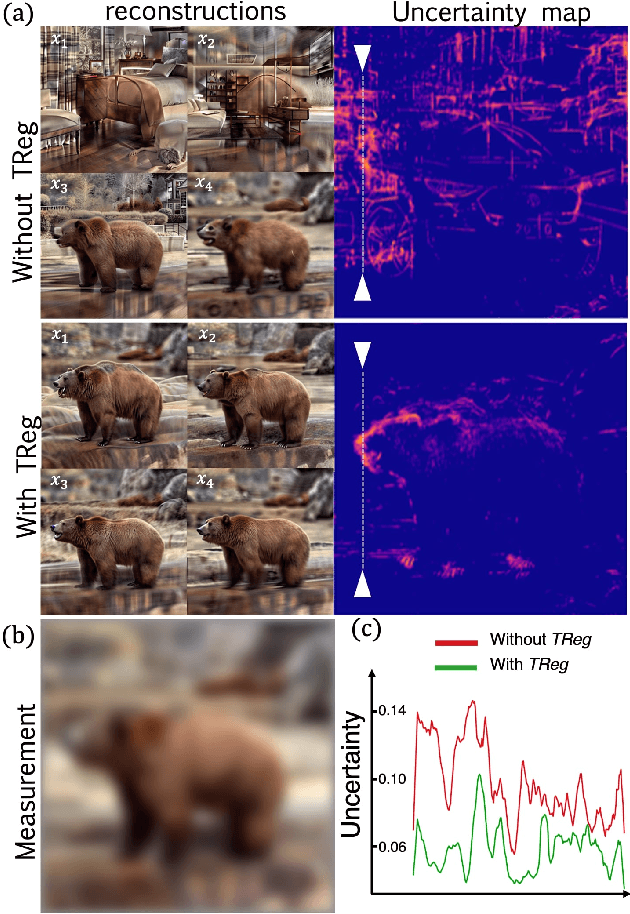
The recent advent of diffusion models has led to significant progress in solving inverse problems, leveraging these models as effective generative priors. Nonetheless, challenges related to the ill-posed nature of such problems remain, often due to inherent ambiguities in measurements. Drawing inspiration from the human ability to resolve visual ambiguities through perceptual biases, here we introduce a novel latent diffusion inverse solver by incorporating regularization by texts (TReg). Specifically, TReg applies the textual description of the preconception of the solution during the reverse sampling phase, of which description isndynamically reinforced through null-text optimization for adaptive negation. Our comprehensive experimental results demonstrate that TReg successfully mitigates ambiguity in latent diffusion inverse solvers, enhancing their effectiveness and accuracy.