 Add to Chrome
 Add to Firefox
 Add to Edge
Spectral Embeddings of Degree-$α$ Laplacians in Random Dot Product Graphs
Aug 11, 2026
Spectral clustering methods for network data are commonly based on a few matrix representations, such as the adjacency matrix and the symmetric Laplacian. We study a continuum of degree-normalized spectral embeddings that includes these commonly used choices as special cases. Under a random dot product graph model, we establish a row-wise central limit theorem for this family of embeddings. The result provides an explicit description of how degree normalization affects both population geometry and the local uncertainty of embedded nodes. We use the limiting distributions to compare different normalizations in two-community stochastic block models through a projected-Gaussian Bayes-error diagnostic. These comparisons show that no single normalization is uniformly preferred. Instead, the favored normalization depends on network density, community imbalance, and block-probability structure. Typically, stronger normalization is favored in lower-density or more imbalanced settings. These results provide a unified distributional understanding of when and why alternative normalizations may improve spectral clustering.

Challenges in Representation Learning: A report on three machine learning contests
Jul 01, 2013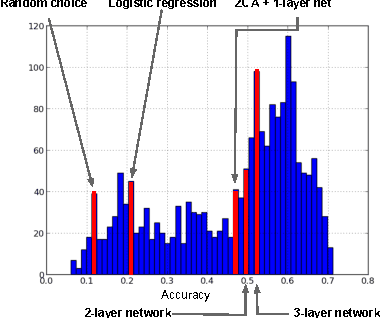

The ICML 2013 Workshop on Challenges in Representation Learning focused on three challenges: the black box learning challenge, the facial expression recognition challenge, and the multimodal learning challenge. We describe the datasets created for these challenges and summarize the results of the competitions. We provide suggestions for organizers of future challenges and some comments on what kind of knowledge can be gained from machine learning competitions.