 Add to Chrome
 Add to Firefox
 Add to Edge
Meta-Learning for Rapid Adaptation in Reference Tracking of Uncertain Nonlinear Systems
May 21, 2026
In this paper, we address the problem of reference tracking for uncertain nonlinear systems. Since collecting data from the target system (i.e., the system of interest) is often challenging, our objective is to design optimal controllers using limited target system data. Meta-learning provides a promising paradigm by leveraging offline data from source systems (systems sharing structural similarities with the target system) to accelerate training and enhance control performance. Motivated by this idea, we propose a meta-learning-based control framework that tailors the implicit model-agnostic meta-learning (iMAML) algorithm to the control setting. The framework operates in two phases: an (offline) meta-training phase, where an aggregated representation is learned from source data to capture the shared system dynamics among similar systems, and an (online) meta-adaptation phase, where this representation is fine-tuned on the target system using only a few data samples and limited adaptation steps. We formulate this framework as a bi-level optimization problem and provide an efficient solution with reduced storage complexity and few approximations. The proposed framework is general, allowing various learning algorithms to be integrated. To demonstrate this flexibility, we propose two specific learning algorithms that can be incorporated into our framework based on a neural state-space model and a deep Q-network, respectively. The primary distinction between these approaches is whether explicit system identification is required. Numerical simulations and hardware experiments demonstrate that the proposed methods enhance control performance and consistently outperform baseline approaches.

Deep Reinforcement Learning for Flexible Job Shop Scheduling with Random Job Arrivals
May 21, 2026The Flexible Job Shop Scheduling Problem (FJSP) is the optimal allocation of a set of jobs to machines. Two primary challenges persist in FJSP: the unpredictable arrival of future jobs and the combinatorial complexity of the problem, rendering it intractable for conventional mixed-integer linear programming solvers. This paper proposes an event-based \gls{DRL} approach to solve FJSP with random job arrivals. Specifically, we employ the Proximal Policy Optimization algorithm and use lightweight Multi-Layer Perceptrons to train the \gls{DRL} agent for minimizing the total completion time of all jobs. We design the state representation to be directly accessible from the environment, and limit the learning agent to selecting from among a set of well-established dispatching rules. Simulations show that our \gls{DRL} approach outperforms any of the individual dispatching rules on datasets with varying heterogeneity and job arrival rates. We benchmark our \gls{DRL} against an arrival-triggered mixed-integer linear programming solution and show that our method achieves good performance especially when the datasets are heterogeneous.
Data-driven generalized perimeter control: Zürich case study
Mar 17, 2026Urban traffic congestion is a key challenge for the development of modern cities, requiring advanced control techniques to optimize existing infrastructures usage. Despite the extensive availability of data, modeling such complex systems remains an expensive and time consuming step when designing model-based control approaches. On the other hand, machine learning approaches require simulations to bootstrap models, or are unable to deal with the sparse nature of traffic data and enforce hard constraints. We propose a novel formulation of traffic dynamics based on behavioral systems theory and apply data-enabled predictive control to steer traffic dynamics via dynamic traffic light control. A high-fidelity simulation of the city of Zürich, the largest closed-loop microscopic simulation of urban traffic in the literature to the best of our knowledge, is used to validate the performance of the proposed method in terms of total travel time and CO2 emissions.
Wasserstein Distributionally Robust Bayesian Optimization with Continuous Context
Mar 26, 2025We address the challenge of sequential data-driven decision-making under context distributional uncertainty. This problem arises in numerous real-world scenarios where the learner optimizes black-box objective functions in the presence of uncontrollable contextual variables. We consider the setting where the context distribution is uncertain but known to lie within an ambiguity set defined as a ball in the Wasserstein distance. We propose a novel algorithm for Wasserstein Distributionally Robust Bayesian Optimization that can handle continuous context distributions while maintaining computational tractability. Our theoretical analysis combines recent results in self-normalized concentration in Hilbert spaces and finite-sample bounds for distributionally robust optimization to establish sublinear regret bounds that match state-of-the-art results. Through extensive comparisons with existing approaches on both synthetic and real-world problems, we demonstrate the simplicity, effectiveness, and practical applicability of our proposed method.
Contractivity and linear convergence in bilinear saddle-point problems: An operator-theoretic approach
Oct 18, 2024
We study the convex-concave bilinear saddle-point problem $\min_x \max_y f(x) + y^\top Ax - g(y)$, where both, only one, or none of the functions $f$ and $g$ are strongly convex, and suitable rank conditions on the matrix $A$ hold. The solution of this problem is at the core of many machine learning tasks. By employing tools from operator theory, we systematically prove the contractivity (in turn, the linear convergence) of several first-order primal-dual algorithms, including the Chambolle-Pock method. Our approach results in concise and elegant proofs, and it yields new convergence guarantees and tighter bounds compared to known results.
Safe Time-Varying Optimization based on Gaussian Processes with Spatio-Temporal Kernel
Sep 26, 2024Ensuring safety is a key aspect in sequential decision making problems, such as robotics or process control. The complexity of the underlying systems often makes finding the optimal decision challenging, especially when the safety-critical system is time-varying. Overcoming the problem of optimizing an unknown time-varying reward subject to unknown time-varying safety constraints, we propose TVSafeOpt, a new algorithm built on Bayesian optimization with a spatio-temporal kernel. The algorithm is capable of safely tracking a time-varying safe region without the need for explicit change detection. Optimality guarantees are also provided for the algorithm when the optimization problem becomes stationary. We show that TVSafeOpt compares favorably against SafeOpt on synthetic data, both regarding safety and optimality. Evaluation on a realistic case study with gas compressors confirms that TVSafeOpt ensures safety when solving time-varying optimization problems with unknown reward and safety functions.
Online Residual Learning from Offline Experts for Pedestrian Tracking
Sep 09, 2024In this paper, we consider the problem of predicting unknown targets from data. We propose Online Residual Learning (ORL), a method that combines online adaptation with offline-trained predictions. At a lower level, we employ multiple offline predictions generated before or at the beginning of the prediction horizon. We augment every offline prediction by learning their respective residual error concerning the true target state online, using the recursive least squares algorithm. At a higher level, we treat the augmented lower-level predictors as experts, adopting the Prediction with Expert Advice framework. We utilize an adaptive softmax weighting scheme to form an aggregate prediction and provide guarantees for ORL in terms of regret. We employ ORL to boost performance in the setting of online pedestrian trajectory prediction. Based on data from the Stanford Drone Dataset, we show that ORL can demonstrate best-of-both-worlds performance.
Randomized algorithms and PAC bounds for inverse reinforcement learning in continuous spaces
May 24, 2024This work studies discrete-time discounted Markov decision processes with continuous state and action spaces and addresses the inverse problem of inferring a cost function from observed optimal behavior. We first consider the case in which we have access to the entire expert policy and characterize the set of solutions to the inverse problem by using occupation measures, linear duality, and complementary slackness conditions. To avoid trivial solutions and ill-posedness, we introduce a natural linear normalization constraint. This results in an infinite-dimensional linear feasibility problem, prompting a thorough analysis of its properties. Next, we use linear function approximators and adopt a randomized approach, namely the scenario approach and related probabilistic feasibility guarantees, to derive epsilon-optimal solutions for the inverse problem. We further discuss the sample complexity for a desired approximation accuracy. Finally, we deal with the more realistic case where we only have access to a finite set of expert demonstrations and a generative model and provide bounds on the error made when working with samples.
MPC of Uncertain Nonlinear Systems with Meta-Learning for Fast Adaptation of Neural Predictive Models
Apr 18, 2024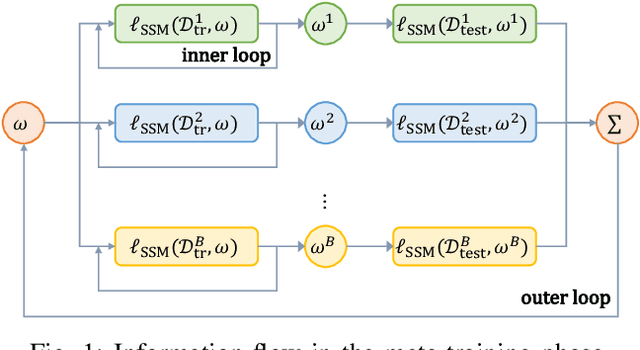
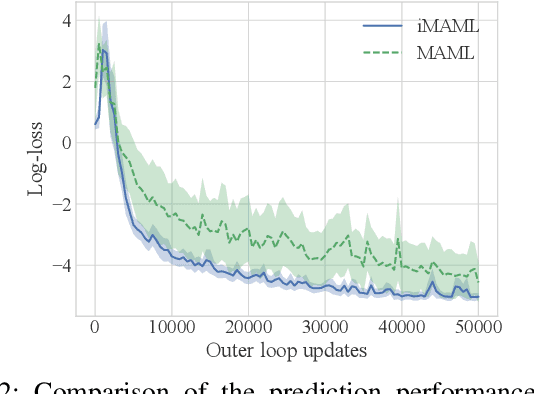
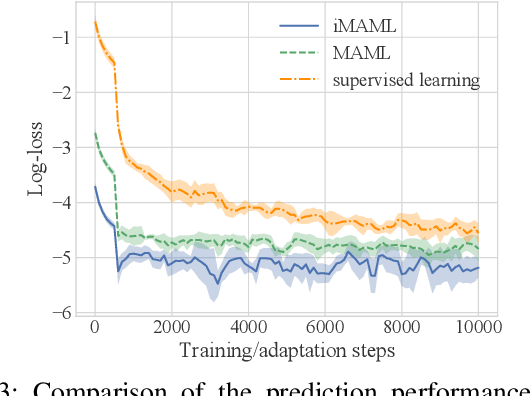

In this paper, we consider the problem of reference tracking in uncertain nonlinear systems. A neural State-Space Model (NSSM) is used to approximate the nonlinear system, where a deep encoder network learns the nonlinearity from data, and a state-space component captures the temporal relationship. This transforms the nonlinear system into a linear system in a latent space, enabling the application of model predictive control (MPC) to determine effective control actions. Our objective is to design the optimal controller using limited data from the \textit{target system} (the system of interest). To this end, we employ an implicit model-agnostic meta-learning (iMAML) framework that leverages information from \textit{source systems} (systems that share similarities with the target system) to expedite training in the target system and enhance its control performance. The framework consists of two phases: the (offine) meta-training phase learns a aggregated NSSM using data from source systems, and the (online) meta-inference phase quickly adapts this aggregated model to the target system using only a few data points and few online training iterations, based on local loss function gradients. The iMAML algorithm exploits the implicit function theorem to exactly compute the gradient during training, without relying on the entire optimization path. By focusing solely on the optimal solution, rather than the path, we can meta-train with less storage complexity and fewer approximations than other contemporary meta-learning algorithms. We demonstrate through numerical examples that our proposed method can yield accurate predictive models by adaptation, resulting in a downstream MPC that outperforms several baselines.
Finite Sample Frequency Domain Identification
Apr 01, 2024We study non-parametric frequency-domain system identification from a finite-sample perspective. We assume an open loop scenario where the excitation input is periodic and consider the Empirical Transfer Function Estimate (ETFE), where the goal is to estimate the frequency response at certain desired (evenly-spaced) frequencies, given input-output samples. We show that under sub-Gaussian colored noise (in time-domain) and stability assumptions, the ETFE estimates are concentrated around the true values. The error rate is of the order of $\mathcal{O}((d_{\mathrm{u}}+\sqrt{d_{\mathrm{u}}d_{\mathrm{y}}})\sqrt{M/N_{\mathrm{tot}}})$, where $N_{\mathrm{tot}}$ is the total number of samples, $M$ is the number of desired frequencies, and $d_{\mathrm{u}},\,d_{\mathrm{y}}$ are the dimensions of the input and output signals respectively. This rate remains valid for general irrational transfer functions and does not require a finite order state-space representation. By tuning $M$, we obtain a $N_{\mathrm{tot}}^{-1/3}$ finite-sample rate for learning the frequency response over all frequencies in the $ \mathcal{H}_{\infty}$ norm. Our result draws upon an extension of the Hanson-Wright inequality to semi-infinite matrices. We study the finite-sample behavior of ETFE in simulations.