 Add to Chrome
 Add to Firefox
 Add to Edge
Enhanced Portable Ultra Low-Field Diffusion Tensor Imaging with Bayesian Artifact Correction and Deep Learning-Based Super-Resolution
Feb 11, 2026
Portable, ultra-low-field (ULF) magnetic resonance imaging has the potential to expand access to neuroimaging but currently suffers from coarse spatial and angular resolutions and low signal-to-noise ratios. Diffusion tensor imaging (DTI), a sequence tailored to detect and reconstruct white matter tracts within the brain, is particularly prone to such imaging degradation due to inherent sequence design coupled with prolonged scan times. In addition, ULF DTI scans exhibit artifacting that spans both the space and angular domains, requiring a custom modelling algorithm for subsequent correction. We introduce a nine-direction, single-shell ULF DTI sequence, as well as a companion Bayesian bias field correction algorithm that possesses angular dependence and convolutional neural network-based superresolution algorithm that is generalizable across DTI datasets and does not require re-training (''DiffSR''). We show through a synthetic downsampling experiment and white matter assessment in real, matched ULF and high-field DTI scans that these algorithms can recover microstructural and volumetric white matter information at ULF. We also show that DiffSR can be directly applied to white matter-based Alzheimers disease classification in synthetically degraded scans, with notable improvements in agreement between DTI metrics, as compared to un-degraded scans. We freely disseminate the Bayesian bias correction algorithm and DiffSR with the goal of furthering progress on both ULF reconstruction methods and general DTI sequence harmonization. We release all code related to DiffSR for $\href{https://github.com/markolchanyi/DiffSR}{public \space use}$.

Quantifying white matter hyperintensity and brain volumes in heterogeneous clinical and low-field portable MRI
Dec 08, 2023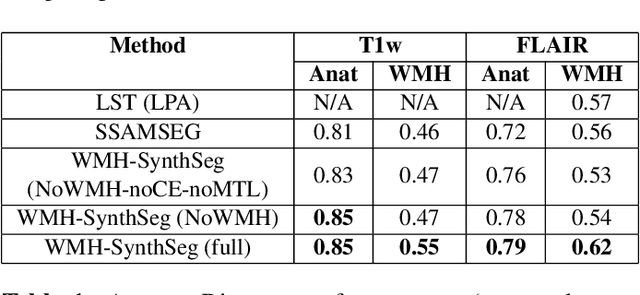
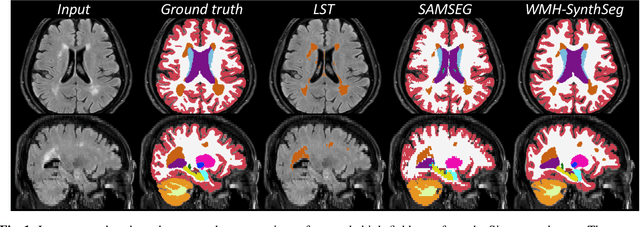
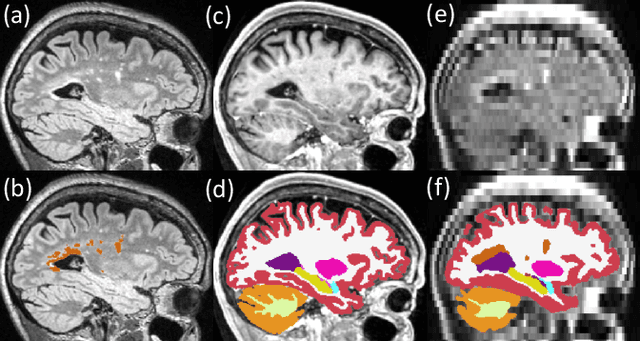
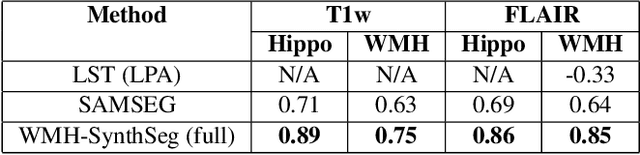
Brain atrophy and white matter hyperintensity (WMH) are critical neuroimaging features for ascertaining brain injury in cerebrovascular disease and multiple sclerosis. Automated segmentation and quantification is desirable but existing methods require high-resolution MRI with good signal-to-noise ratio (SNR). This precludes application to clinical and low-field portable MRI (pMRI) scans, thus hampering large-scale tracking of atrophy and WMH progression, especially in underserved areas where pMRI has huge potential. Here we present a method that segments white matter hyperintensity and 36 brain regions from scans of any resolution and contrast (including pMRI) without retraining. We show results on six public datasets and on a private dataset with paired high- and low-field scans (3T and 64mT), where we attain strong correlation between the WMH ($\rho$=.85) and hippocampal volumes (r=.89) estimated at both fields. Our method is publicly available as part of FreeSurfer, at: http://surfer.nmr.mgh.harvard.edu/fswiki/WMH-SynthSeg.