 Add to Chrome
 Add to Firefox
 Add to Edge
Bridging Spherical Black-Box Optimizers
Jun 24, 2026
When gradient information is unavailable, black-box optimization (BBO) methods provide a practical alternative. While Evolution Strategies (ES), Consensus-Based Optimization (CBO), Optimization via Integration (OVI), and related methods have each been studied independently, their connections remain underexplored. We unify these approaches within a common theoretical framework, revealing that they differ primarily in two design choices: fitness aggregation (controlling sharpness preference) and consensus scope (controlling modality). Leveraging these insights, we introduce hybrid optimizers that interpolate between existing methods. Our ES-OVI hybrid allows explicit control over the preference for flat minima, enabling a trade-off between performance and robustness in continuous control tasks. Our CBO-OVI hybrids combine the higher-dimensional efficiency of parametric methods with the multimodal capabilities of particle-based approaches, achieving competitive results on language model merging under limited evaluation budgets. We validate our methods on standard BBO benchmarks and higher-dimensional locomotion tasks, demonstrating that the hybrid methods can outperform their constituent algorithms.

KamonBench: A Grammar-Based Dataset for Evaluating Compositional Factor Recovery in Vision-Language Models
May 13, 2026Kamon (family crests) are an important part of Japanese culture and a natural test case for compositional visual recognition: each crest combines a small number of symbolic choices, but the space of possible descriptions is sparse. We introduce KamonBench, a grammar-based image-to-structure benchmark with 20,000 synthetic composite crests and auxiliary component examples. Each composite crest is paired with a formal kamon description language - "kamon yōgo" - description, a segmented Japanese analysis, an English translation, and a non-linguistic program code. Because each synthetic crest is generated from known factors, namely container, modifier, and motif, KamonBench supports evaluation beyond caption-level accuracy: direct program-code factor metrics, controlled factor-pair recombination splits, counterfactual motif-sensitivity groups under fixed container-modifier contexts, and linear probes of factor accessibility. We include baseline results for a ViT encoder/Transformer decoder and two VGG n-gram decoders, with and without learned positional masks. KamonBench therefore provides a controlled testbed for sparse compositional visual recognition and factor recovery in vision-language models.
Sparser, Faster, Lighter Transformer Language Models
Mar 24, 2026Scaling autoregressive large language models (LLMs) has driven unprecedented progress but comes with vast computational costs. In this work, we tackle these costs by leveraging unstructured sparsity within an LLM's feedforward layers, the components accounting for most of the model parameters and execution FLOPs. To achieve this, we introduce a new sparse packing format and a set of CUDA kernels designed to seamlessly integrate with the optimized execution pipelines of modern GPUs, enabling efficient sparse computation during LLM inference and training. To substantiate our gains, we provide a quantitative study of LLM sparsity, demonstrating that simple L1 regularization can induce over 99% sparsity with negligible impact on downstream performance. When paired with our kernels, we show that these sparsity levels translate into substantial throughput, energy efficiency, and memory usage benefits that increase with model scale. We will release all code and kernels under an open-source license to promote adoption and accelerate research toward establishing sparsity as a practical axis for improving the efficiency and scalability of modern foundation models.
BM$^2$: Coupled Schrödinger Bridge Matching
Sep 14, 2024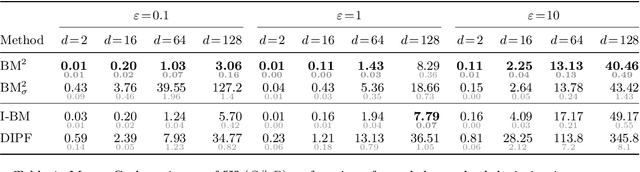
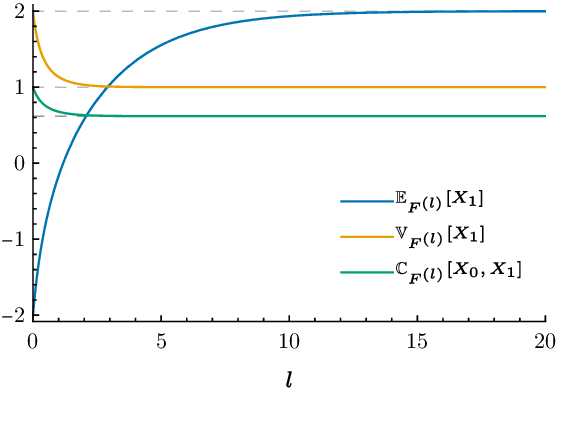
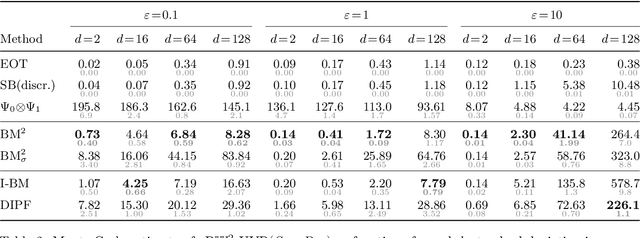
A Schr\"{o}dinger bridge establishes a dynamic transport map between two target distributions via a reference process, simultaneously solving an associated entropic optimal transport problem. We consider the setting where samples from the target distributions are available, and the reference diffusion process admits tractable dynamics. We thus introduce Coupled Bridge Matching (BM$^2$), a simple \emph{non-iterative} approach for learning Schr\"{o}dinger bridges with neural networks. A preliminary theoretical analysis of the convergence properties of BM$^2$ is carried out, supported by numerical experiments that demonstrate the effectiveness of our proposal.
Non-Denoising Forward-Time Diffusions
Dec 22, 2023The scope of this paper is generative modeling through diffusion processes. An approach falling within this paradigm is the work of Song et al. (2021), which relies on a time-reversal argument to construct a diffusion process targeting the desired data distribution. We show that the time-reversal argument, common to all denoising diffusion probabilistic modeling proposals, is not necessary. We obtain diffusion processes targeting the desired data distribution by taking appropriate mixtures of diffusion bridges. The resulting transport is exact by construction, allows for greater flexibility in choosing the dynamics of the underlying diffusion, and can be approximated by means of a neural network via novel training objectives. We develop a unifying view of the drift adjustments corresponding to our and to time-reversal approaches and make use of this representation to inspect the inner workings of diffusion-based generative models. Finally, we leverage on scalable simulation and inference techniques common in spatial statistics to move beyond fully factorial distributions in the underlying diffusion dynamics. The methodological advances contained in this work contribute toward establishing a general framework for generative modeling based on diffusion processes.
Diffusion Bridge Mixture Transports, Schrödinger Bridge Problems and Generative Modeling
Apr 03, 2023The dynamic Schr\"odinger bridge problem seeks a stochastic process that defines a transport between two target probability measures, while optimally satisfying the criteria of being closest, in terms of Kullback-Leibler divergence, to a reference process. We propose a novel sampling-based iterative algorithm, the iterated diffusion bridge mixture transport (IDBM), aimed at solving the dynamic Schr\"odinger bridge problem. The IDBM procedure exhibits the attractive property of realizing a valid coupling between the target measures at each step. We perform an initial theoretical investigation of the IDBM procedure, establishing its convergence properties. The theoretical findings are complemented by numerous numerical experiments illustrating the competitive performance of the IDBM procedure across various applications. Recent advancements in generative modeling employ the time-reversal of a diffusion process to define a generative process that approximately transports a simple distribution to the data distribution. As an alternative, we propose using the first iteration of the IDBM procedure as an approximation-free method for realizing this transport. This approach offers greater flexibility in selecting the generative process dynamics and exhibits faster training and superior sample quality over longer discretization intervals. In terms of implementation, the necessary modifications are minimally intrusive, being limited to the training loss computation, with no changes necessary for generative sampling.
Neural tangent kernel analysis of shallow $α$-Stable ReLU neural networks
Jun 18, 2022
There is a recent literature on large-width properties of Gaussian neural networks (NNs), i.e. NNs whose weights are distributed according to Gaussian distributions. Two popular problems are: i) the study of the large-width behaviour of NNs, which provided a characterization of the infinitely wide limit of a rescaled NN in terms of a Gaussian process; ii) the study of the training dynamics of NNs, which set forth a large-width equivalence between training the rescaled NN and performing a kernel regression with a deterministic kernel referred to as the neural tangent kernel (NTK). In this paper, we consider these problems for $\alpha$-Stable NNs, which generalize Gaussian NNs by assuming that the NN's weights are distributed as $\alpha$-Stable distributions with $\alpha\in(0,2]$, i.e. distributions with heavy tails. For shallow $\alpha$-Stable NNs with a ReLU activation function, we show that if the NN's width goes to infinity then a rescaled NN converges weakly to an $\alpha$-Stable process, i.e. a stochastic process with $\alpha$-Stable finite-dimensional distributions. As a novelty with respect to the Gaussian setting, in the $\alpha$-Stable setting the choice of the activation function affects the scaling of the NN, namely: to achieve the infinitely wide $\alpha$-Stable process, the ReLU function requires an additional logarithmic scaling with respect to sub-linear functions. Then, our main contribution is the NTK analysis of shallow $\alpha$-Stable ReLU-NNs, which leads to a large-width equivalence between training a rescaled NN and performing a kernel regression with an $(\alpha/2)$-Stable random kernel. The randomness of such a kernel is a novelty with respect to the Gaussian setting, namely: in the $\alpha$-Stable setting the randomness of the NN at initialization does not vanish in the NTK analysis, thus inducing a distribution for the kernel of the underlying kernel regression.
Deep Stable neural networks: large-width asymptotics and convergence rates
Aug 02, 2021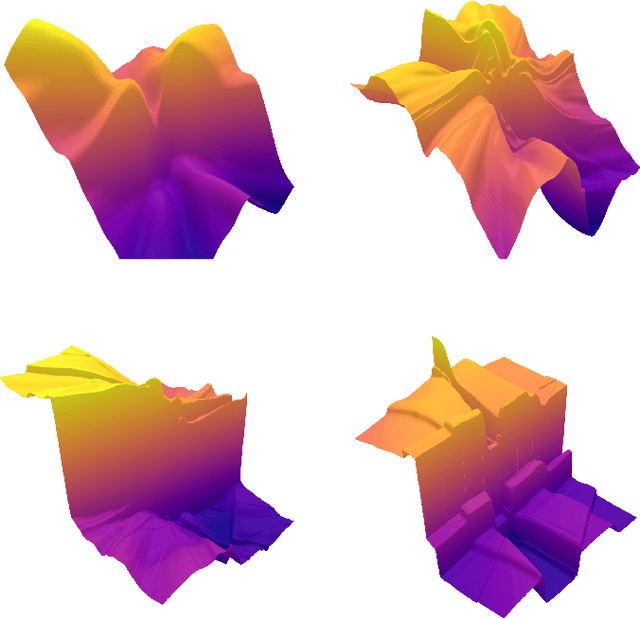
In modern deep learning, there is a recent and growing literature on the interplay between large-width asymptotics for deep Gaussian neural networks (NNs), i.e. deep NNs with Gaussian-distributed weights, and classes of Gaussian stochastic processes (SPs). Such an interplay has proved to be critical in several contexts of practical interest, e.g. Bayesian inference under Gaussian SP priors, kernel regression for infinite-wide deep NNs trained via gradient descent, and information propagation within infinite-wide NNs. Motivated by empirical analysis, showing the potential of replacing Gaussian distributions with Stable distributions for the NN's weights, in this paper we investigate large-width asymptotics for (fully connected) feed-forward deep Stable NNs, i.e. deep NNs with Stable-distributed weights. First, we show that as the width goes to infinity jointly over the NN's layers, a suitable rescaled deep Stable NN converges weakly to a Stable SP whose distribution is characterized recursively through the NN's layers. Because of the non-triangular NN's structure, this is a non-standard asymptotic problem, to which we propose a novel and self-contained inductive approach, which may be of independent interest. Then, we establish sup-norm convergence rates of a deep Stable NN to a Stable SP, quantifying the critical difference between the settings of ``joint growth" and ``sequential growth" of the width over the NN's layers. Our work extends recent results on infinite-wide limits for deep Gaussian NNs to the more general deep Stable NNs, providing the first result on convergence rates for infinite-wide deep NNs.
Learning Stochastic Optimal Policies via Gradient Descent
Jun 07, 2021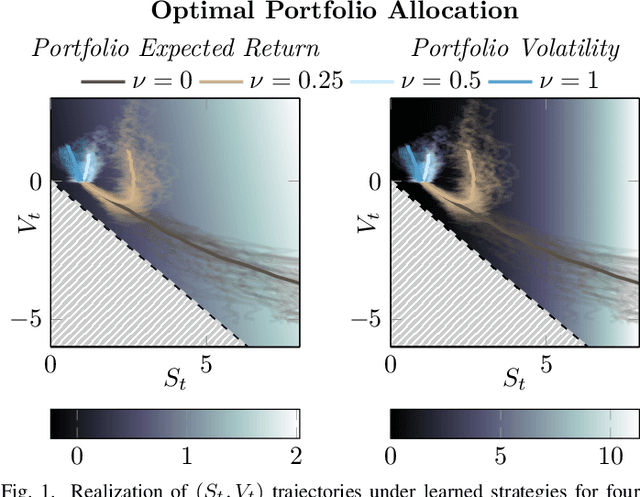
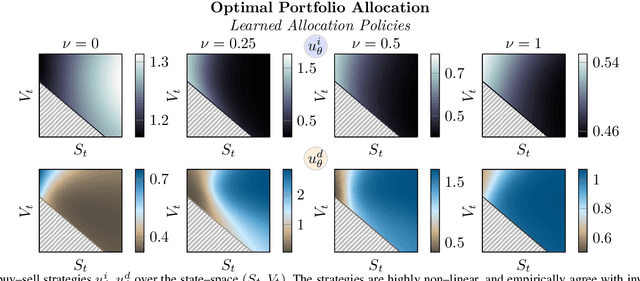
We systematically develop a learning-based treatment of stochastic optimal control (SOC), relying on direct optimization of parametric control policies. We propose a derivation of adjoint sensitivity results for stochastic differential equations through direct application of variational calculus. Then, given an objective function for a predetermined task specifying the desiderata for the controller, we optimize their parameters via iterative gradient descent methods. In doing so, we extend the range of applicability of classical SOC techniques, often requiring strict assumptions on the functional form of system and control. We verify the performance of the proposed approach on a continuous-time, finite horizon portfolio optimization with proportional transaction costs.
Large-width functional asymptotics for deep Gaussian neural networks
Feb 20, 2021In this paper, we consider fully connected feed-forward deep neural networks where weights and biases are independent and identically distributed according to Gaussian distributions. Extending previous results (Matthews et al., 2018a;b; Yang, 2019) we adopt a function-space perspective, i.e. we look at neural networks as infinite-dimensional random elements on the input space $\mathbb{R}^I$. Under suitable assumptions on the activation function we show that: i) a network defines a continuous Gaussian process on the input space $\mathbb{R}^I$; ii) a network with re-scaled weights converges weakly to a continuous Gaussian process in the large-width limit; iii) the limiting Gaussian process has almost surely locally $\gamma$-H\"older continuous paths, for $0 < \gamma <1$. Our results contribute to recent theoretical studies on the interplay between infinitely wide deep neural networks and Gaussian processes by establishing weak convergence in function-space with respect to a stronger metric.