 Add to Chrome
 Add to Firefox
 Add to Edge
Relevance Matters: A Multi-Task and Multi-Stage Large Language Model Approach for E-commerce Query Rewriting
Mar 03, 2026
For e-commerce search, user experience is measured by users' behavioral responses to returned products, like click-through rate and conversion rate, as well as the relevance between returned products and search queries. Consequently, relevance and user conversion constitute the two primary objectives in query rewriting, a strategy to bridge the lexical gap between user expressions and product descriptions. This research proposes a multi-task and multi-stage query rewriting framework grounded in large language models (LLMs). Critically, in contrast to previous works that primarily emphasized rewritten query generation, we inject the relevance task into query rewriting. Specifically, leveraging a pretrained model on user data and product information from JD.com, the approach initiates with multi-task supervised fine-tuning (SFT) comprising of the rewritten query generation task and the relevance tagging task between queries and rewrites. Subsequently, we employ Group Relative Policy Optimization (GRPO) for the model's objective alignment oriented toward enhancing the relevance and stimulating user conversions. Through offline evaluation and online A/B test, our framework illustrates substantial improvements in the effectiveness of e-commerce query rewriting, resulting in elevating the search results' relevance and boosting the number of purchases made per user (UCVR). Since August 2025, our approach has been implemented on JD.com, one of China's leading online shopping platforms.

On Age of Information for Discrete Time Status Updating System With Ber/G/1/1 Queues
Sep 01, 2021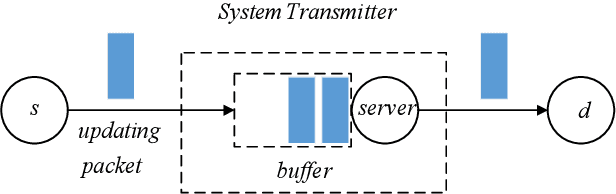
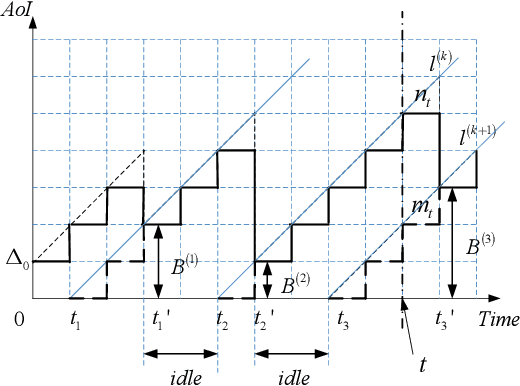
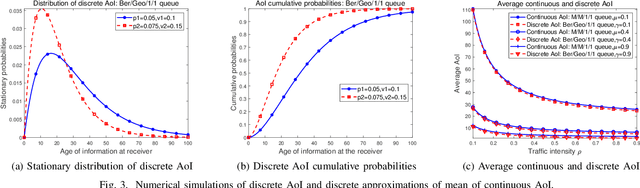
In this paper, we consider the age of information (AoI) of a discrete time status updating system, focusing on finding the stationary AoI distribution assuming that the Ber/G/1/1 queue is used. Following the standard queueing theory, we show that by invoking a two-dimensional state vector which tracks the AoI and packet age in system simultaneously, the stationary AoI distribution can be derived by analyzing the steady state of the constituted two-dimensional stochastic process. We give the general formula of the AoI distribution and calculate the explicit expression when the service time is also geometrically distributed. The discrete and continuous AoI are compared, we depict the mean of discrete AoI and that of continuous time AoI for system with M/M/1/1 queue. Although the stationary AoI distribution of some continuous time single-server system has been determined before, in this paper, we shall prove that the standard queueing theory is still appliable to analyze the discrete AoI, which is even stronger than the proposed methods handling the continuous AoI.
Localizing Discriminative Visual Landmarks for Place Recognition
Apr 14, 2019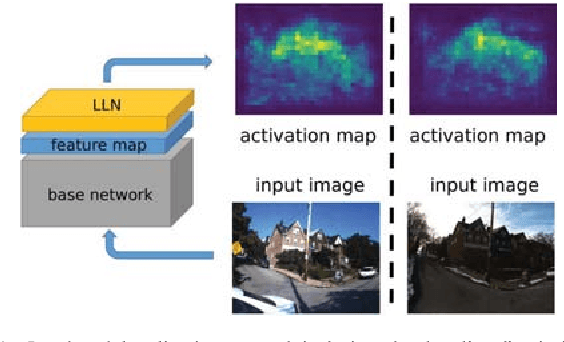
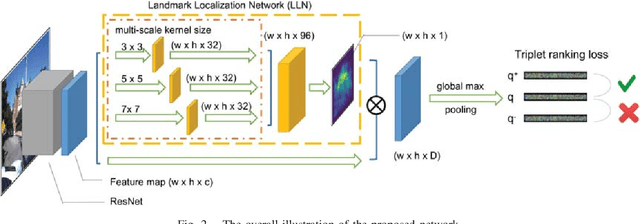
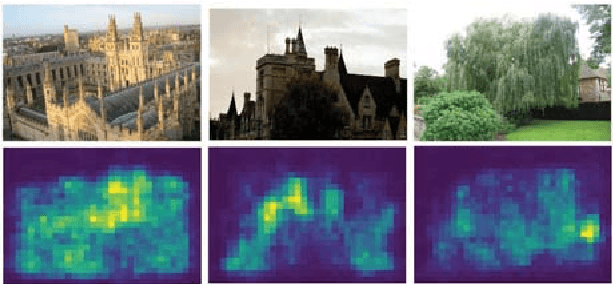
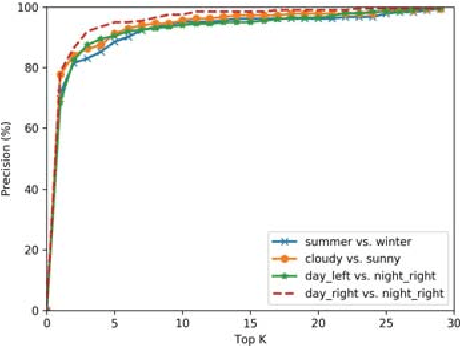
We address the problem of visual place recognition with perceptual changes. The fundamental problem of visual place recognition is generating robust image representations which are not only insensitive to environmental changes but also distinguishable to different places. Taking advantage of the feature extraction ability of Convolutional Neural Networks (CNNs), we further investigate how to localize discriminative visual landmarks that positively contribute to the similarity measurement, such as buildings and vegetations. In particular, a Landmark Localization Network (LLN) is designed to indicate which regions of an image are used for discrimination. Detailed experiments are conducted on open source datasets with varied appearance and viewpoint changes. The proposed approach achieves superior performance against state-of-the-art methods.