 Add to Chrome
 Add to Firefox
 Add to Edge
Biological Reasoning-Informed Regression for Interpretable Regulatory DNA Activity Prediction
Jun 06, 2026
DNA cis-regulatory elements (CREs) such as enhancers control gene expression levels. Accurately predicting regulatory activity from DNA sequences is valuable but challenging, as it requires understanding complex biological regulatory processes. Existing methods typically regress activity scores from sequences in a black-box manner, limiting both interpretability and regression performance. Meanwhile, large language models (LLMs) benefit from explicit reasoning processes, yet directly applying LLMs to raw DNA sequences performs poorly. In this paper, we bridge this gap by introducing R3LM, a framework that teaches LLMs reasoning-informed regression on regulatory DNA through structured biological knowledge. Specifically, we design a biologically grounded data format that structures DNA's regulatory information for improved LLM understanding, and construct CRE-ReasonBench, the first dataset that associates DNA sequences and activity scores with mechanistic reasoning traces. Through two-stage training that first teaches LLMs reasoning over structured biological information then performs regression, R3LM achieves state-of-the-art performance on enhancer prediction across three cell types, outperforming both LLMs with raw sequence input and specialized DNA models while providing interpretable mechanistic explanations. We expect R3LM as an interpretable reward model that can effectively assist biologists in CRE design. Code is available at https://github.com/DuanYi516/R3LM.

Extending Sequence Length is Not All You Need: Effective Integration of Multimodal Signals for Gene Expression Prediction
Feb 25, 2026Gene expression prediction, which predicts mRNA expression levels from DNA sequences, presents significant challenges. Previous works often focus on extending input sequence length to locate distal enhancers, which may influence target genes from hundreds of kilobases away. Our work first reveals that for current models, long sequence modeling can decrease performance. Even carefully designed algorithms only mitigate the performance degradation caused by long sequences. Instead, we find that proximal multimodal epigenomic signals near target genes prove more essential. Hence we focus on how to better integrate these signals, which has been overlooked. We find that different signal types serve distinct biological roles, with some directly marking active regulatory elements while others reflect background chromatin patterns that may introduce confounding effects. Simple concatenation may lead models to develop spurious associations with these background patterns. To address this challenge, we propose Prism, a framework that learns multiple combinations of high-dimensional epigenomic features to represent distinct background chromatin states and uses backdoor adjustment to mitigate confounding effects. Our experimental results demonstrate that proper modeling of multimodal epigenomic signals achieves state-of-the-art performance using only short sequences for gene expression prediction.
Efficient universal shuffle attack for visual object tracking
Mar 14, 2022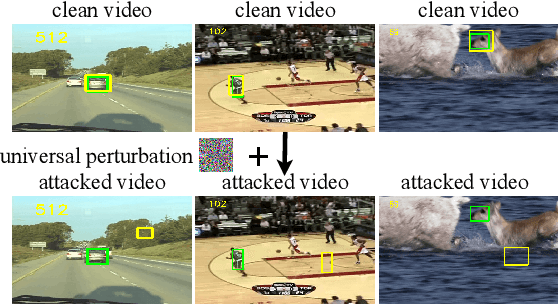
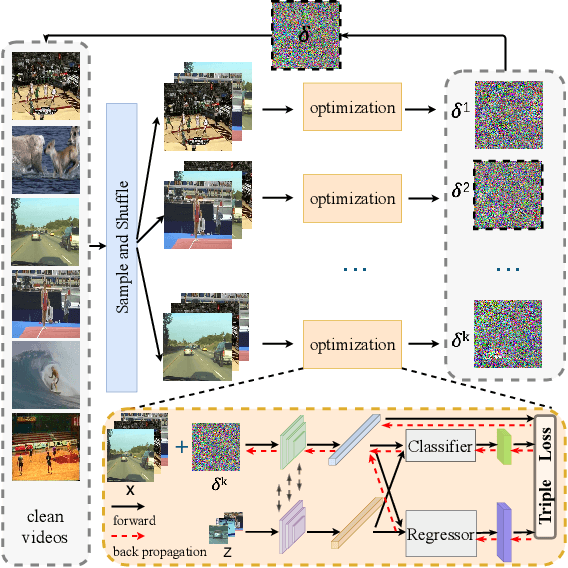
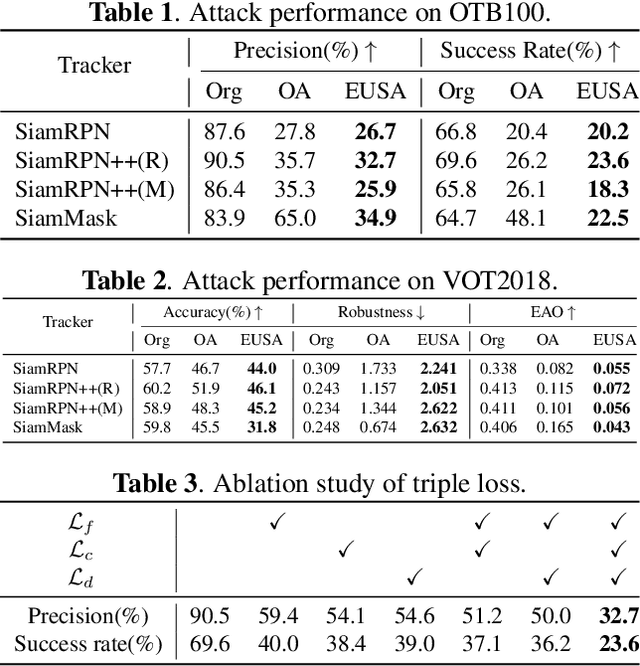
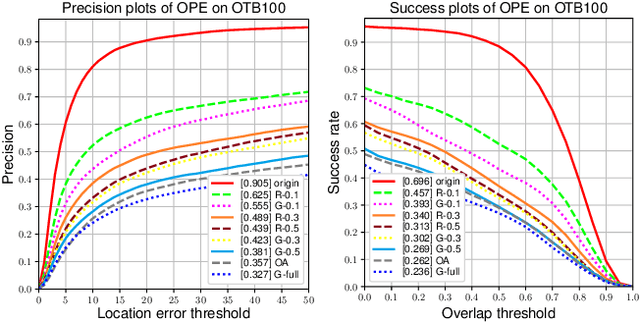
Recently, adversarial attacks have been applied in visual object tracking to deceive deep trackers by injecting imperceptible perturbations into video frames. However, previous work only generates the video-specific perturbations, which restricts its application scenarios. In addition, existing attacks are difficult to implement in reality due to the real-time of tracking and the re-initialization mechanism. To address these issues, we propose an offline universal adversarial attack called Efficient Universal Shuffle Attack. It takes only one perturbation to cause the tracker malfunction on all videos. To improve the computational efficiency and attack performance, we propose a greedy gradient strategy and a triple loss to efficiently capture and attack model-specific feature representations through the gradients. Experimental results show that EUSA can significantly reduce the performance of state-of-the-art trackers on OTB2015 and VOT2018.