 Add to Chrome
 Add to Firefox
 Add to Edge
PriCoRec: A Privacy-Aware Cloud-Device Collaborative Framework for Ad Recommendation under Feature Constraints
Aug 14, 2026
Privacy regulations increasingly restrict cloud processing of sensitive user data (e.g., age, gender), hindering traditional cloud-only recommendation models. To mitigate this challenge, we propose a Privacy-aware Collaborative cloud-device ads Recommendation framework (PriCoRec) which personalizes recommendations while keeping sensitive features on-device. While separating recommendation into cloud-based and on-device stages enables privacy-aware deployment, naive splitting suffers from degraded shortlist quality and inefficient on-device inference due to limited private features. We therefore design a collaborative framework that comprises a cloud-based pre-ranking stage using cloud-accessible features, and an on-device ranking stage that locally incorporates highly personalized features. We introduce a diversity regularizer to pre-ranking to improve candidate quality. Moreover, to control device power consumption and computational cost, we incorporate a cloud-guided training mechanism that enhances device model performance while keeping the model lightweight. Experiments demonstrate that the proposed framework maintains strong recommendation performance while keeping sensitive features on-device.

RAMP: Robust Ad Recommendation Under Limited Personalized-Feature Availability via Masking and Alignment Pathways
Jul 20, 2026Click-through rate (CTR) and conversion rate (CVR) prediction are fundamental tasks in online advertising, aiming to estimate the likelihood of user interactions based on various features. While personalized attributes such as age and gender can significantly enhance predictive accuracy, their use is increasingly restricted by privacy regulations, thereby limiting available data for both training and inference. To address this challenge, we propose RAMP (Robust Ad Recommendation Under Limited Personalized-Feature Availability via Masking and Alignment Pathways), which is designed to improve CTR/CVR prediction accuracy when personalized features are not accessible, thus supporting deployment in privacy-constrained settings.RAMP consists of (i) a personalized pathway built upon a dual-tower component with identical inputs but independent parameters, where output masking separates predictions for personalized and non-personalized signals, (ii) a separate non-personalized pathway trained with non-personalized features only, and (iii) a distillation-inspired prediction-alignment architecture between (i) and (ii) that improves prediction when personalized features are unavailable. We conduct comprehensive experiments using both public benchmarks and industrial datasets to evaluate the performance of RAMP. Our evaluation spans multiple backbone models and different settings: with and without access to personalized features. The results show that RAMP consistently outperforms state-of-the-art methods when personalized features are missing, while maintaining competitive performance when all features are available. %demonstrating its effectiveness and practicality for real-world advertising systems. Our code is publicly available at https://github.com/Ruixinhua/RAMP.
Simple Multigraph Convolution Networks
Mar 08, 2024

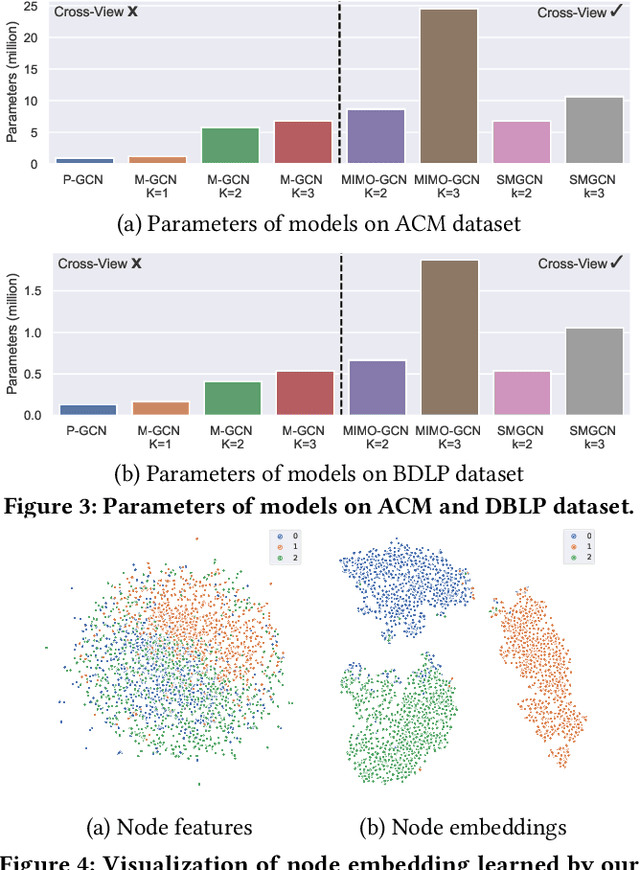
Existing multigraph convolution methods either ignore the cross-view interaction among multiple graphs, or induce extremely high computational cost due to standard cross-view polynomial operators. To alleviate this problem, this paper proposes a Simple MultiGraph Convolution Networks (SMGCN) which first extracts consistent cross-view topology from multigraphs including edge-level and subgraph-level topology, then performs polynomial expansion based on raw multigraphs and consistent topologies. In theory, SMGCN utilizes the consistent topologies in polynomial expansion rather than standard cross-view polynomial expansion, which performs credible cross-view spatial message-passing, follows the spectral convolution paradigm, and effectively reduces the complexity of standard polynomial expansion. In the simulations, experimental results demonstrate that SMGCN achieves state-of-the-art performance on ACM and DBLP multigraph benchmark datasets. Our codes are available at https://github.com/frinkleko/SMGCN.
A Novel Normalized-Cut Solver with Nearest Neighbor Hierarchical Initialization
Nov 26, 2023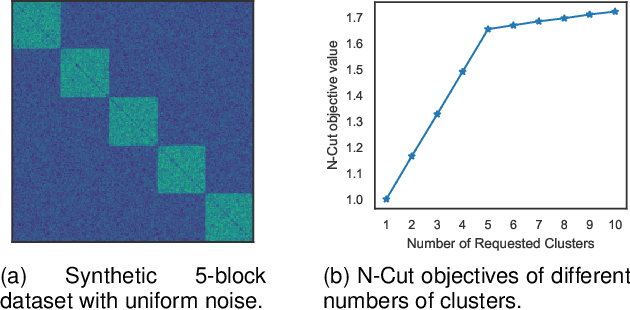
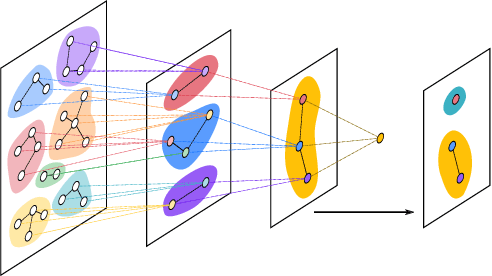
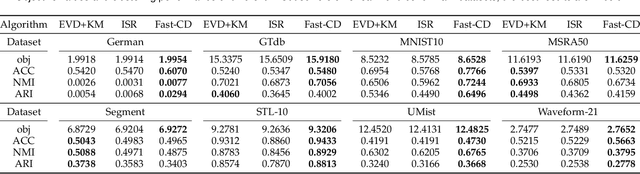
Normalized-Cut (N-Cut) is a famous model of spectral clustering. The traditional N-Cut solvers are two-stage: 1) calculating the continuous spectral embedding of normalized Laplacian matrix; 2) discretization via $K$-means or spectral rotation. However, this paradigm brings two vital problems: 1) two-stage methods solve a relaxed version of the original problem, so they cannot obtain good solutions for the original N-Cut problem; 2) solving the relaxed problem requires eigenvalue decomposition, which has $\mathcal{O}(n^3)$ time complexity ($n$ is the number of nodes). To address the problems, we propose a novel N-Cut solver designed based on the famous coordinate descent method. Since the vanilla coordinate descent method also has $\mathcal{O}(n^3)$ time complexity, we design various accelerating strategies to reduce the time complexity to $\mathcal{O}(|E|)$ ($|E|$ is the number of edges). To avoid reliance on random initialization which brings uncertainties to clustering, we propose an efficient initialization method that gives deterministic outputs. Extensive experiments on several benchmark datasets demonstrate that the proposed solver can obtain larger objective values of N-Cut, meanwhile achieving better clustering performance compared to traditional solvers.
NP$^2$L: Negative Pseudo Partial Labels Extraction for Graph Neural Networks
Oct 02, 2023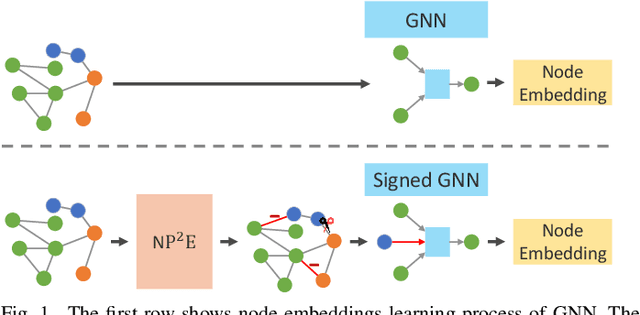
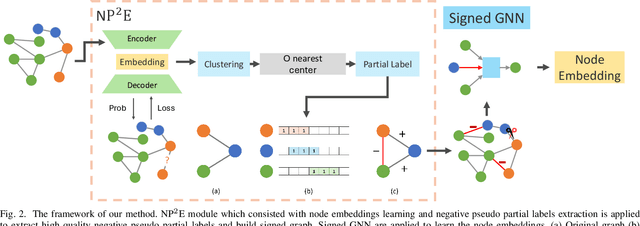
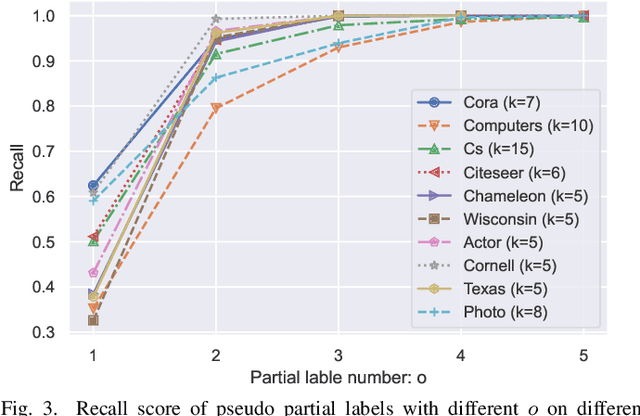
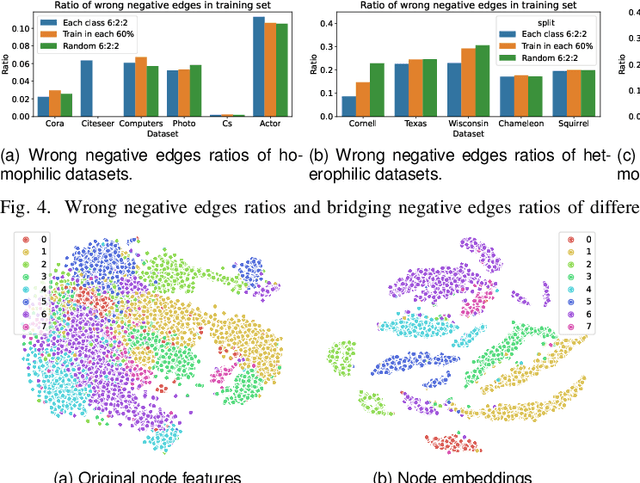
How to utilize the pseudo labels has always been a research hotspot in machine learning. However, most methods use pseudo labels as supervised training, and lack of valid assessing for their accuracy. Moreover, applications of pseudo labels in graph neural networks (GNNs) oversee the difference between graph learning and other machine learning tasks such as message passing mechanism. Aiming to address the first issue, we found through a large number of experiments that the pseudo labels are more accurate if they are selected by not overlapping partial labels and defined as negative node pairs relations. Therefore, considering the extraction based on pseudo and partial labels, negative edges are constructed between two nodes by the negative pseudo partial labels extraction (NP$^2$E) module. With that, a signed graph are built containing highly accurate pseudo labels information from the original graph, which effectively assists GNN in learning at the message-passing level, provide one solution to the second issue. Empirical results about link prediction and node classification tasks on several benchmark datasets demonstrate the effectiveness of our method. State-of-the-art performance is achieved on the both tasks.