 Add to Chrome
 Add to Firefox
 Add to Edge
Less Traffic, Better Outcomes: Competition-Aware Request Dispatch in Real-Time Ad Exchanges
Aug 04, 2026
Real-time bidding (RTB) ad exchanges typically forward nearly all incoming requests to demand-side platforms (DSPs), even though only a small fraction receive bids. This over-distribution weakens auction outcomes: DSPs throttle participation under compute and budget constraints, reducing the effective use of limited bidding capacity. We present a competition-aware request dispatch framework that uses distributional bid prediction and probabilistic forwarding to decide whether each request should be sent to each DSP. The system adapts per-DSP thresholds over time through lightweight policy optimization to track non-stationary market conditions. We evaluate the framework through four sequential online experiments on a production platform serving over 20 billion daily requests. A full multi-DSP deployment reduces DSP request volume under the policy by 34.2% while increasing net revenue by 4.6% (p<0.001) in a recent 14-day window after an initial DSP adaptation period. Further analysis highlights strong heterogeneity across traffic segments and reveals that aggregate metrics can be misleading. Segment-level and per-DSP analyses suggest that the policy surfaces comparative advantages among DSPs, improving monetized outcomes without increasing overall request volume.

RAMP: Robust Ad Recommendation Under Limited Personalized-Feature Availability via Masking and Alignment Pathways
Jul 20, 2026Click-through rate (CTR) and conversion rate (CVR) prediction are fundamental tasks in online advertising, aiming to estimate the likelihood of user interactions based on various features. While personalized attributes such as age and gender can significantly enhance predictive accuracy, their use is increasingly restricted by privacy regulations, thereby limiting available data for both training and inference. To address this challenge, we propose RAMP (Robust Ad Recommendation Under Limited Personalized-Feature Availability via Masking and Alignment Pathways), which is designed to improve CTR/CVR prediction accuracy when personalized features are not accessible, thus supporting deployment in privacy-constrained settings.RAMP consists of (i) a personalized pathway built upon a dual-tower component with identical inputs but independent parameters, where output masking separates predictions for personalized and non-personalized signals, (ii) a separate non-personalized pathway trained with non-personalized features only, and (iii) a distillation-inspired prediction-alignment architecture between (i) and (ii) that improves prediction when personalized features are unavailable. We conduct comprehensive experiments using both public benchmarks and industrial datasets to evaluate the performance of RAMP. Our evaluation spans multiple backbone models and different settings: with and without access to personalized features. The results show that RAMP consistently outperforms state-of-the-art methods when personalized features are missing, while maintaining competitive performance when all features are available. %demonstrating its effectiveness and practicality for real-world advertising systems. Our code is publicly available at https://github.com/Ruixinhua/RAMP.
Story Disambiguation: Tracking Evolving News Stories across News and Social Streams
Aug 16, 2018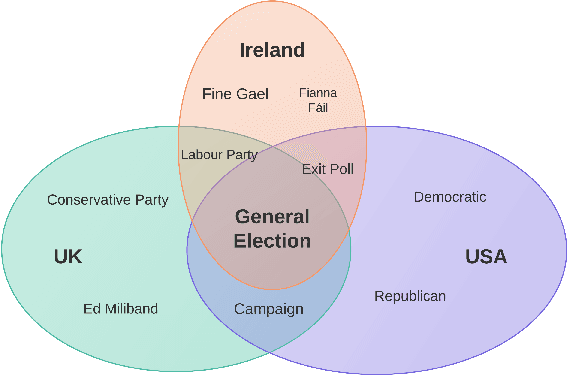
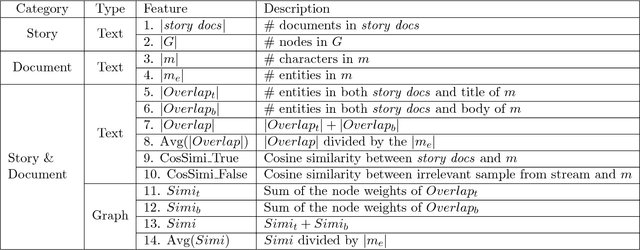
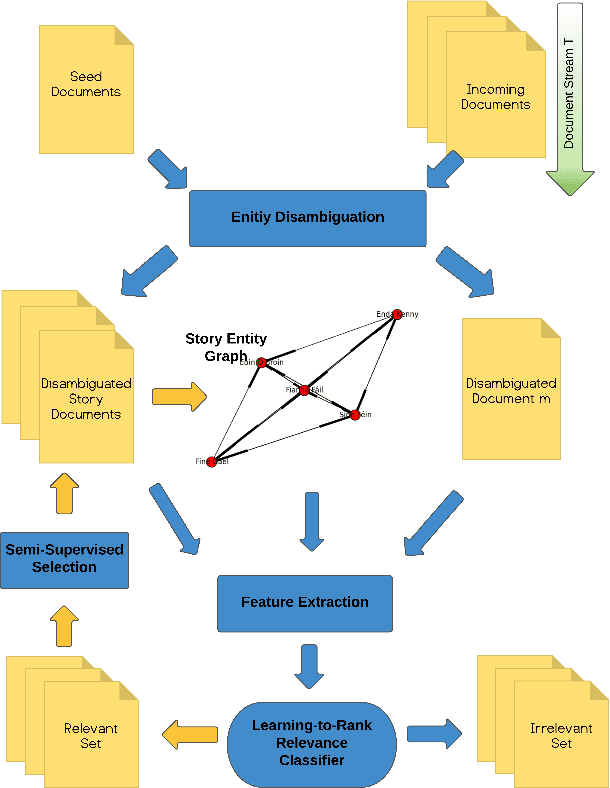
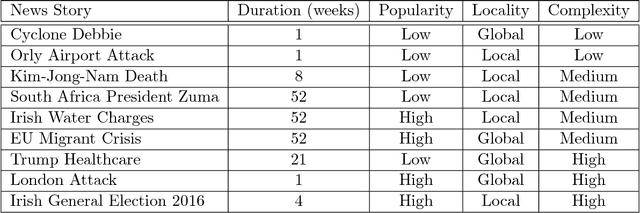
Following a particular news story online is an important but difficult task, as the relevant information is often scattered across different domains/sources (e.g., news articles, blogs, comments, tweets), presented in various formats and language styles, and may overlap with thousands of other stories. In this work we join the areas of topic tracking and entity disambiguation, and propose a framework named Story Disambiguation - a cross-domain story tracking approach that builds on real-time entity disambiguation and a learning-to-rank framework to represent and update the rich semantic structure of news stories. Given a target news story, specified by a seed set of documents, the goal is to effectively select new story-relevant documents from an incoming document stream. We represent stories as entity graphs and we model the story tracking problem as a learning-to-rank task. This enables us to track content with high accuracy, from multiple domains, in real-time. We study a range of text, entity and graph based features to understand which type of features are most effective for representing stories. We further propose new semi-supervised learning techniques to automatically update the story representation over time. Our empirical study shows that we outperform the accuracy of state-of-the-art methods for tracking mixed-domain document streams, while requiring fewer labeled data to seed the tracked stories. This is particularly the case for local news stories that are easily over shadowed by other trending stories, and for complex news stories with ambiguous content in noisy stream environments.
Distributed Entity Disambiguation with Per-Mention Learning
Apr 20, 2016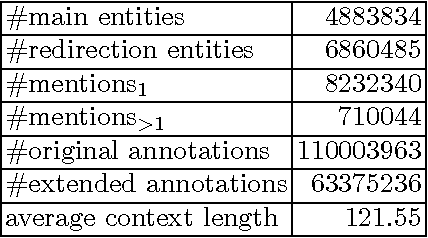
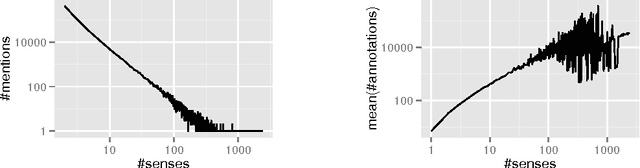
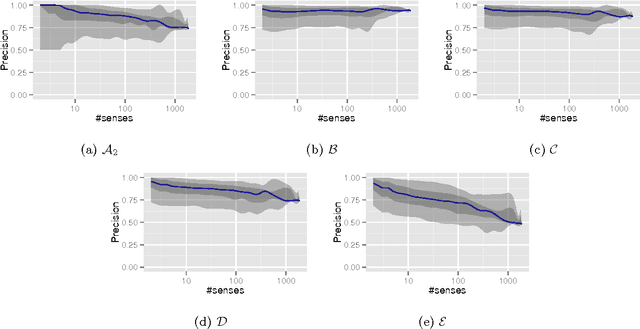
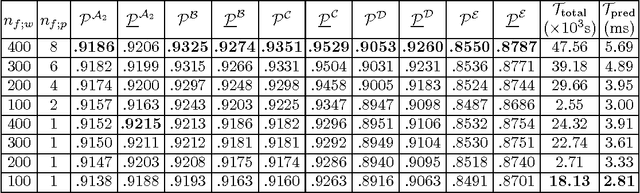
Entity disambiguation, or mapping a phrase to its canonical representation in a knowledge base, is a fundamental step in many natural language processing applications. Existing techniques based on global ranking models fail to capture the individual peculiarities of the words and hence, either struggle to meet the accuracy requirements of many real-world applications or they are too complex to satisfy real-time constraints of applications. In this paper, we propose a new disambiguation system that learns specialized features and models for disambiguating each ambiguous phrase in the English language. To train and validate the hundreds of thousands of learning models for this purpose, we use a Wikipedia hyperlink dataset with more than 170 million labelled annotations. We provide an extensive experimental evaluation to show that the accuracy of our approach compares favourably with respect to many state-of-the-art disambiguation systems. The training required for our approach can be easily distributed over a cluster. Furthermore, updating our system for new entities or calibrating it for special ones is a computationally fast process, that does not affect the disambiguation of the other entities.
A Machine Learning Approach to Predicting the Smoothed Complexity of Sorting Algorithms
Mar 23, 2015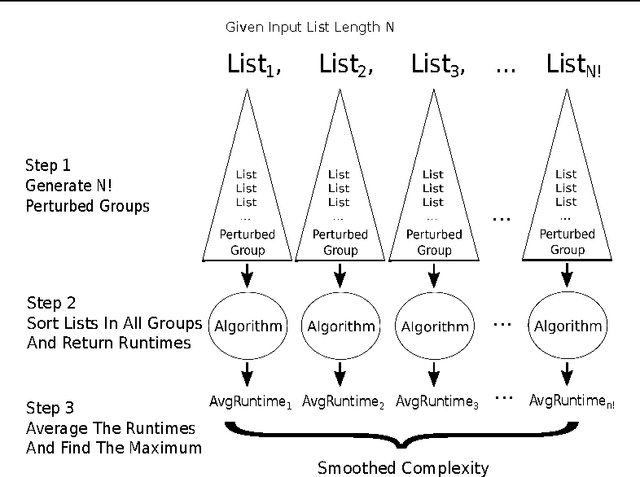
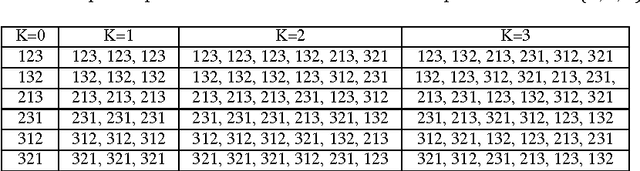
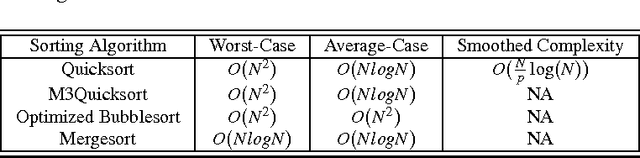
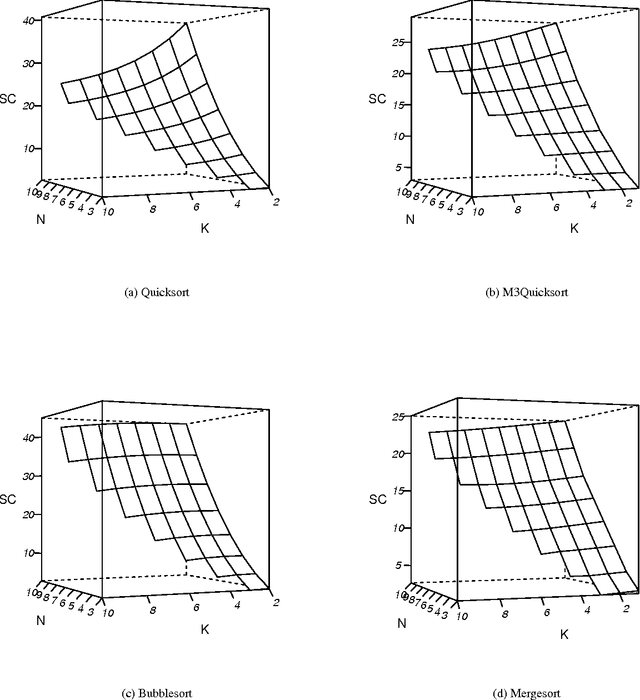
Smoothed analysis is a framework for analyzing the complexity of an algorithm, acting as a bridge between average and worst-case behaviour. For example, Quicksort and the Simplex algorithm are widely used in practical applications, despite their heavy worst-case complexity. Smoothed complexity aims to better characterize such algorithms. Existing theoretical bounds for the smoothed complexity of sorting algorithms are still quite weak. Furthermore, empirically computing the smoothed complexity via its original definition is computationally infeasible, even for modest input sizes. In this paper, we focus on accurately predicting the smoothed complexity of sorting algorithms, using machine learning techniques. We propose two regression models that take into account various properties of sorting algorithms and some of the known theoretical results in smoothed analysis to improve prediction quality. We show experimental results for predicting the smoothed complexity of Quicksort, Mergesort, and optimized Bubblesort for large input sizes, therefore filling the gap between known theoretical and empirical results.