 Add to Chrome
 Add to Firefox
 Add to Edge
Simplex Relaxation for Discrete Diffusion
Aug 11, 2026
Discrete diffusion models for categorical generation are defined by a corruption kernel, which determines the intermediate state space and the associated reverse prediction problem. We study uniform discrete diffusion and ask whether its training objective and reverse transitions can be enriched without changing the underlying categorical corruption process. We introduce Simplax, an exact Dirichlet--categorical augmentation that couples each corrupted categorical state with an auxiliary simplex-valued variable while preserving the original uniform diffusion process as its categorical marginal. This augmentation yields a tractable Rao--Blackwellized reverse-bridge objective and a corresponding stochastic reverse sampler, while retaining the corrupted categorical state as the denoiser input. Empirically, Simplax improves the generative perplexity--entropy tradeoff on unconditional OpenWebText generation. On Sudoku, a model trained exclusively on $30$-clue puzzles achieves the highest accuracy among the compared methods across all evaluated clue densities, including the minimum uniquely solvable $17$-clue regime, and also achieves the highest validity in unconditional generation.

Test-Time Scaling for Safe Text-Guided Image Generation via Intermediate Clean Estimates
Aug 04, 2026Ensuring safety and policy compliance in text-to-image diffusion models remains a critical challenge, as benign or adversarial prompts can often elicit prohibited content, e.g. nudity and protected intellectual property. While training-based unlearning methods are effective, they are computationally expensive and prone to catastrophic interference with general capabilities. Conversely, existing test-time defenses are primarily prompt-centric, relying on modifying textual descriptions only, and overlook the visual signals for detection. In this paper, we propose to leverage the intermediate clean image estimated during the generation process and employ a sparse margin objective to detect prohibited concepts. When a violation is detected, we immediately intervene by optimizing a structured low-rank residual in the text-conditioning space via truncated backpropagation. This design allows weight-preserving detection, keeps non-violating inference latency nearly unchanged as the maximum budget increases, and offers flexibility in safety performance via test-time scaling. Extensive experiments on Stable Diffusion v1.4 and v3.5 across nudity removal, IP protection, and style erasure demonstrate superior performance across suppression, fidelity and preservation compared to prior weight-preserving baselines, providing a scalable and flexible solution for safe generative deployment.
FairT2I: Mitigating Social Bias in Text-to-Image Generation via Large Language Model-Assisted Detection and Attribute Rebalancing
Feb 06, 2025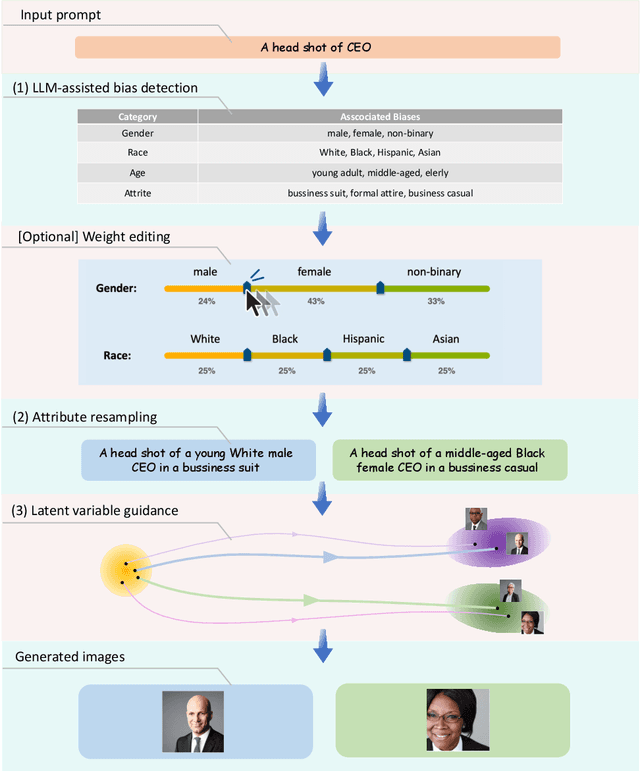
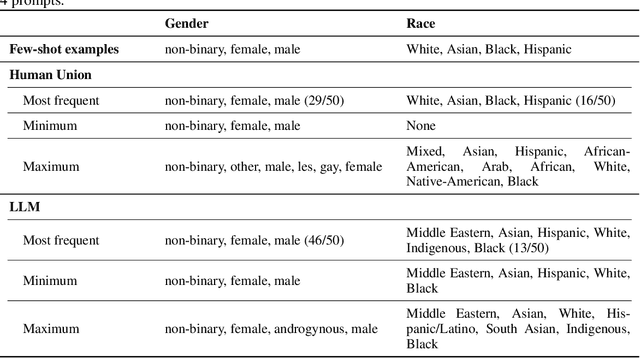
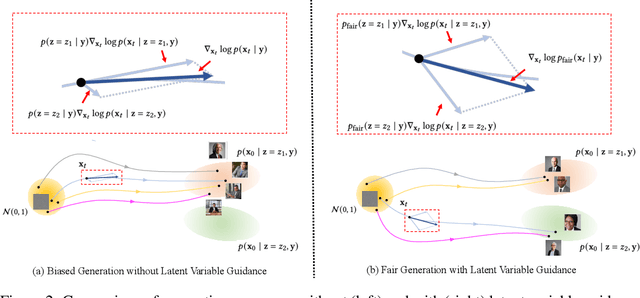
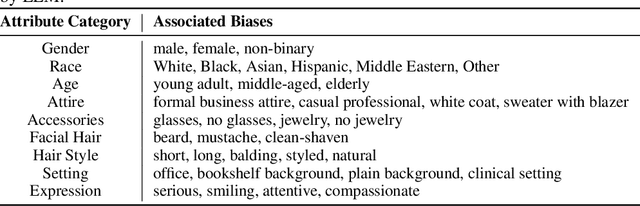
The proliferation of Text-to-Image (T2I) models has revolutionized content creation, providing powerful tools for diverse applications ranging from artistic expression to educational material development and marketing. Despite these technological advancements, significant ethical concerns arise from these models' reliance on large-scale datasets that often contain inherent societal biases. These biases are further amplified when AI-generated content is included in training data, potentially reinforcing and perpetuating stereotypes in the generated outputs. In this paper, we introduce FairT2I, a novel framework that harnesses large language models to detect and mitigate social biases in T2I generation. Our framework comprises two key components: (1) an LLM-based bias detection module that identifies potential social biases in generated images based on text prompts, and (2) an attribute rebalancing module that fine-tunes sensitive attributes within the T2I model to mitigate identified biases. Our extensive experiments across various T2I models and datasets show that FairT2I can significantly reduce bias while maintaining high-quality image generation. We conducted both qualitative user studies and quantitative non-parametric analyses in the generated image feature space, building upon the occupational dataset introduced in the Stable Bias study. Our results show that FairT2I successfully mitigates social biases and enhances the diversity of sensitive attributes in generated images. We further demonstrate, using the P2 dataset, that our framework can detect subtle biases that are challenging for human observers to perceive, extending beyond occupation-related prompts. On the basis of these findings, we introduce a new benchmark dataset for evaluating bias in T2I models.
Optimizing Implicit Neural Representations from Point Clouds via Energy-Based Models
Nov 05, 2023Reconstructing a continuous surface from an unoritented 3D point cloud is a fundamental task in 3D shape processing. In recent years, several methods have been proposed to address this problem using implicit neural representations (INRs). In this study, we propose a method to optimize INRs using energy-based models (EBMs). By employing the absolute value of the coordinate-based neural networks as the energy function, the INR can be optimized through the estimation of the point cloud distribution by the EBM. In addition, appropriate parameter settings of the EBM enable the model to consider the magnitude of point cloud noise. Our experiments confirmed that the proposed method is more robust against point cloud noise than conventional surface reconstruction methods.