 Add to Chrome
 Add to Firefox
 Add to Edge
FinSight-Net:A Physics-Aware Decoupled Network with Frequency-Domain Compensation for Underwater Fish Detection in Smart Aquaculture
Feb 23, 2026
Underwater fish detection (UFD) is a core capability for smart aquaculture and marine ecological monitoring. While recent detectors improve accuracy by stacking feature extractors or introducing heavy attention modules, they often incur substantial computational overhead and, more importantly, neglect the physics that fundamentally limits UFD: wavelength-dependent absorption and turbidity-induced scattering significantly degrade contrast, blur fine structures, and introduce backscattering noise, leading to unreliable localization and recognition. To address these challenges, we propose FinSight-Net, an efficient and physics-aware detection framework tailored for complex aquaculture environments. FinSight-Net introduces a Multi-Scale Decoupled Dual-Stream Processing (MS-DDSP) bottleneck that explicitly targets frequency-specific information loss via heterogeneous convolutional branches, suppressing backscattering artifacts while compensating distorted biological cues through scale-aware and channel-weighted pathways. We further design an Efficient Path Aggregation FPN (EPA-FPN) as a detail-filling mechanism: it restores high-frequency spatial information typically attenuated in deep layers by establishing long-range skip connections and pruning redundant fusion routes, enabling robust detection of non-rigid fish targets under severe blur and turbidity. Extensive experiments on DeepFish, AquaFishSet, and our challenging UW-BlurredFish benchmark demonstrate that FinSight-Net achieves state-of-the-art performance. In particular, on UW-BlurredFish, FinSight-Net reaches 92.8% mAP, outperforming YOLOv11s by 4.8% while reducing parameters by 29.0%, providing a strong and lightweight solution for real-time automated monitoring in smart aquaculture.

AICoderEval: Improving AI Domain Code Generation of Large Language Models
Jun 07, 2024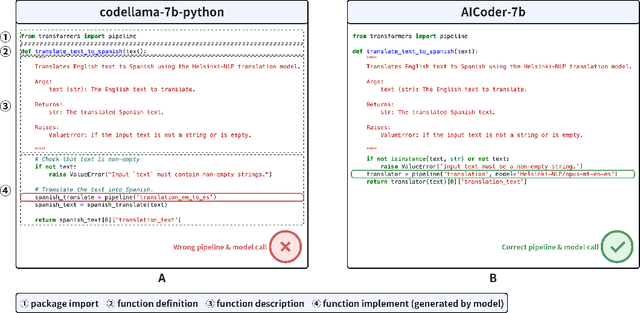
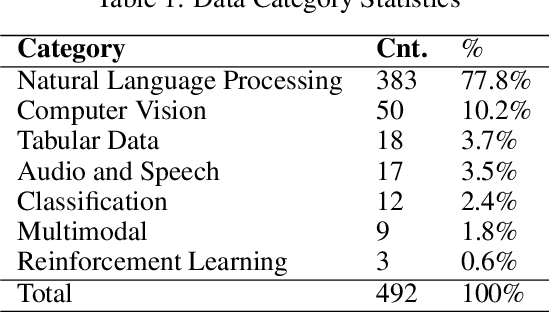
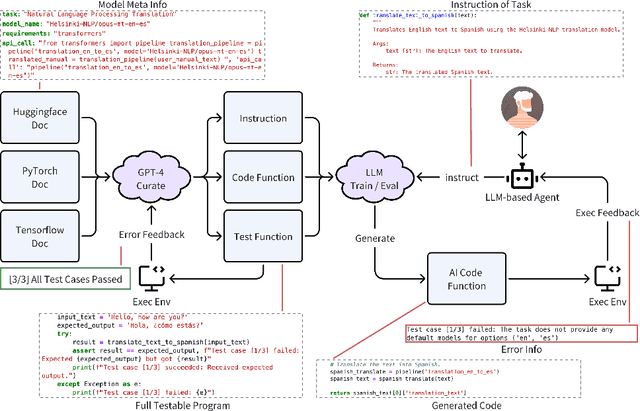
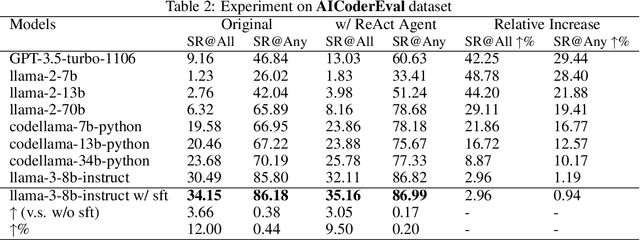
Automated code generation is a pivotal capability of large language models (LLMs). However, assessing this capability in real-world scenarios remains challenging. Previous methods focus more on low-level code generation, such as model loading, instead of generating high-level codes catering for real-world tasks, such as image-to-text, text classification, in various domains. Therefore, we construct AICoderEval, a dataset focused on real-world tasks in various domains based on HuggingFace, PyTorch, and TensorFlow, along with comprehensive metrics for evaluation and enhancing LLMs' task-specific code generation capability. AICoderEval contains test cases and complete programs for automated evaluation of these tasks, covering domains such as natural language processing, computer vision, and multimodal learning. To facilitate research in this area, we open-source the AICoderEval dataset at \url{https://huggingface.co/datasets/vixuowis/AICoderEval}. After that, we propose CoderGen, an agent-based framework, to help LLMs generate codes related to real-world tasks on the constructed AICoderEval. Moreover, we train a more powerful task-specific code generation model, named AICoder, which is refined on llama-3 based on AICoderEval. Our experiments demonstrate the effectiveness of CoderGen in improving LLMs' task-specific code generation capability (by 12.00\% on pass@1 for original model and 9.50\% on pass@1 for ReAct Agent). AICoder also outperforms current code generation LLMs, indicating the great quality of the AICoderEval benchmark.