 Add to Chrome
 Add to Firefox
 Add to Edge
Mirroring the Mind: Distilling Human-Like Metacognitive Strategies into Large Language Models
Feb 26, 2026
Large Reasoning Models (LRMs) often exhibit structural fragility in complex reasoning tasks, failing to produce correct answers even after successfully deriving valid intermediate steps. Through systematic analysis, we observe that these failures frequently stem not from a lack of reasoning capacity, but from a deficiency in self-regulatory control, where valid logic is destabilized by uncontrolled exploration or the failure to recognize logical sufficiency. Motivated by this observation, we propose Metacognitive Behavioral Tuning (MBT), a post-training framework that explicitly injects metacognitive behaviors into the model's thought process. MBT implements this via two complementary formulations: (1) MBT-S, which synthesizes rigorous reasoning traces from scratch, and (2) MBT-R, which rewrites the student's initial traces to stabilize intrinsic exploration patterns. Experiments across multi-hop QA benchmarks demonstrate that MBT consistently outperforms baselines, achieving notable gains on challenging benchmarks. By effectively eliminating reasoning collapse, MBT achieves higher accuracy with significantly reduced token consumption, demonstrating that internalizing metacognitive strategies leads to more stable and robust reasoning.

LLM Meets Scene Graph: Can Large Language Models Understand and Generate Scene Graphs? A Benchmark and Empirical Study
May 26, 2025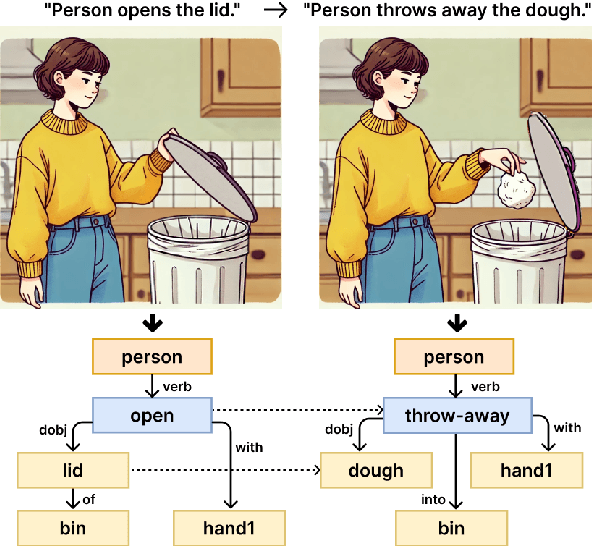
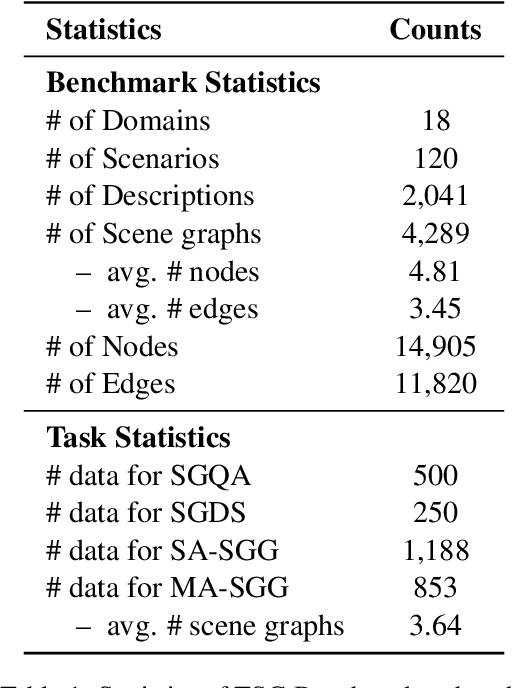
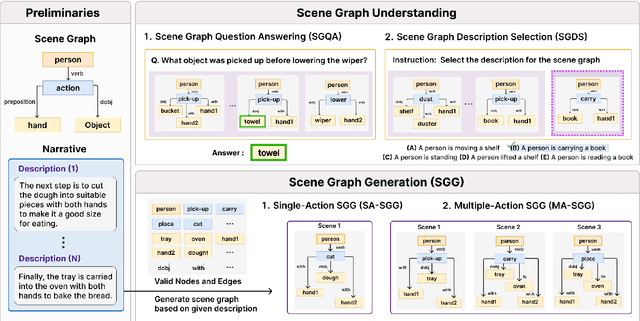
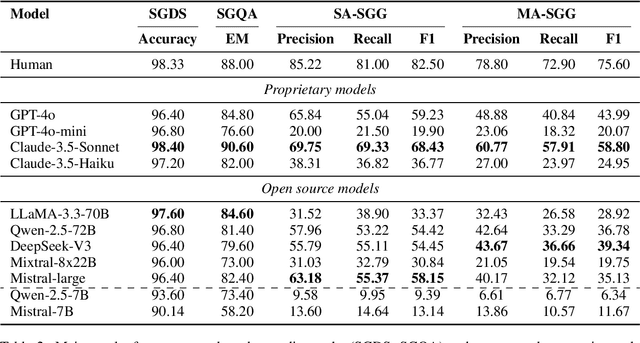
The remarkable reasoning and generalization capabilities of Large Language Models (LLMs) have paved the way for their expanding applications in embodied AI, robotics, and other real-world tasks. To effectively support these applications, grounding in spatial and temporal understanding in multimodal environments is essential. To this end, recent works have leveraged scene graphs, a structured representation that encodes entities, attributes, and their relationships in a scene. However, a comprehensive evaluation of LLMs' ability to utilize scene graphs remains limited. In this work, we introduce Text-Scene Graph (TSG) Bench, a benchmark designed to systematically assess LLMs' ability to (1) understand scene graphs and (2) generate them from textual narratives. With TSG Bench we evaluate 11 LLMs and reveal that, while models perform well on scene graph understanding, they struggle with scene graph generation, particularly for complex narratives. Our analysis indicates that these models fail to effectively decompose discrete scenes from a complex narrative, leading to a bottleneck when generating scene graphs. These findings underscore the need for improved methodologies in scene graph generation and provide valuable insights for future research. The demonstration of our benchmark is available at https://tsg-bench.netlify.app. Additionally, our code and evaluation data are publicly available at https://anonymous.4open.science/r/TSG-Bench.