 Add to Chrome
 Add to Firefox
 Add to Edge
Workspace-Bench 1.0: Benchmarking AI Agents on Workspace Tasks with Large-Scale File Dependencies
May 05, 2026
Workspace learning requires AI agents to identify, reason over, exploit, and update explicit and implicit dependencies among heterogeneous files in a worker's workspace, enabling them to complete both routine and advanced tasks effectively. Despite its importance, existing relevant benchmarks largely evaluate agents on pre-specified or synthesized files with limited real-world dependencies, leaving workspace-level evaluation underexplored. To this end, we introduce Workspace-Bench, a benchmark for evaluating AI agents on Workspace Learning invOlving Large-Scale File Dependencies. We construct realistic workspaces with 5 worker profiles, 74 file types, 20,476 files (up to 20GB) and curate 388 tasks, each with its own file dependency graph, evaluated across 7,399 total rubrics that require cross-file retrieval, contextual reasoning, and adaptive decision-making. We further provide Workspace-Bench-Lite, a 100-task subset that preserves the benchmark distribution while reducing evaluation costs by about 70%. We evaluate 4 popular agent harnesses and 7 foundation models. Experimental results show that current agents remain far from reliable workspace learning, where the best reaches only 68.7%, substantially below the human result of 80.7%, and the average performance across agents is only 47.4%.

Training-free Editioning of Text-to-Image Models
May 27, 2024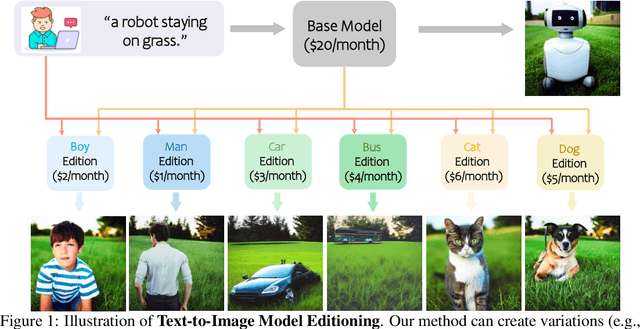
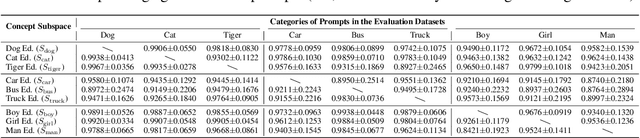
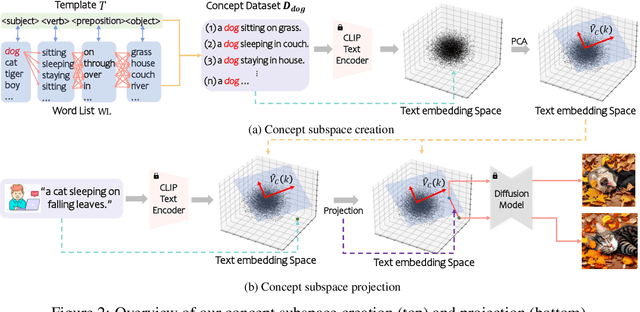

Inspired by the software industry's practice of offering different editions or versions of a product tailored to specific user groups or use cases, we propose a novel task, namely, training-free editioning, for text-to-image models. Specifically, we aim to create variations of a base text-to-image model without retraining, enabling the model to cater to the diverse needs of different user groups or to offer distinct features and functionalities. To achieve this, we propose that different editions of a given text-to-image model can be formulated as concept subspaces in the latent space of its text encoder (e.g., CLIP). In such a concept subspace, all points satisfy a specific user need (e.g., generating images of a cat lying on the grass/ground/falling leaves). Technically, we apply Principal Component Analysis (PCA) to obtain the desired concept subspaces from representative text embedding that correspond to a specific user need or requirement. Projecting the text embedding of a given prompt into these low-dimensional subspaces enables efficient model editioning without retraining. Intuitively, our proposed editioning paradigm enables a service provider to customize the base model into its "cat edition" (or other editions) that restricts image generation to cats, regardless of the user's prompt (e.g., dogs, people, etc.). This introduces a new dimension for product differentiation, targeted functionality, and pricing strategies, unlocking novel business models for text-to-image generators. Extensive experimental results demonstrate the validity of our approach and its potential to enable a wide range of customized text-to-image model editions across various domains and applications.