 Add to Chrome
 Add to Firefox
 Add to Edge
Retrofitting Linear Attention into Diffusion Language Models
Aug 06, 2026
Diffusion language models (dLLMs) offer a promising alternative to autoregressive models by accelerating inference through parallel decoding. Recent dLLMs commonly use blockwise semi-autoregressive decoding, generating blocks autoregressively while denoising tokens within each active block in parallel. However, despite KV caching, each denoising step still attends to all previous blocks, repeatedly incurring prefix-attention cost. Motivated by this bottleneck, we ask whether dLLM inference can be further accelerated by linearizing attention over previous blocks. We introduce block-hybrid attention, which retains exact softmax attention within the active denoising block while applying linear attention over previous blocks. We show that this hybrid attention can be retrofitted into a pretrained dLLM with minimal post-training: LLaDA-Hybrid replaces 6 of the 20 attention layers in LLaDA~2.1, a 16B open-source dLLM, largely following LoLCAT (Zhang et al, 2024). The conversion takes only approximately 60 hours while preserving benchmark performance: 72.0% vs. 75.6% on HumanEval, 63.0% vs. 57.7% on MBPP+, and 86.7% vs. 88.3% on CMATH. With a Triton implementation, LLaDA-Hybrid achieves up to $1.7\times$ higher decoding throughput and supports more concurrent requests before exhausting memory, showing that pretrained dLLMs can be efficiently linearized for faster inference. Our code is available at: https://github.com/Diuven/LLaDA-Hybrid.

Swish-T : Enhancing Swish Activation with Tanh Bias for Improved Neural Network Performance
Jul 02, 2024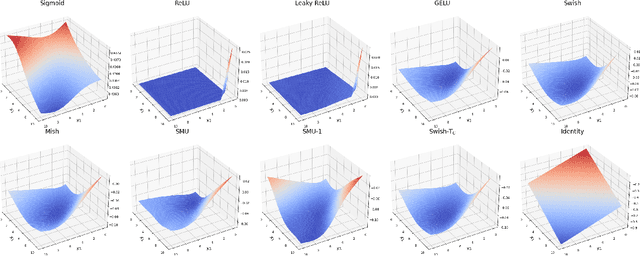
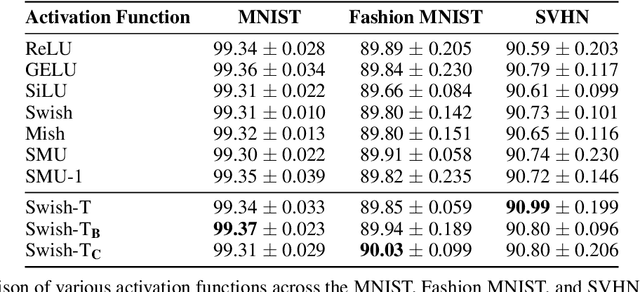
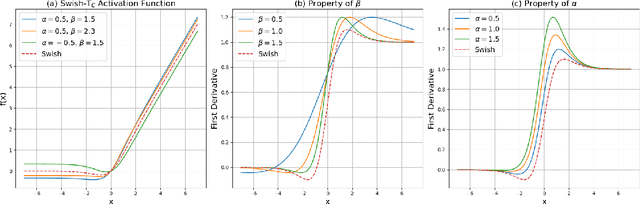
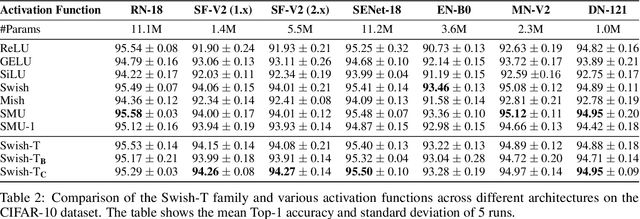
We propose the Swish-T family, an enhancement of the existing non-monotonic activation function Swish. Swish-T is defined by adding a Tanh bias to the original Swish function. This modification creates a family of Swish-T variants, each designed to excel in different tasks, showcasing specific advantages depending on the application context. The Tanh bias allows for broader acceptance of negative values during initial training stages, offering a smoother non-monotonic curve than the original Swish. We ultimately propose the Swish-T$_{\textbf{C}}$ function, while Swish-T and Swish-T$_{\textbf{B}}$, byproducts of Swish-T$_{\textbf{C}}$, also demonstrate satisfactory performance. Furthermore, our ablation study shows that using Swish-T$_{\textbf{C}}$ as a non-parametric function can still achieve high performance. The superiority of the Swish-T family has been empirically demonstrated across various models and benchmark datasets, including MNIST, Fashion MNIST, SVHN, CIFAR-10, and CIFAR-100. The code is publicly available at "https://github.com/ictseoyoungmin/Swish-T-pytorch".
Can Contrastive Learning Refine Embeddings
Apr 11, 2024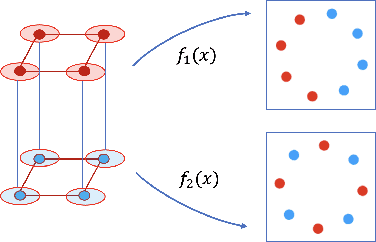
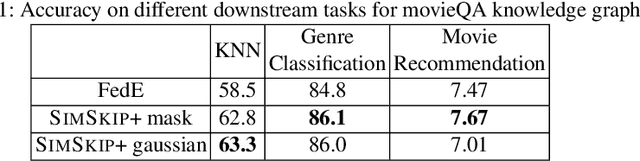
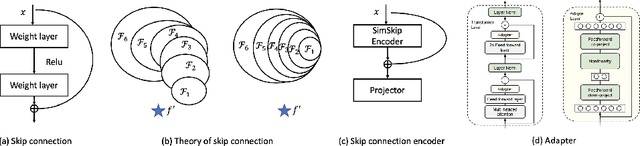
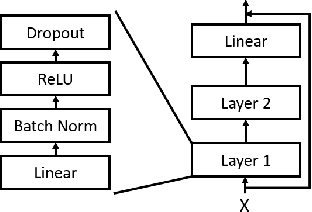
Recent advancements in contrastive learning have revolutionized self-supervised representation learning and achieved state-of-the-art performance on benchmark tasks. While most existing methods focus on applying contrastive learning to input data modalities such as images, natural language sentences, or networks, they overlook the potential of utilizing outputs from previously trained encoders. In this paper, we introduce SIMSKIP, a novel contrastive learning framework that specifically refines input embeddings for downstream tasks. Unlike traditional unsupervised learning approaches, SIMSKIP takes advantage of the output embeddings of encoder models as its input. Through theoretical analysis, we provide evidence that applying SIMSKIP does not result in larger upper bounds on downstream task errors than those of the original embeddings, which serve as SIMSKIP's input. Experimental results on various open datasets demonstrate that the embeddings produced by SIMSKIP improve performance on downstream tasks.
Reversed Image Signal Processing and RAW Reconstruction. AIM 2022 Challenge Report
Oct 20, 2022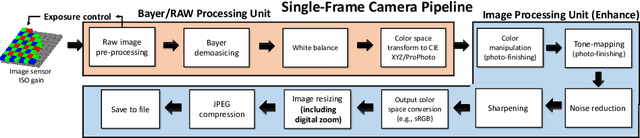
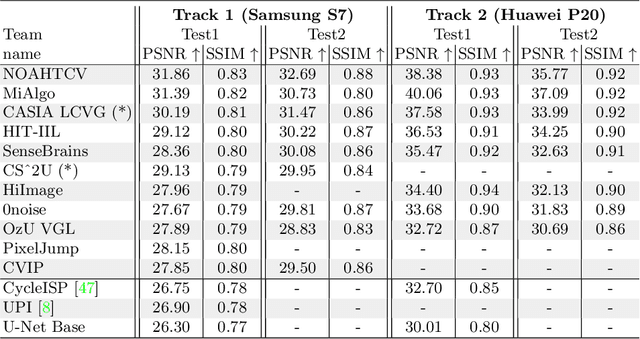
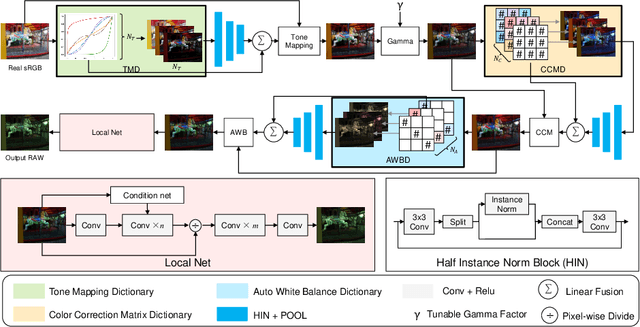
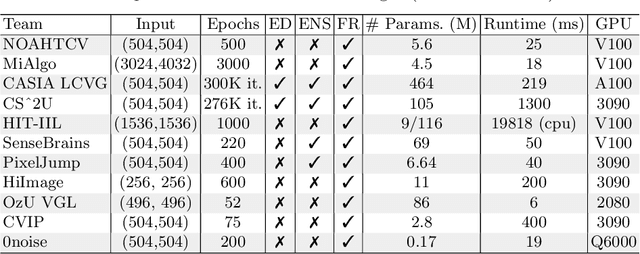
Cameras capture sensor RAW images and transform them into pleasant RGB images, suitable for the human eyes, using their integrated Image Signal Processor (ISP). Numerous low-level vision tasks operate in the RAW domain (e.g. image denoising, white balance) due to its linear relationship with the scene irradiance, wide-range of information at 12bits, and sensor designs. Despite this, RAW image datasets are scarce and more expensive to collect than the already large and public RGB datasets. This paper introduces the AIM 2022 Challenge on Reversed Image Signal Processing and RAW Reconstruction. We aim to recover raw sensor images from the corresponding RGBs without metadata and, by doing this, "reverse" the ISP transformation. The proposed methods and benchmark establish the state-of-the-art for this low-level vision inverse problem, and generating realistic raw sensor readings can potentially benefit other tasks such as denoising and super-resolution.